- Plants
- ›Vascular Plants
- ›flowering plants
- ›Dicots
- ›honeysuckles, moschatels, and allies
- ›honeysuckle family
- ›bush honeysuckles and Weigela bushes
- ›Diervilla
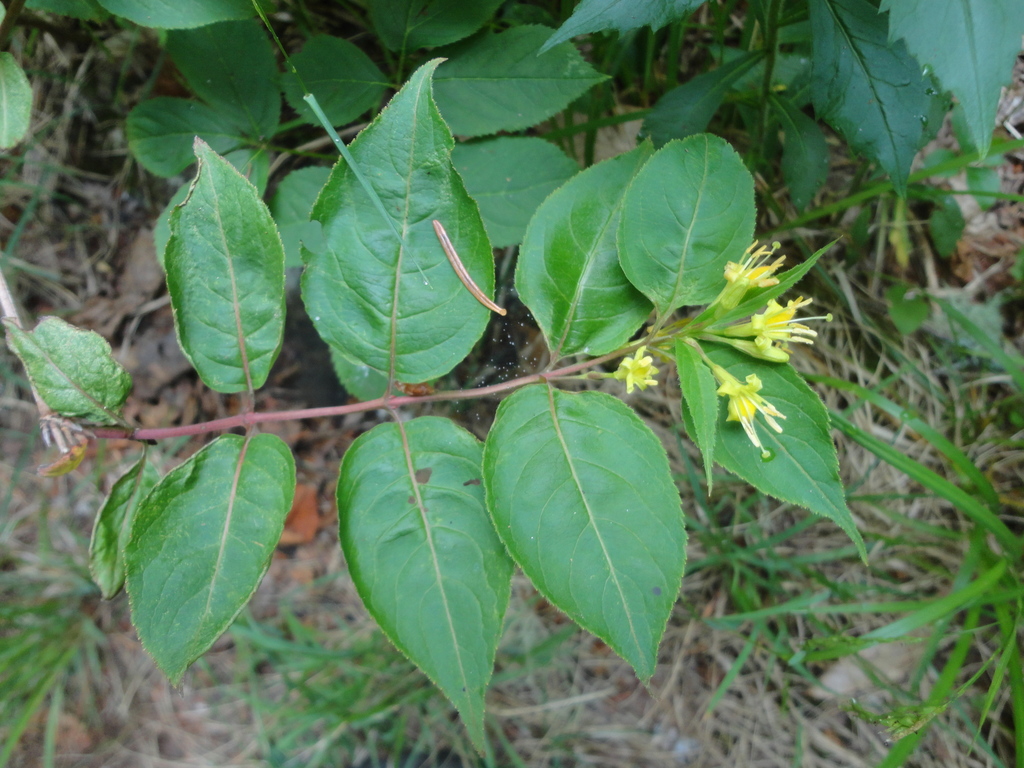
northern bush honeysuckle
Diervilla lonicera
Diervilla lonicera, commonly referred to as northern bush honeysuckle, low bush honeysuckle, dwarf bush honeysuckle, or yellow-flowered upright honeysuckle, is a deciduous shrub native to the northeastern United States and Canada. Its specific epithet, lonicera (the Latin term for ‘honeysuckle’) refers to its similarity in appearance to the true honeysuckles, genus Lonicera. It attracts bumblebees and is an important source of nectar for them.
From the article Diervilla lonicera on Wikipedia (CC BY-SA), quoted section by section
Description
Northern bush honeysuckle is a deciduous shrub, reaching a maximum height between 0.6 and 1.2 metres (24 and 47 in). This particular species is known for the following characteristics: branches lying close to the ground, fibrous roots, pale yellow flowers, and dry, woody fruit. Northern bush honeysuckle's simple leaves are placed in an opposite arrangement. As the seasons change, so do the leaves' colours: initially green, the leaf gradually deepens to a dark red. The flowers are in full bloom between early July and early August; the woody seeds are fully matured by September in preparation for dispersal. Diervilla lonicera has protogynous flowers (initially female-dominant plant), is well-adapted for pollination, and its stigmas remain receptive after anthesis (fully functioning flower).
Range & habitat
Exposed rocky sites, combined with the plant's tolerance for cool climates, dry, or infertile soils are varying characteristics to describe a typical habitat for Diervilla lonicera. It is commonly found in forests dominated by balsam fir (Abies balsamea) and jack pine (Pinus banksiana). Unlike some plant species that are restricted to specific light conditions, the northern bush honeysuckle is insensitive to changes in light, allowing for broader ranges of habitat. In addition, it is well-adapted to fire-prone habitats, because it can regenerate quickly from underground stems if destroyed by fire. For example, D.J. Schoen found that Diervilla lonicera was the most abundant shrub over a 50-year span on dry ground areas that were destroyed by fire.
Wikipedia: “Habitat”
Where it lives
Recorded sightings
—
geo-referenced records in GBIF, from museums, herbaria and field observers.
Drag the globe to turn it. Dots are where records exist, not a range map; darker means more records.
In the stacks
Searching the stacks…
Every page naming Diervilla lonicera in the Biodiversity Heritage Library →
This page is assembled live from iNaturalist, GBIF, Wikipedia, the Source Library and the Internet Archive. It is not yet part of the hand-edited codex. iNaturalist taxon 67983.