- Animals
- ›Chordates
- ›Vertebrates
- ›Cartilaginous Fishes
- ›Sharks and Rays
- ›Sharks
- ›Galean Sharks
- ›Ground Sharks
- ›Requiem Sharks
- ›Carcharhinus
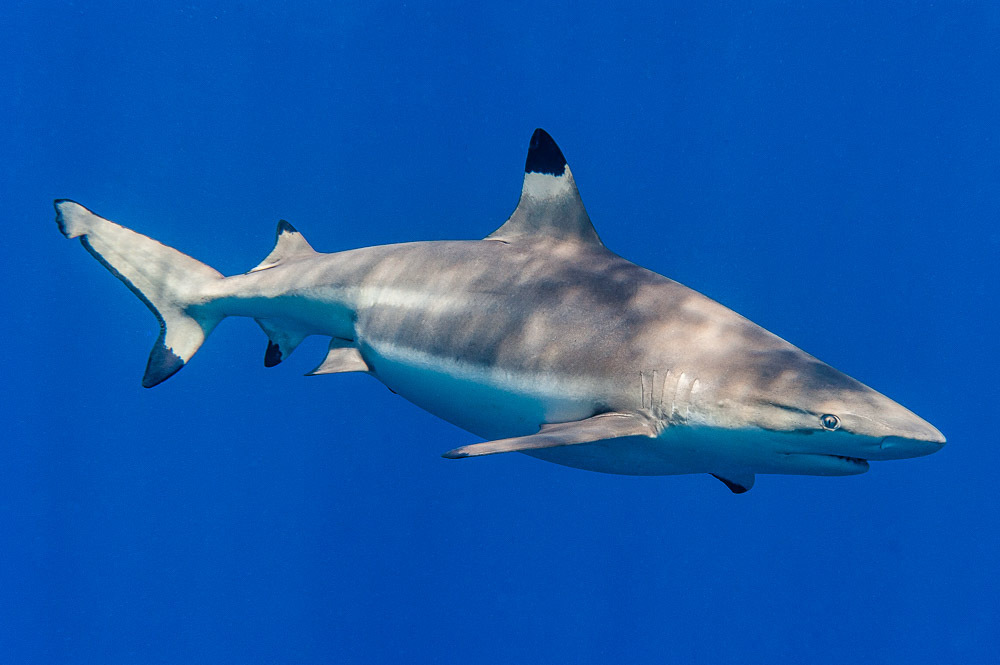
Blacktip Reef Shark
Carcharhinus melanopterus
The blacktip reef shark (Carcharhinus melanopterus) is a species of requiem shark, in the family Carcharhinidae, which can be easily identified by the prominent black tips on its fins (especially on the first dorsal fin and its caudal fin). Among the most abundant sharks inhabiting the tropical coral reefs of the Indian and Pacific Oceans, this species prefers shallow, inshore waters. Its exposed first dorsal fin is a common sight in the region. The blacktip reef shark is usually found over reef ledges and sandy flats, though it has also been known to enter brackish and freshwater environments. It typically attains a length of 1.6 m (5.2 ft). Like other sharks, the females are larger than the males.
The blacktip reef shark has extremely small home ranges and exhibits strong site fidelity, remaining within the same local area for up to several years at a time. It is an active predator of small bony fish, cephalopods, and crustaceans, and has also been known to feed on sea snakes and seabirds. Accounts of the blacktip reef shark's life history have been variable and sometimes contradictory, in part reflecting geographical differences within the species. Like other members of its family, this shark is viviparous, with females giving birth to two to five young on a biennial, annual, or possibly biannual cycle. Reports of the gestation period range from 7–9, through 10–11, to possibly 16 months. Mating is preceded by the male following closely behind the female, likely attracted by her chemical signals.
From the article Blacktip reef shark on Wikipedia (CC BY-SA), quoted section by section
Description
A robustly built species with a streamlined "typical shark" form, the blacktip reef shark has a short, wide, rounded snout and moderately large, oval eyes. Each nostril has a flap of skin in front that is expanded into a nipple-shaped lobe. Not counting small symphysial (central) teeth, the tooth rows number 11–13 (usually 12) on either side of the upper jaw and 10–12 (usually 11) on either side of the lower jaw. The upper teeth are upright to angled and narrowly triangular in shape, bearing serrations that are more coarse on the bases; the lower teeth are similar, but more finely serrated. The teeth of adult males are more abruptly curved than those of females. The pectoral fins are large and narrowly falcate (sickle-shaped), tapering to points. The sizable first dorsal fin is high with a curving S-shaped rear margin, and originates over the free rear tips of the pectoral fins. The second dorsal fin is relatively large with a short rear margin, and is placed opposite the anal fin. There is no ridge between the dorsal fins. This shark is a pale grayish-brown above and white below, with an obvious white band on the sides extending forward from above the anal fin. All the fins have black tips highlighted by lighter-colored borders, which are especially striking on the first dorsal fin and lower caudal fin lobe. …
Range & habitat
The blacktip reef shark is found throughout nearshore waters of the tropical and subtropical Indo-Pacific. In the Indian Ocean, it occurs from South Africa to the Red Sea, including Madagascar, Mauritius, and the Seychelles, and from there eastward along the coast of the Indian subcontinent to Southeast Asia, including Sri Lanka, the Andaman Islands, and the Maldives. In the Pacific Ocean, it is found from southern China and the Philippines to Indonesia, northern Australia and New Caledonia, and also inhabits numerous oceanic islands, including the Marshall, Gilbert, Society, and Hawaiian Islands and Tuamotu. Contrary to what most sources state, there is a report suggesting that the specimens of this species from Japanese waters might be from Taiwan, however a number of sightings and captures of this species have been reported from the inshore waters of Ishigaki Island of Okinawa Prefecture in southern Japan. A Lessepsian migrant, this shark has colonized the eastern Mediterranean Sea by way of the Suez Canal. Although it has been reported from a depth of 75 m (246 ft), the blacktip reef shark is usually found in water only a few meters deep, and can often be seen swimming close to shore with its dorsal fin exposed. Younger sharks prefer shallow, sandy flats, while older sharks are most common around reef ledges and can also be found near reef drop-offs. …
Wikipedia: “Distribution and habitat”
What it does
Along with the grey reef shark (C. amblyrhinchos) and the whitetip reef shark (Triaenodon obesus), the blacktip reef shark is one of the three most common sharks inhabiting coral reefs in the Indo-Pacific. This species predominates in shallow habitats, while the other two are mostly found deeper. Fast-swimming and active, the blacktip reef shark may be encountered alone or in small groups; large "social" aggregations have also been observed. For the most part, juvenile and adult sharks are not segregated by sex, save for the movements of pregnant females to give birth. Individuals exhibit strong fidelity to particular areas, where they may remain for several years. A tracking study off Palmyra Atoll in the central Pacific has found the blacktip reef shark has a home range of around 0.55 km2 (0.21 mi2), among the smallest of any shark species. The size and location of the range does not change with time of day. Within this range, 3–17% of the area constitute favored hunting patches that are disproportionately occupied by the resident shark. The sharks spend most of their time swimming back and forth along reef ledges, making occasional short forays onto sandy flats. Their average swimming speed decreases when the tide rises at night, possibly because the influx of cooler water reduces their metabolism, or the accompanying movement of prey fishes makes foraging easier. …
Wikipedia: “Biology and ecology”
In human culture
Like the other members of its family, the blacktip reef shark is viviparous, though the details of its life history vary across its range. Its reproductive cycle is annual off northern Australia, with mating taking place from January to February, as well as off Moorea in French Polynesia, where mating occurs from November to March. The cycle is biennial off Aldabra, where intense competition within and between species for food may constrain females to only bearing young every other year. Earlier accounts from the Indian Ocean by Johnson (1978), Madagascar by Fourmanoir (1961), and the Red Sea by Gohar and Mazhar (1964), indicated a biannual cycle in these regions with two breeding seasons per year from June to July and December to January. If accurate, the shorter reproductive cycles of these subpopulations may be a consequence of warmer water. When receptive to mating, a female blacktip reef shark swims slowly in a sinusoidal pattern near the bottom with her head pointed down; observations in the wild suggest female sharks release chemical signals that allow males to track them. Once the male finds her, he closes to around 15 cm (5.9 in) and follows her with his snout oriented towards her vent. A courting male may also bite the female behind her gills or on her pectoral fins; these mating wounds heal completely after 4–6 weeks. …
Wikipedia: “Life history”
Where it lives
Recorded sightings
—
geo-referenced records in GBIF, from museums, herbaria and field observers.
Drag the globe to turn it. Dots are where records exist, not a range map; darker means more records.
In the stacks
Searching the stacks…
Every page naming Carcharhinus melanopterus in the Biodiversity Heritage Library →
This page is assembled live from iNaturalist, GBIF, Wikipedia, the Source Library and the Internet Archive. It is not yet part of the hand-edited codex. iNaturalist taxon 67964.