- Plants
- ›Vascular Plants
- ›flowering plants
- ›Dicots
- ›Roses, Elms, Figs, and Allies
- ›rose family
- ›Dryadoideae
- ›Purshia
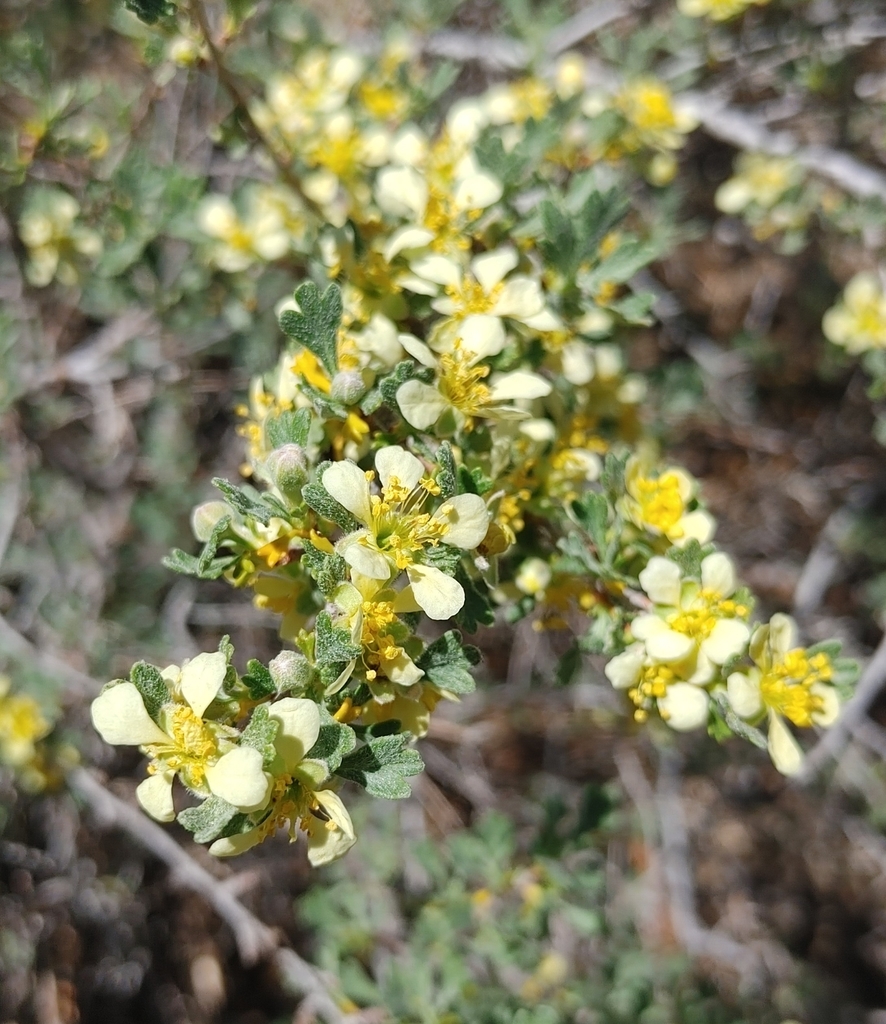
Antelope Bitterbrush
Purshia tridentata
Purshia tridentata, with the common name bitterbrush, is a shrub in the genus Purshia of the family Rosaceae. It is native to mountainous areas of western North America.
Common names include antelope bitterbrush, antelope bush, buckbrush, quinine brush, and less commonly deerbrush, blackbrush, and greasewood. Some of these names are shared with other species.
From the article Purshia tridentata on Wikipedia (CC BY-SA), quoted section by section
Description
Purshia tridentata is a deciduous shrub growing to a height of 1–5 metres (3+1⁄2–16+1⁄2 feet). It has many branches and slender green, three- to five-lobed leaves 5–20 millimetres (1⁄4–3⁄4 in) long. It is a nitrogen-fixing plant. The flowers are pale yellow, with five petals 6–8 mm long, and darker yellow anthers. The fruit is a cluster of dry, slender, leathery achenes each up to 1 centimetre (1⁄2 in) long.
Varieties. There are two named varieties of the species:
Purshia tridentata var. glandulosa — Eastern Sierra Nevada, Southern California Purshia tridentata var. tridentata
Range & habitat
The plant is found from southeastern British Columbia in the north, east to Montana and Wyoming, south to New Mexico, and west in California. It grows on arid mountainsides and slopes, as well as rocky or drained soils with somewhat more moisture than the sagebrush steppe. It is often associated with Balsamorhiza as well as Wyethia species, and in southern areas hybridizes with Purshia stansburyana. In California it occurs between 700–3,400 m (2,300–11,200 ft) above sea level, including in the Peninsular Ranges, Transverse Ranges, and Sierra Nevada, and southern Cascade Range. Further north it occurs at lower elevations, such as at 320–1,065 m (1,050–3,494 ft) in British Columbia.
Wikipedia: “Distribution”
What it does
The shrub is an important forage plant for many game animals, including deer, especially during the winter.
Wikipedia: “Ecology”
Where it lives
Recorded sightings
—
geo-referenced records in GBIF, from museums, herbaria and field observers.
Drag the globe to turn it. Dots are where records exist, not a range map; darker means more records.
In the stacks
Searching the stacks…
Every page naming Purshia tridentata in the Biodiversity Heritage Library →
This page is assembled live from iNaturalist, GBIF, Wikipedia, the Source Library and the Internet Archive. It is not yet part of the hand-edited codex. iNaturalist taxon 67804.