- Plants
- ›Vascular Plants
- ›flowering plants
- ›Dicots
- ›pinks, cactuses, and allies
- ›Pussypaw Family
- ›Claytonia
- ›Claytonia
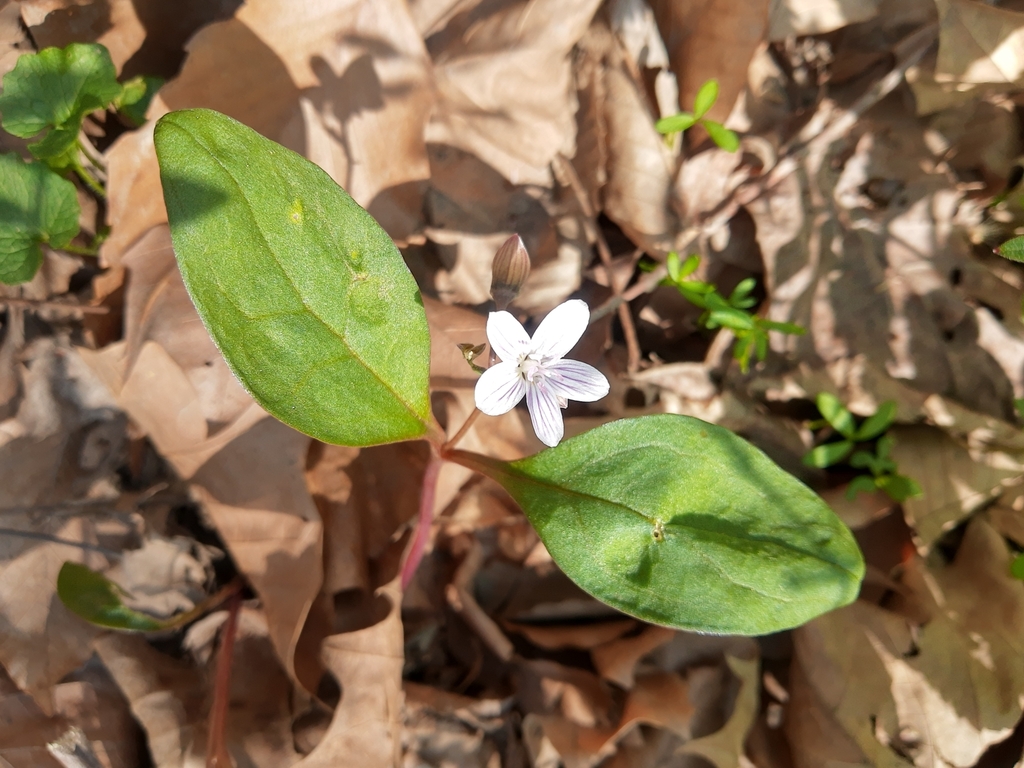
Carolina Springbeauty
Claytonia caroliniana
Claytonia caroliniana, the Carolina springbeauty, is an herbaceous perennial in the family Montiaceae. It was formerly placed in the Portulacaceae. Its native range is eastern and central North America. It is most commonly found in the New England area of the United States but its habitat extends from Ontario and a northern limit in the Cape Anguille Mountains of Newfoundland and south to Alabama. It grows approximately 6 inches tall in forests of the Appalachian Mountains and piedmont
From the article Claytonia caroliniana on Wikipedia (CC BY-SA), quoted section by section
Description
Claytonia caroliniana is a flowering, woodland perennial herb. It grows from March though June and is one of the earliest spring ephemerals. The plant grows from spherical underground tubers in light humus. They sprout and bloom before the tree canopy develops. Once the area is shaded, the plants wither leaving only the tuberous roots underground. The flowers consist of five pink and purple petals. Dark pink veins accent the petals and give them a striped appearance. The carpels are fused together. They grow on a stem 3 - 10 inches tall that bears a single pair of broad leaves. This distinguishes it from Claytonia virginica, which, although similar in other ways, has longer and much narrower leaves. Claytonia caroliniana is similar to some of the Arctic claytonias, but is probably allied to Claytonia ozarkensis. Natural hybrids with Claytonia virginica have been documented There are two green leaves that grow opposite each other on a node. The leaf has no teeth or lobes and a prominent central vein. They grow up to three inches long and 1/2 to 3/4 inches wide.
Uses. The plant is edible but its usability is limited due to difficulty harvesting and the small quantities each plant produces. Its tuberous roots are edible and rich in starch and can be cooked or eaten raw. The leaves can be eaten as well. …
Where it lives
Recorded sightings
—
geo-referenced records in GBIF, from museums, herbaria and field observers.
Drag the globe to turn it. Dots are where records exist, not a range map; darker means more records.
In the stacks
Searching the stacks…
Every page naming Claytonia caroliniana in the Biodiversity Heritage Library →
This page is assembled live from iNaturalist, GBIF, Wikipedia, the Source Library and the Internet Archive. It is not yet part of the hand-edited codex. iNaturalist taxon 67775.