- Plants
- ›Vascular Plants
- ›flowering plants
- ›monocots
- ›Agaves, Orchids, Irises, and Allies
- ›agave and allies
- ›Dragon tree subfamily
- ›true and false Solomon's seals
- ›Maianthemum
- ›Maianthemum
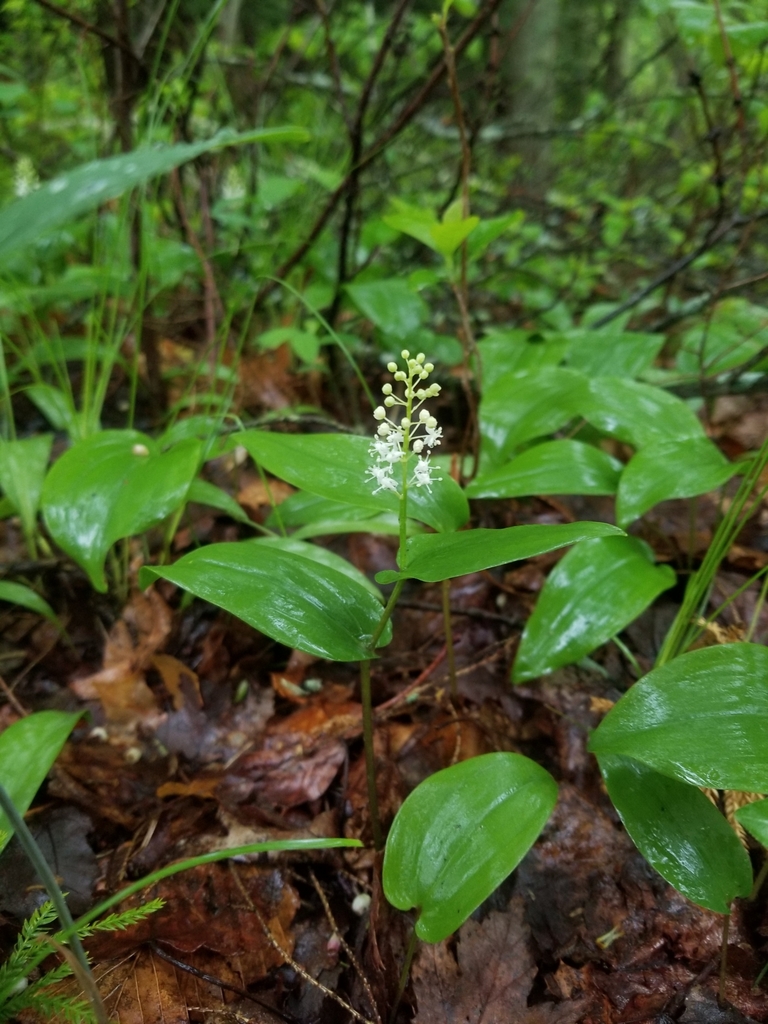
Canada mayflower
Maianthemum canadense
Maianthemum canadense (Canadian may-lily, Canada mayflower, false lily-of-the-valley, Canadian lily-of-the-valley, wild lily-of-the-valley, two-leaved Solomon's seal)
is an understory perennial flowering plant, native to Canada and the northeastern United States, from Yukon and British Columbia east to Newfoundland, into St. Pierre and Miquelon. It can be found growing in both coniferous and deciduous forests. The plant appears in two forms, either as a single leaf rising from the ground with no fruiting structures or as a flowering/fruiting stem with two to three leaves. Flowering shoots have clusters of 12–25 starry-shaped, white flowers held above the leaves.
From the article Maianthemum canadense on Wikipedia (CC BY-SA), quoted section by section
Description
Plants grow to 10–25 cm (4–10 in) tall, arising from branching rhizomes that have roots only at the nodes. Plants may be one-leaved and without fruiting structures (sterile). the fertile, flowering shoots have 2–3 leaves.
Leaves. The leaf blades are 4.5–9 cm (2–4 in) long by 3–5.5 cm (1–2 in) wide with a pointed tip. The lowest leaves are usually egg-shaped with two lobes at the base and a narrow space (sinus) between the lobes. Upper leaves are usually heart-shaped and set on a short 1–7 mm long petiole.
Flowering clusters. The clusters of 12–25 starry-shaped, white flowers are set in a complex raceme - an unbranched flowering cluster that has 1-3 (usually 2) stalked flowers per node, set at roughly equal distances along a central axis. The lowest flowers open first. The flower stalks (pedicels) are 3–7 mm long and thin (0.2-0.5 mm wide).
Flowers and fruits. The flowers are produced from spring to mid summer. They have four conspicuous, white, 1.5–2 mm long tepals. The fruit is a berry containing one or two round seeds. The berries are 4–6 mm across, mottled red in early summer and turning deep red by mid summer. A seed is produced infrequently and most plants in a location are vegetative clones, spreading by their shallow, trailing, white rhizomes.
Range & habitat
It is found in Canada from southeastern Yukon, southern Northwest Territories, into eastern British Columbia and east to Newfoundland and Labrador, and into St. Pierre and Miquelon. It is also found in the northern United States from the Dakotas east, south along the Appalachian Mountains and disjunct populations in Colorado, Wyoming, Nebraska and Kansas. It is possibly extirpated from Montana.
Wikipedia: “Distribution”
What it does
Primarily a boreal forest understory species, but also found at low elevation sites in the Rocky Mountains, to 1800 m. It is associated with moist woods but is also found in sandy pine woods in the north and can persist in clearings.
Wikipedia: “Habitat and ecology”
Where it lives
Recorded sightings
—
geo-referenced records in GBIF, from museums, herbaria and field observers.
Drag the globe to turn it. Dots are where records exist, not a range map; darker means more records.
In the stacks
Searching the stacks…
Every page naming Maianthemum canadense in the Biodiversity Heritage Library →
This page is assembled live from iNaturalist, GBIF, Wikipedia, the Source Library and the Internet Archive. It is not yet part of the hand-edited codex. iNaturalist taxon 67748.