- Plants
- ›Vascular Plants
- ›flowering plants
- ›Dicots
- ›Gentians, Dogbanes, Madders, and Allies
- ›Dogbane Family
- ›milkweeds
- ›Asclepiadeae
- ›Asclepiadinae
- ›Calotropis
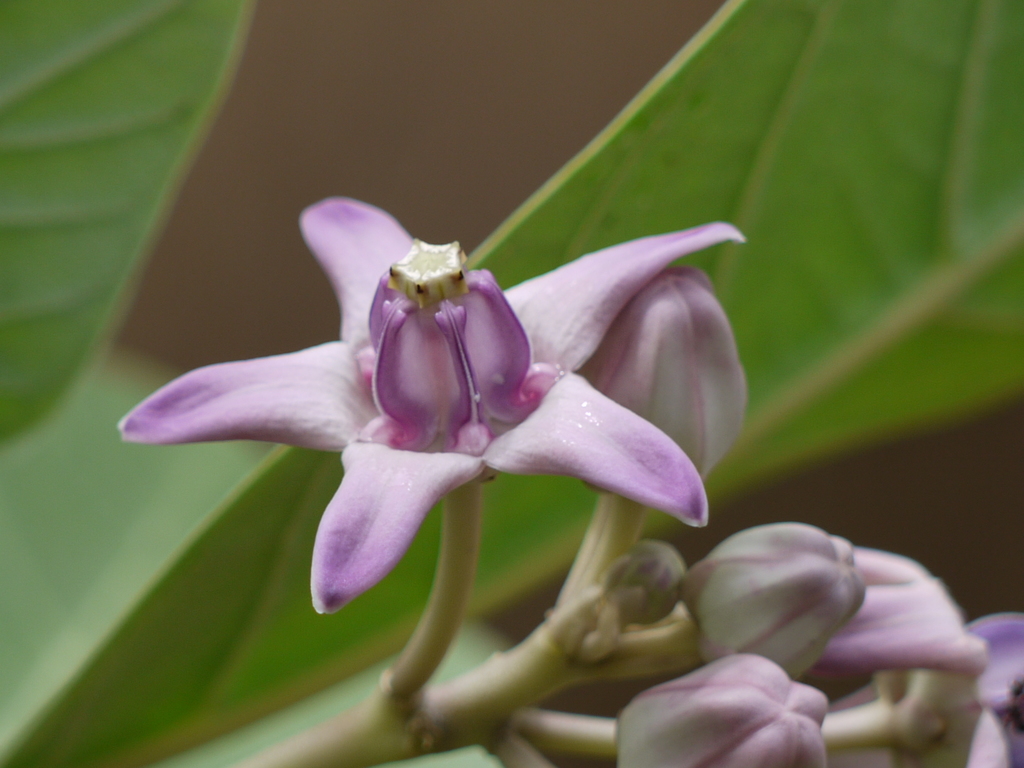
crown flower
Calotropis gigantea
Calotropis gigantea, the crown flower, is a species of Calotropis native to India, Cambodia, Vietnam, Bangladesh, Indonesia, Malaysia, Philippines, Thailand, Sri Lanka, China, Pakistan, and Nepal.
From the article Calotropis gigantea on Wikipedia (CC BY-SA), quoted section by section
Description
It is a large shrub growing to 4 m (13 ft) tall. It has clusters of waxy flowers that are either white or lavender in colour. Each flower consists of five pointed petals and a small "crown" rising from the center which holds the stamens. The aestivation found in calotropis is valvate i.e. sepals or petals in a whorl just touch one another at the margin, without overlapping. The plant has oval, light green leaves and milky stem. The latex of Calotropis gigantea contains cardiac glycosides, fatty acids, and calcium oxalate. The roots also contain Calotropone.
Stem : Erect, branched, cylindrical, solid, contains milky latex. Leaves : 100–200 mm (4–8 in) long, decussate, obovate or elliptic-oblong, shortly acute, subsessile, cordate or often amplexicaul at the base. Inflorescence : Umbellate cymes. Flowers : Large, white, not scented, peduncles arising between the petioles. Flower-buds ovoid, angled, Calyx lobes 5, divided to the base, white, ovate; corolla broadly rotate, valvate, lobes 5, deltoid ovate, reflexed, coronate-appendages broad, obtusely 2-auricled below the rounded apex which is lower than the staminal-column. Stamen : 5, anthers short with membranous appendages, inflexed over the depressed apex of the pentagonal stigma. …
At the table
The flowers are long lasting, and in Thailand they are used in floral arrangements. The extract of flowers and leaves has shown hypoglycemic effect in preclinical studies. They were favored by the Hawaiian Queen Liliuokalani, who considered them a symbol of royalty and wore them strung into leis. In Cambodia, they are used in funerals to decorate the urn or sarcophagus and the interior of the house holding the funeral. In Hindu mythology, according to the Shiva Purana, the madar flower/crown flower is very much liked by Lord Shiva; therefore the crown flower and its garland are offered to Lord Shiva for peace, prosperity and stability in society. The Crown flower is also one of the major parts of the nine astrological trees (Navagrah tree). Calotropis yields a durable fiber (commercially known as bowstring of India) useful for ropes, carpets, fishing nets, and sewing thread. Floss, obtained from seeds, is used as stuffing. Crown flower cotton can also be used to make a pillow. A fermented mixture of Calotropis and salt is used to remove the hair from goat skins for production of nari leather and from sheep skins to make leather which is much used for inexpensive book binding. Fungicidal and insecticidal properties of Calotropis have been reported, with some preparations found to be more effective than ointment. …
Wikipedia: “Uses”
Toxicity
Calotropis is a poisonous plant. The active principles are uscharin, calotoxin, calactin, and calotropin. The leaves and stem when incised yield thick milky juice. It is used as an arrow poison, cattle poison (see also Sutari), rarely for suicide and homicide and mostly an accidental poison. The milky latex sap of Calotropis gigantea is a known cause of toxic keratoconjunctivitis and reversible vision loss. Crown flower keratitis is a rare condition and is usually the result of accidental ocular exposure to the sap. During the process of making a Hawaiian lei flower necklace, touching the sap and then touching the ocular surface may result in crown flower keratitis. Damage (poisoning) of the cornea endothelium results in corneal stromal edema and decreased visual acuity. Although there is some permanent damage to the corneal endothelium with decreased endothelial cell count and irregular shape, the remaining corneal endothelial cells usually recover with complete resolution of the corneal edema and a return to normal visual acuity. The condition is usually self-limited and resolves faster with topical steroids. The clinical course of this condition suggests that Calotropis is paradoxically relatively nontoxic to corneal epithelium and highly toxic to corneal endothelium. …
Wikipedia: “Poisoning”
Where it lives
Recorded sightings
—
geo-referenced records in GBIF, from museums, herbaria and field observers.
Drag the globe to turn it. Dots are where records exist, not a range map; darker means more records.
In the stacks
Searching the stacks…
Every page naming Calotropis gigantea in the Biodiversity Heritage Library →
This page is assembled live from iNaturalist, GBIF, Wikipedia, the Source Library and the Internet Archive. It is not yet part of the hand-edited codex. iNaturalist taxon 67574.