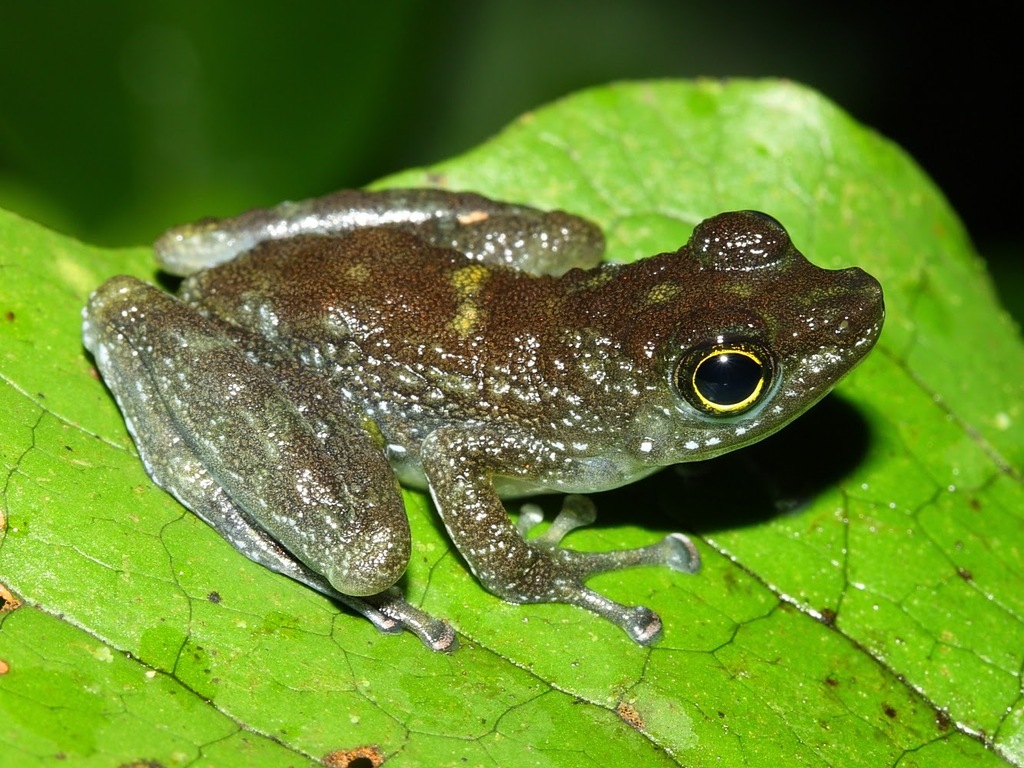
White-spotted Foot-flagging Frog
Staurois parvus
Staurois tuberilinguis (common names: Borneo splash frog, green-spotted rock frog) is a semi-aquatic amphibian of the true frog family (Ranidae). This diurnal and crepuscular frog is also commonly associated with its very close relative Staurois parvus (common name: Borneo rock frog). In fact, many do not consider the two species to be taxonomically separate. This species is commonly found within the tropical rainforests of on Borneo, Malaysia next to fast-flowing rivers and streams. Due to the frog's noisy choice of habitat, S. parvus are well-known for their multi-modal system of communication that combines acoustic calls with visual display signals. S. parvus seems to be in decline in part of its range, but overall is listed as being of "least concern" in the IUCN Red List of Threatened Species. It is threatened by habitat loss, especially by deforestation and sedimentation of streams.
From the article Staurois tuberilinguis on Wikipedia (CC BY-SA), quoted section by section
Range & habitat
The species is found in northern Borneo in Sabah and Sarawak (Malaysia), Brunei, and northeastern Kalimantan (Indonesia) at up to 2,000 m (6,600 ft) above sea level. A smaller relative, only known from the Crocker Range in Sabah (Malaysia), was described as S. parvus. Later, it was considered a junior synonym of S. tuberilinguis, but more recently it was confirmed to be distinct according to morphological and DNA sequence data. This frog is commonly found along the banks of small, rocky streams with clear water in primary rainforests. They can often be seen perched on rocks or other vegetation near water, usually around the rapids. They breed in streams and the males vocalize during the day. Like other members of Staurois, they use visual signalling to attract mates.
Wikipedia: “Habitat and distribution”
What it does
Ontogenetic development When S. parvus first metamorphosize from being a tadpole, they possess white and bluish coloration on their feet to assist with visual signaling. As they age from juvenile to adult this coloration increases in brightness to enhance their visual conspicuousness. Meta-analytical studies have shown that this ontogenetic change in coloration happens along with sexual development and maturity in S. parvus. In terms of bodily changes, S. parvus juveniles begin as bright green, which serve as a form of camouflage as the species is known to dwell nearly mossy rocks next to rivers and streams in rainforest environments.
Wikipedia: “Life cycle”
Listen
Looking for field recordings…
Where it lives
Recorded sightings
—
geo-referenced records in GBIF, from museums, herbaria and field observers.
Drag the globe to turn it. Dots are where records exist, not a range map; darker means more records.
In the stacks
Searching the stacks…
Every page naming Staurois parvus in the Biodiversity Heritage Library →
This page is assembled live from iNaturalist, GBIF, Wikipedia, the Source Library and the Internet Archive. It is not yet part of the hand-edited codex. iNaturalist taxon 67203.