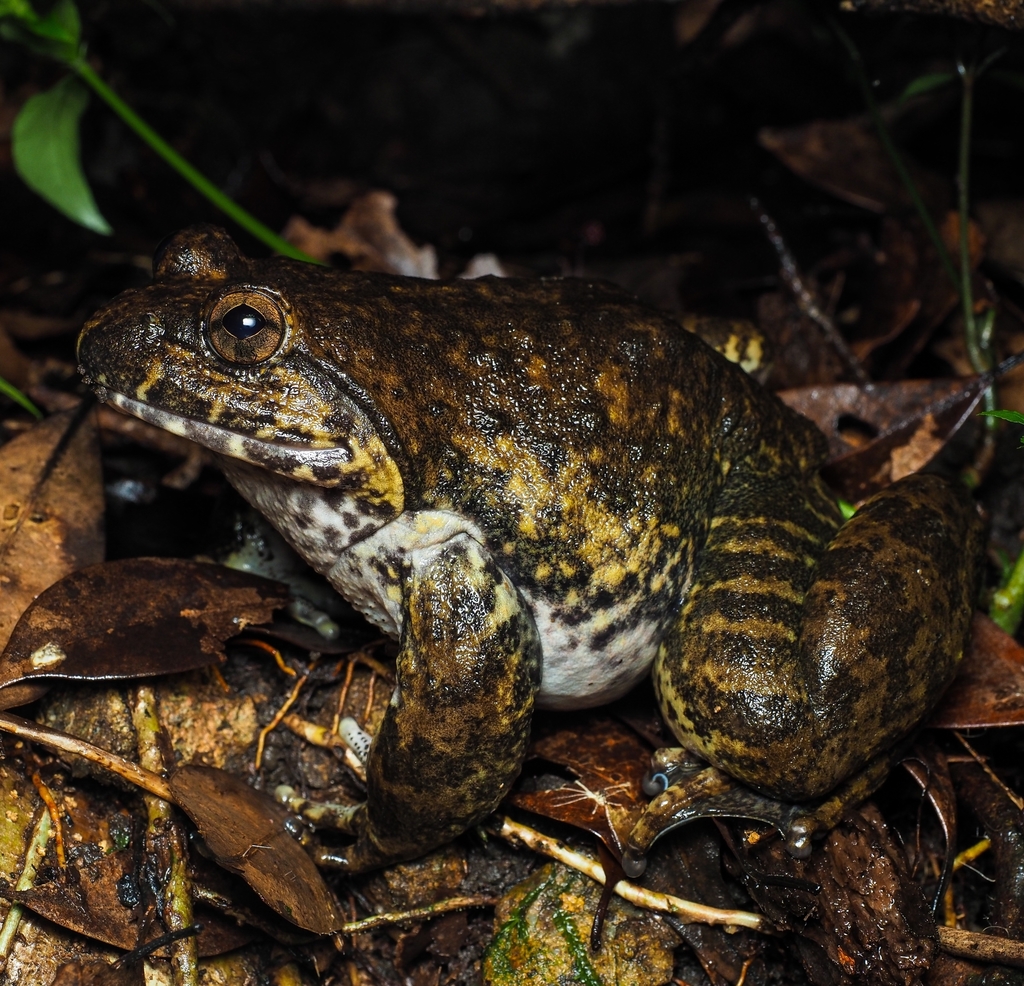
Giant Spiny Frog
Quasipaa spinosa
Quasipaa spinosa is a species of frog in the family Dicroglossidae. It is known under many common names, including Chinese spiny frog, giant spiny frog, Chinese edible frog, and spiny paa frog. Its names refer to the distinctive characteristics of the species, relatively large size and the spiny chest of male frogs. Giant in frog terms only, it can nevertheless grow to lengths above 10 cm (4 in); this makes it the largest frog in Hong Kong.
From the article Quasipaa spinosa on Wikipedia (CC BY-SA), quoted section by section
Description
The most distinctive characteristic of Quasipaa spinosa are the keratinized skin spines in the chest of males. It is dark brown in colour, interspersed with dense, yellowish mottling. Quasipaa spinosa are moderately large frogs: males grow to a snout–vent length of about 80 mm (3.1 in) and females to 82 mm (3.2 in) or more, up to 128 mm (5.0 in) in snout–vent length. It is the largest frog in Hong Kong. Later studies has shown that usually males are larger than females, but with considerable overlap between sexes. Body size is positively correlated with maximum temperature and rainfall. Mean body weight among males may reach at least 133 g (4.7 oz). Quasipaa spinosa breeds in streams, laying the eggs in water under stones. Reproduction takes place in April–October. Male frogs call near slow-flowing sections of streams or around pools adjacent to streams. The advertisement call consists of three to seven notes, the last being the longest. Pairs in amplexus are found within the chorus area. Population demography of Quasipaa spinosa has been studied for two populations in the Tai Mo Shan Country Park in Hong Kong. These populations exhibit high site fidelity. Populations have low densities (13–42 frogs per 100 m of stream) and female-biased sex ratio. Each female produced an average 1.26 juveniles that survived until the age of 2 years. Annual survival was low, 38–65%.
Wikipedia: “Description and life cycle”
Range & habitat
It is found in China south of the Yangtze River, including Hong Kong. It is expected to be found in Vietnam, Laos, and Myanmar. No certain records exist from Vietnam, earlier records may refer to Quasipaa acanthophora described in 2009 as a new species from that country. It may also have been mixed with Quasipaa verrucospinosa and Nanorana yunnanensis. Quasipaa spinosa is associated with rocky streams in evergreen forests and open countryside on hills and mountains. Its altitude range is about 200–1,500 m (660–4,920 ft) above sea level.
Wikipedia: “Distribution and habitat”
Listen
Looking for field recordings…
Where it lives
Recorded sightings
—
geo-referenced records in GBIF, from museums, herbaria and field observers.
Drag the globe to turn it. Dots are where records exist, not a range map; darker means more records.
In the stacks
Searching the stacks…
Every page naming Quasipaa spinosa in the Biodiversity Heritage Library →
This page is assembled live from iNaturalist, GBIF, Wikipedia, the Source Library and the Internet Archive. It is not yet part of the hand-edited codex. iNaturalist taxon 67012.