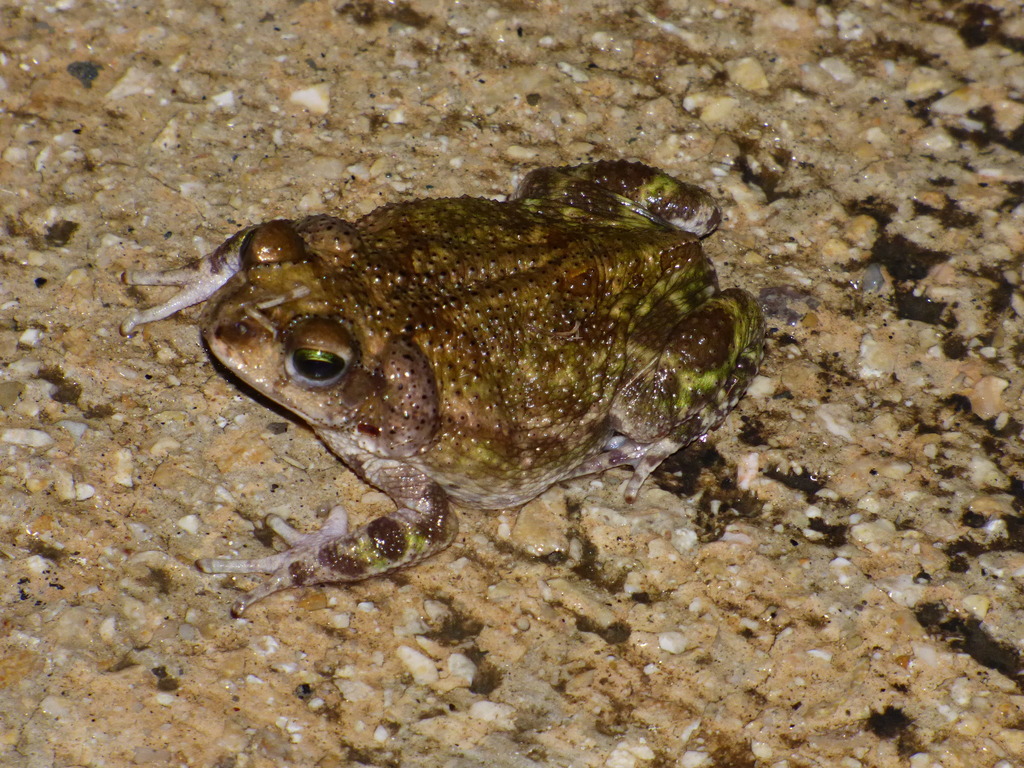
Cuban Small-eared Toad
Peltophryne empusa
Peltophryne empusa, Cuban small-eared toad, Cuban toad, or Cope's Caribbean toad (in Spanish guasabalo or sapo de concha) is a species of toad in the family Bufonidae that is endemic to Cuba including Isla de Juventud.
From the article Cuban small-eared toad on Wikipedia (CC BY-SA), quoted section by section
Description
Species description of Peltophryne empusa was published by Edward Drinker Cope in 1862 as an addendum to his work entitled "Notes upon some reptiles of the Old World" (reptiles and amphibians were not necessarily considered very distinct at that time):
Supraorbital ridges very prominent, not crenate, presenting a posterior process. Postorbital and supra-tympanic processes prominent, obtuse; preorbital straight, more acute. Canthus rostrales acute, converging so as to produce a very acute angle; their profile very declive, that of the muzzle more so, but not perpendicular. Maxillary region oblique from a front view; the labial border forming a prominent rim, which is thickened and everted posteriorly. Two occipital knobs on each side. Tympanum small, one-fourth or one-third the length of the palpebral border in diameter. Paratoid gland small, rounded, lateral, studded with warts; the dorsal region is similarly studded, most abundantly anteriorly. Sides, extremities and gular region covered with smaller warts; belly areolate. One large oval flat metacarpal tubercle; a large one at the base of the interior digit. Two metatarsal tubercles; the interior most elongate and acute, blackish brown. A short, thickened, internal tarsal fold. …
Range & habitat
Peltophryne empusa has a wide but patchy distribution in xeric and mesic lowland forests and savannas of Cuba and the Isla de Juventud to 70 m (230 ft) asl. However, it burrows underground and is rarely seen except during the breeding season when it is abundant. It is an explosive breeder; males call from flooded ditches and large temporary pools of rainwater. Eggs are laid in still water.
Wikipedia: “Distribution and habitat”
Listen
Looking for field recordings…
Where it lives
Recorded sightings
—
geo-referenced records in GBIF, from museums, herbaria and field observers.
Drag the globe to turn it. Dots are where records exist, not a range map; darker means more records.
In the stacks
Searching the stacks…
Every page naming Peltophryne empusa in the Biodiversity Heritage Library →
This page is assembled live from iNaturalist, GBIF, Wikipedia, the Source Library and the Internet Archive. It is not yet part of the hand-edited codex. iNaturalist taxon 66340.