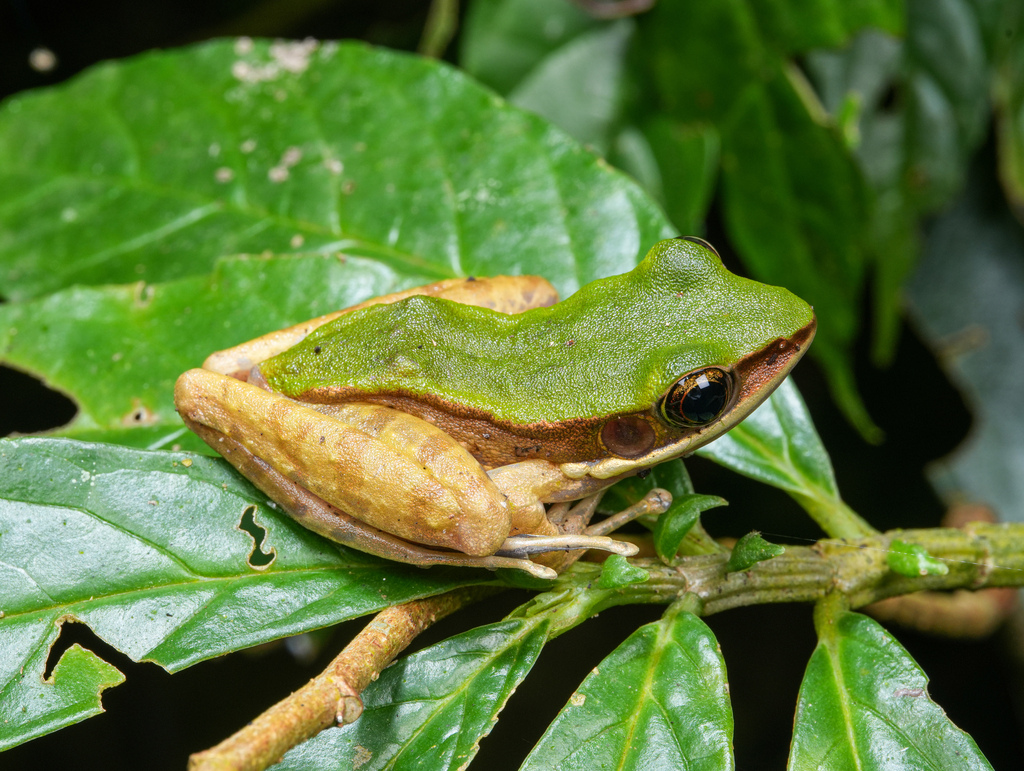
Large Odorous Frog
Odorrana graminea
Odorrana graminea, the large odorous frog, inhabits fast-flowing streams in elevated mountainous regions of Southern China and Northern Indochina. It is one of 56 species in the genus Odorrana. Male O. graminea are noted for their ultrasonic call characteristics and are one of three frog species able to detect ultrasonic frequencies (>20 kHz), likely evolved to facilitate communication amidst noisy streams and waterfalls. Studies on O. graminea courtship vocalizations suggest female preference for increased proportion of nonlinear vocal phenomena (NLP).
From the article Odorrana graminea on Wikipedia (CC BY-SA), quoted section by section
Description
Odorrana graminea have a dorsoventrally compressed body with large eyes. Dorsum is green with smooth skin; flanks are brown with yellow marbling and with slight granulations. They are relatively large frogs, particularly the females: females grow to a snout–vent length of 78–100 mm (3.1–3.9 in), whereas males attain a more modest length of 42–53 mm (1.7–2.1 in). Apart from size, males differ from females by their smaller digital disks, stronger forearms, larger tympanum, velvety nuptial pads on thumb, and paired gular pouches below jaw articulations. Odorrana graminea can produce ultrasonic calls. This is very rare among non-mammalian vertebrates, but has been shown for the related concave-eared torrent frog Odorrana tormota. However, O. graminea does not have recessed ears, a feature believed to be important for ultrasonic hearing in O. tormota. Exactly how O. graminea detects ultrasound remains yet to be determined.
Range & habitat
Odorrana graminea is found in southern China (from southern Anhui and northern Zhejiang west to extreme southern Gansu, southeastern Sichuan, and southern Yunnan to the border of Vietnam, Laos and Myanmar, although it has not yet been recorded in the latter two countries. Its type locality is the Wuzhi Mountain in Hainan. Until the revision of "Rana livida" in 2003, this frog was considered a synonym of Odorrana livida. The species occurs near fast-flowing rivers and streams in montane (sub-)tropical forests.
Wikipedia: “Habitat and distribution”
What it does
Information on the O. graminea diet is lacking. However, studies of the related Odorraa morafkai in Southern Vietnam suggest a diverse diet of both aquatic and terrestrial prey. 90% of O. morafkai prey consists of insects, especially beetles. Distribution of prey type varied with season, likely due to increased range of access during the rainy versus dry season.
Wikipedia: “Diet”
Listen
Looking for field recordings…
Where it lives
Recorded sightings
—
geo-referenced records in GBIF, from museums, herbaria and field observers.
Drag the globe to turn it. Dots are where records exist, not a range map; darker means more records.
In the stacks
Searching the stacks…
Every page naming Odorrana graminea in the Biodiversity Heritage Library →
This page is assembled live from iNaturalist, GBIF, Wikipedia, the Source Library and the Internet Archive. It is not yet part of the hand-edited codex. iNaturalist taxon 66240.