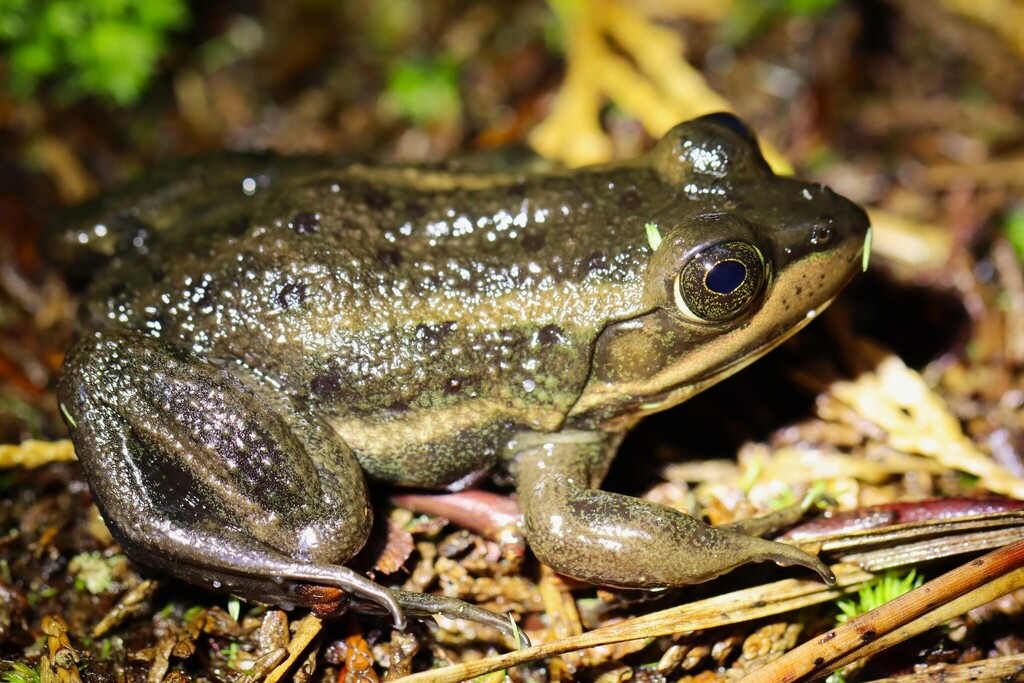
Carpenter Frog
Lithobates virgatipes
The carpenter frog (Lithobates virgatipes) is a species of true frog found on coastal plain of the Atlantic coast of the United States between central New Jersey and northeastern Florida.
From the article Carpenter frog on Wikipedia (CC BY-SA), quoted section by section
Range & habitat
The carpenter frog is found in the Atlantic coastal plains in the United States. From the pine barrens of New Jersey to the bottom of Georgia, the carpenter frog makes its home. The frog is also found, but not common, in Florida. They are usually found in water and rarely on land. The carpenter frog adapted to be able to live in acidic waters. The frog has been observed in cypress ponds, interdunal swales, tupelo swamps, acid swamps, canals, and is associated with sphagnum mats and other vegetation in coffee-colored waters of pine savanna bogs or ponds. They most commonly are found in relatively acidic water abundant Sphagnum or other vegetation leading to being sometimes referred to "sphagnum frogs." They depend on aquatic vegetation in shallow waters for protection and breeding. It is said that carpenter frogs are found in waterways that are tea or coffee colored, where they can easily be camouflaged.
Wikipedia: “Habitat”
What it does
Carpenter frogs are prolonged breeders with a breeding season between 2–3 months. The breeding season typically occurs with onset of warm weather in late April and continues until late July or early August. Males maintain territories with a median radius of 1 meter and produce mating calls on most nights of the breeding season. Intensity of the calls varies according to body size, with smaller males having high pitched calls of lower intensity relative to larger males. Their calls resemble the sound of a carpenter hammer, which is the origin of their common name. They exhibit five different call types with each one being reserved for a different social interaction. Calling activity occurs between sunset and sunrise but peaks near midnight. After mating, females lay globular egg masses of 200-600 eggs attached to underwater vegetation up to 8 inches deep.
Wikipedia: “Reproduction”
Listen
Looking for field recordings…
Where it lives
Recorded sightings
—
geo-referenced records in GBIF, from museums, herbaria and field observers.
Drag the globe to turn it. Dots are where records exist, not a range map; darker means more records.
In the stacks
Searching the stacks…
Every page naming Lithobates virgatipes in the Biodiversity Heritage Library →
This page is assembled live from iNaturalist, GBIF, Wikipedia, the Source Library and the Internet Archive. It is not yet part of the hand-edited codex. iNaturalist taxon 66018.