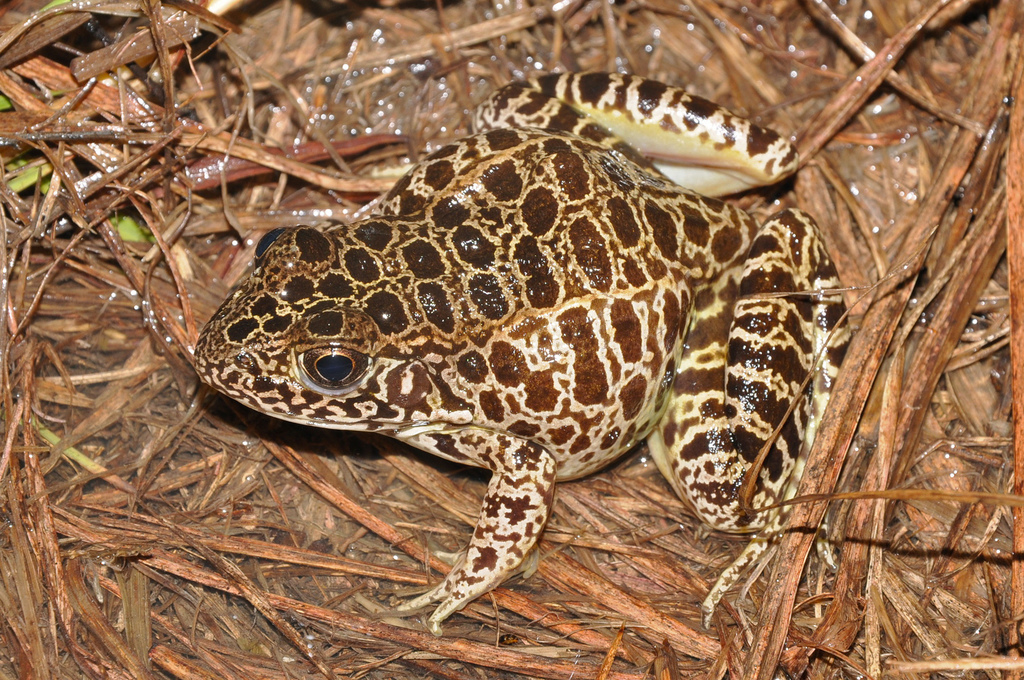
Crawfish Frog
Lithobates areolatus
The crawfish frog (Lithobates areolatus) is a medium-sized species of frog native to the prairies and grasslands of the central United States. It gets its name because it inhabits the burrows of crayfish for most of the year. They have defined golden or black circles all over their body.
From the article Crawfish frog on Wikipedia (CC BY-SA), quoted section by section
Description
The crawfish frog grows from 2.2 to 3.0 in (5.6 to 7.6 cm) in length. It ranges from yellow to brown in color, with a white ventral surface. The numerous dark brown spots on the back of L. areolatus each has a light-colored ring around it. It has a distinct skin fold on either side of its back, which are much more pronounced in males than females, and a relatively small tympanum.
Range & habitat
The crawfish frog is found in portions of central and southern United States, from Indiana west to Kansas, south to Texas, and east to Alabama. This species is largely associated with former prairie regions where crawfish burrows are found, but with the effects of habitat loss along with urbanization, many populations have been extirpated. During the early 2000s, a sizable and geographically disjunct crawfish frog population was discovered at Big Oaks National Wildlife Refuge in southeastern Indiana. In 2016 a sizable population was documented in Sumter County, Alabama. A new county record was added in 2017 in Perry County, Arkansas within the Ouachita Mountains. See Notes below.
Wikipedia: “Geographic range”
What it does
Crawfish frogs are found primarily in association with prairie or grassland habitat, though they will also make use of pastures and overgrown fields. This species spends most of the year in association with a terrestrial crayfish burrow. Lithobates areolatus spends a substantial amount of time active and above ground even on hot summer days, but they never stray far from their burrow which serves as an important retreat from predators, a vital source of water, an escape from grassland fires, and a means to get below the frost line during winter. Crawfish frogs feed opportunistically on insects and other small invertebrates that pass by their burrow. The crawfish frog breeds following mild, rainy weather in mid-March throughout most of its range (breeding occurs much earlier in the southern portion of its distribution). During this time, males seek out ephemeral ponds and wetlands that lack fish and begin calling. The low-frequency call may carry over a mile, drawing females in from the surrounding area. Once the females arrive, amplexus is likely to take place and the females deposit up to 7,000 eggs at a time in large, globular masses. The eggs hatch in an average of 12 days, and the tadpoles metamorphose into froglets within three or four months. The newly metamorphosed juvenile frogs must quickly seek out a crayfish burrow to occupy to avoid predation. …
Wikipedia: “Behavior”
Listen
Looking for field recordings…
Where it lives
Recorded sightings
—
geo-referenced records in GBIF, from museums, herbaria and field observers.
Drag the globe to turn it. Dots are where records exist, not a range map; darker means more records.
In the stacks
Searching the stacks…
Every page naming Lithobates areolatus in the Biodiversity Heritage Library →
This page is assembled live from iNaturalist, GBIF, Wikipedia, the Source Library and the Internet Archive. It is not yet part of the hand-edited codex. iNaturalist taxon 65974.