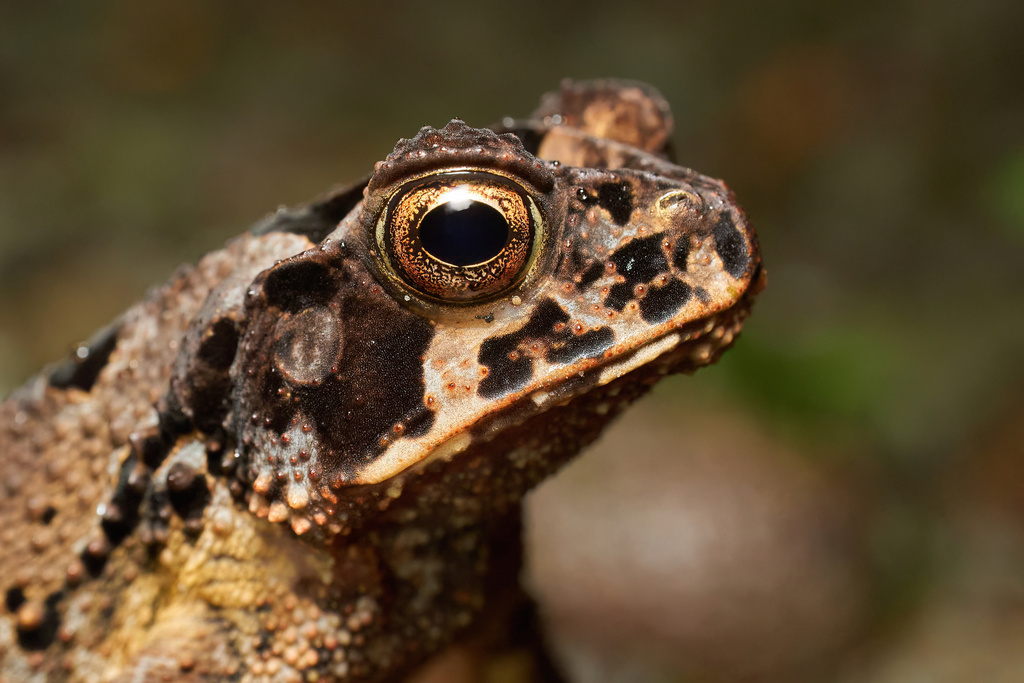
Wet Forest Toad
Incilius melanochlorus
Incilius melanochlorus, formerly Bufo melanochlorus, is a mid-sized species of toad with a crested head in the family Bufonidae. It is primarily distinguished by its very long first finger with respect to the other fingers. It is found in southern Nicaragua, in the northern Cordillera Central (central highlands) and on the Atlantic slopes of eastern Costa Rica, and in western Panama.
From the article Incilius melanochlorus on Wikipedia (CC BY-SA), quoted section by section
Description
Incilius melanochlorus are moderately large toads, with males attaining 65 mm (2.6 in) to 74 mm (2.9 in) in snout–vent length, and females 103 mm (4.1 in) to 107 mm (4.2 in). There is marked sexual dimorphism, the females having more irregular dark colouration on their back and being larger, but the males having longer heads and more brawny forearms. The head is wider than it is long. The head is crested, with the cranium sporting well-developed, thin and high crests. This crest ornamentation consists of canthal, supraorbital, and postpreorbital crests, and parietal crests with transverse folds between them (other species have crests on other locations). The crests run from the nostril, behind the eye, to the back of the head. The skin of the top of the head is hardened and stuck to the top of the skull. Males have a vocal sac. The vocal slits which hide the vocal sac inside the throat are small and bilateral, the sac has a single lobe, and is large, heavily pigmented with a greenish cast, and when calling inflates fully to a round shape. The eyes are large with a coppery bronze iris and a black pupil, the top half of the iris lighter than the bottom half, with a thin, dark line separating the two halves. The tongue is long and thin. …
Range & habitat
In the 1960s the range was considered to include Nicaragua, but in 1972 Villa stated all earlier collections from this country were to be considered misidentified specimens of Incilius luetkenii or I. valliceps. It was subsequently believed to be endemic to Costa Rica. In 2004 similar toads from the Pacific slopes of Costa Rica were reassigned to a new species, I. aucoinae. In Costa Rica it occurs throughout the northern section of the Cordillera Central at mid-latitudes, and throughout the Cordillera de Talamanca and the eastern Caribbean seaboard. As of 2008 it is unclear if I. melanochlorus also occurs on the Pacific slopes of Costa Rica, or if those are misidentified I. aucoinae. McDiarmid and Savage recorded it in 2005 in meadows of the Peninsula de Osa, extending the distribution to the Pacific slopes in the far southwest of the country. According to Pounds et al. in 1997, it disappeared from Monteverde, Costa Rica, in the late 1980s and then reappeared there in the 1990s. In 2004 the toad was recorded in Nicaragua for first time (correctly) in the Indio Maíz Biological Reserve by Gunther Köhler and his team, in 2009 it was also recorded from Río San Juan under auspices of an expedition by Köhler and in 2014 it was reported in Rivas Department on the Pacific coast by a Nicaraguan team. In 2009 the distribution was extended to Panama following Jaramillo and Ibáñez (2009).
Wikipedia: “Distribution”
What it does
This toad is nocturnal and insectivorous. The toads may become more active during light rain showers.
Habitat. The native habitats of this species are wet lowland rainforests and the lower premontane wet forests at elevations to about 1,080 m (3,540 ft) asl. Its favourite locations are near large streams and at the edges of forests. In the northeastern rainforests of Costa Rica it occurs from sea level to 2,000 m (6,600 ft) in elevation, with frogs of the genus Eleutherodactylus being the few amphibians to occur at higher altitudes here. It is occasionally found amongst the leaf litter on the forest floor.
Reproduction. Reproduction happens during the dry season starting with the males calling from January to February from pools along rocky streams, or within 50 cm (20 in) of water. Males may call at odd times of the year. Males develop dark-brown nuptial pads on their first and second fingers during breeding season. Although some sources claim breeding (amplexus) takes place in large streams, according to Savage (2002) it occurs in small, somewhat rocky-bottomed streams which are at low water for the season.
Interspecific relationships. Male toads may share their pools with the larger Bufo marinus toads.
Diseases. The pathogenic fungus Batrachochytrium dendrobatidis has had no impact on this toad.
Wikipedia: “Ecology”
Listen
Looking for field recordings…
Where it lives
Recorded sightings
—
geo-referenced records in GBIF, from museums, herbaria and field observers.
Drag the globe to turn it. Dots are where records exist, not a range map; darker means more records.
In the stacks
Searching the stacks…
Every page naming Incilius melanochlorus in the Biodiversity Heritage Library →
This page is assembled live from iNaturalist, GBIF, Wikipedia, the Source Library and the Internet Archive. It is not yet part of the hand-edited codex. iNaturalist taxon 65848.