- Animals
- ›Chordates
- ›Vertebrates
- ›Amphibians
- ›Frogs and Toads
- ›Poison Frogs
- ›Poison Dart Frogs
- ›Hyloxalinae
- ›Hyloxalus
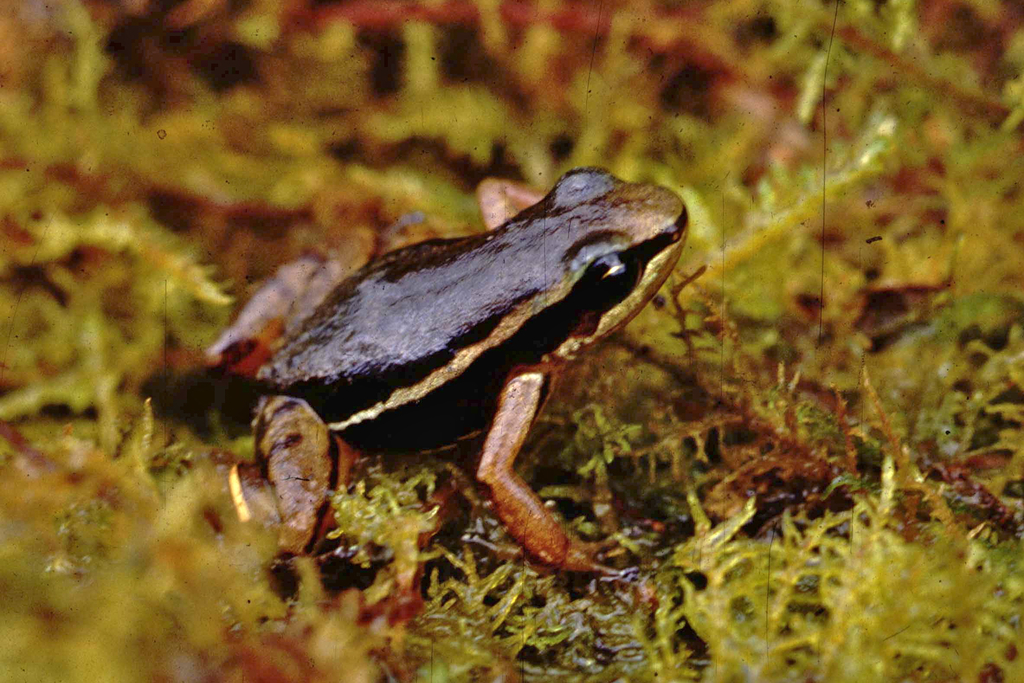
El Laurel Rocket Frog
Hyloxalus delatorreae
Hyloxalus delatorreae is a species of frog in the family Dendrobatidae. It is endemic to the western slopes of the Andes in extreme northern Ecuador. It is only known from four nearby locations in the Carchi Province. Its natural habitats are wetlands and bogs, and it can also be found on areas of cattle ranching surrounded by forest remnants, at elevations of 2,340–3,000 m (7,680–9,840 ft) asl. It is threatened by habitat loss caused by agriculture and logging.
From the article Hyloxalus delatorreae on Wikipedia (CC BY-SA), quoted section by section
Description
Males measure 18–21 mm (0.71–0.83 in) and females 19–21 mm (0.75–0.83 in) in snout–vent length. The skin of the dorsum is gray-brown in color. There is a gold or cream line down each side of the body starting at the eye. The female frog has a white belly. The male frog's belly has white spots. There are two dark spots where the front legs meet the body. The male frog's testicles are white in color.
Range & habitat
It is only known from four nearby locations in the Carchi Province. Its natural habitats are wetlands and bogs, and it can also be found on areas of cattle ranching surrounded by forest remnants, at elevations of 2,340–3,000 m (7,680–9,840 ft) asl.
Wikipedia: “Habitat”
What it does
This frog breeds between February and June. The female frogs lay eggs on the ground. After the eggs hatch, the male frogs carry the tadpoles to streams and ponds where they develop further. The tadpoles are dark brown in color. Some of the muscles are cream-white in color with brown flecks.
Wikipedia: “Reproduction”
In human culture
Scientists named this frog after Stella de la Torre, who helped collect the specimens of this and other species.
Wikipedia: “Etymology”
Listen
Looking for field recordings…
Where it lives
Recorded sightings
—
geo-referenced records in GBIF, from museums, herbaria and field observers.
Drag the globe to turn it. Dots are where records exist, not a range map; darker means more records.
In the stacks
Searching the stacks…
Every page naming Hyloxalus delatorreae in the Biodiversity Heritage Library →
This page is assembled live from iNaturalist, GBIF, Wikipedia, the Source Library and the Internet Archive. It is not yet part of the hand-edited codex. iNaturalist taxon 65684.