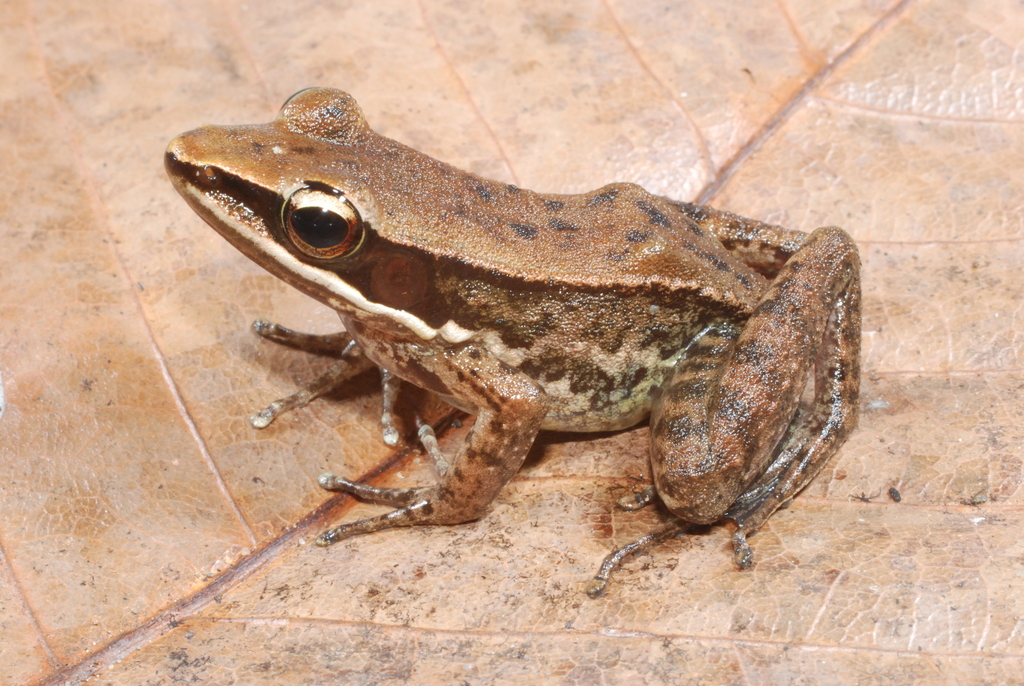
Papua Frog
Hylarana papua
Papurana papua is a species of true frog, family Ranidae. It is endemic to New Guinea and found in the northern part of the island in both Indonesia and Papua New Guinea as well in some offshore islands (including Normanby, Waigeo, and Manus Island). Common name Papua frog has been coined for it.
From the article Papurana papua on Wikipedia (CC BY-SA), quoted section by section
Description
Papurana papua is a comparatively small frog. Adult males grow to 60 mm (2.4 in) and adult females to 67 mm (2.6 in) in snout–vent length; mean length is respectively 56 and 64 mm (2.2 and 2.5 in). The limbs are short, giving this frog an oddly elongated appearance. The upper lip is white and contrasts with the surrounding dark ground color. As typical for the genus, dark post-ocular mask is present, but it is not clearly demarcated posteriorly. The sides have low-contrast pattern of brown clouded over white, gray, or faint yellow. The venter is white or with faint, dark yellow cast, evenly suffused with dark punctations or gray clouding. The dorsum is smooth or finely granular and has few, scattered, large, dark brown warts. The male advertisement call is a single pulsed note, sounding like a "quack".
Range & habitat
Papurana papua lives in swampy forests and flooded grasslands, including disturbed habitats, at elevations up to 1,200 m (3,900 ft) above sea level. Breeding takes place in pools and swamps. It is an abundant and widely distributed species. No significant threats to it are known. It lives in some protected areas.
== References ==
Wikipedia: “Habitat and conservation”
Listen
Looking for field recordings…
Where it lives
Recorded sightings
—
geo-referenced records in GBIF, from museums, herbaria and field observers.
Drag the globe to turn it. Dots are where records exist, not a range map; darker means more records.
In the stacks
Searching the stacks…
Every page naming Hylarana papua in the Biodiversity Heritage Library →
This page is assembled live from iNaturalist, GBIF, Wikipedia, the Source Library and the Internet Archive. It is not yet part of the hand-edited codex. iNaturalist taxon 65617.