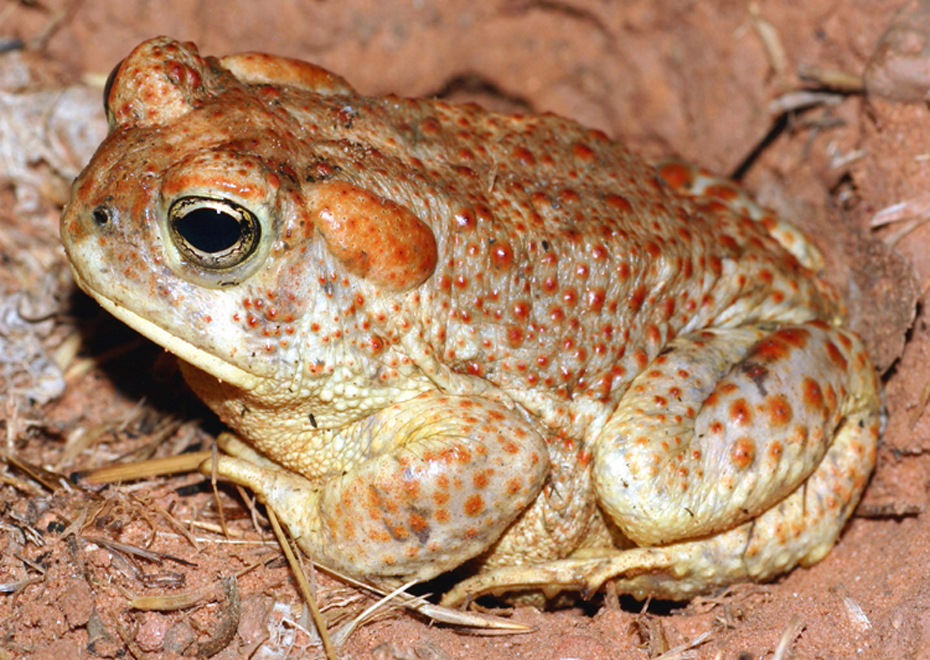
Arizona Toad
Anaxyrus microscaphus
The Arizona toad (Anaxyrus microscaphus) is a species of toad in the family Bufonidae. It is endemic to the south-western United States, where its natural habitats are temperate lowland forests, rivers and streams, swamps, freshwater marshes, freshwater springs, ponds, open excavations, irrigated land, and seasonally flooded agricultural land.
From the article Arizona toad on Wikipedia (CC BY-SA), quoted section by section
Description
The Arizona toad grows to a snout-to-vent length of 53 to 79 mm (2 to 3 in). The dorsal colour is variable but is often gray or beige with reddish-brown warts. The parotoid glands are oval and widely separated and there is often a pale stripe or patch on the head or spine. Juveniles are often salmon-coloured or greenish-brown.
Range & habitat
This species' range is continuous along the Virgin River and its tributaries in southwestern Utah, and southern Nevada, and in locations across Arizona and western New Mexico. It is a protected species in Utah, Nevada and Arizona. Protected populations occur in the Virgin River and its tributaries in Zion National Park. The toads are usually found in sandy areas within about 100 metres (330 ft) of streams, often in locations with flood channels and dense clumps of willow, or on nearby sandy terraces with live oaks and cottonwoods. In Arizona and New Mexico they sometimes occur at higher altitudes, up to about 2,000 metres (6,600 ft) in forested areas in riparian corridors during rainy periods in summer. They also move into irrigated fields after the breeding season is over, and are found around reservoirs, ponds and other impounded areas.
Wikipedia: “Distribution and habitat”
What it does
Breeding takes place in backwaters, the edges of streams and side-pools. Trees and shrubs growing at the streamside include Fremont's cottonwood (Populus fremontii), willows (Salix spp.), and seep willows (Baccharis salicifolia). Breeding starts in late February in Arizona but does not commence at higher altitudes in Arizona and in Utah until several weeks later. The male's call is a trill lasting about six seconds. Calling males are often outnumbered by satellite males which opportunistically mate with approaching females. Amplexus takes place and a clutch of about 4,500 eggs is laid in shallow water. The eggs take three to six days to hatch and the development period of the tadpoles before metamorphosis depends largely on the water temperature. The tadpoles probably feed on algae and other organisms attached to underwater surfaces but the diet of adults has not been studied. The toads are nocturnal, spending the day in sandy burrows. They enter a state of torpor and remain underground from about September to February. They may live for four or five years and the main cause of mortality is probably predation, with raccoons (Procyon lotor), a medium-sized plover the killdeer (Charadrius vociferus), and the wandering garter snake (Thamnophis elegans vagrans) feeding on the toads.
Wikipedia: “Behavior”
Listen
Looking for field recordings…
Where it lives
Recorded sightings
—
geo-referenced records in GBIF, from museums, herbaria and field observers.
Drag the globe to turn it. Dots are where records exist, not a range map; darker means more records.
In the stacks
Searching the stacks…
Every page naming Anaxyrus microscaphus in the Biodiversity Heritage Library →
This page is assembled live from iNaturalist, GBIF, Wikipedia, the Source Library and the Internet Archive. It is not yet part of the hand-edited codex. iNaturalist taxon 64982.