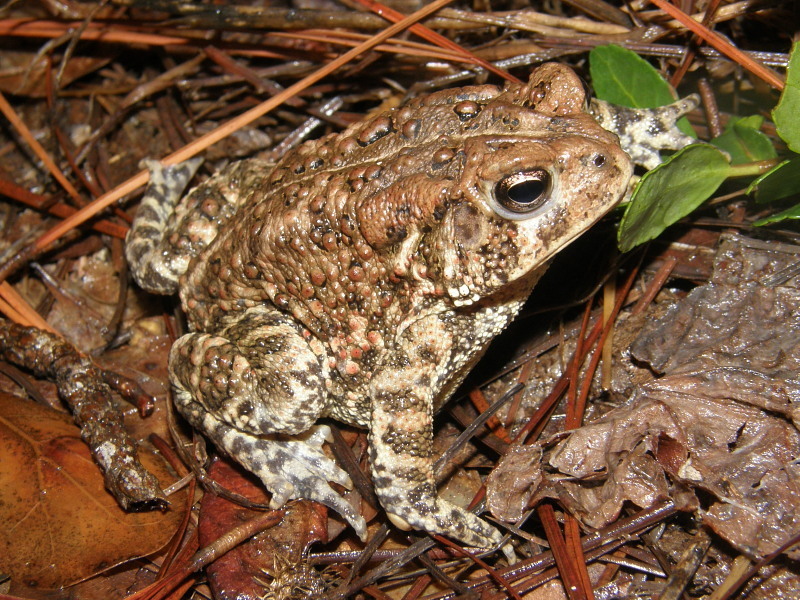
Houston Toad
Anaxyrus houstonensis
The Houston toad (Anaxyrus houstonensis), formerly Bufo houstonensis, is an endangered species of amphibian that is endemic to Texas in the United States. This toad was discovered in the late 1940s and named in 1953. It was among the first amphibians added to the United States List of Endangered Native Fish and Wildlife and is currently protected by the Endangered Species Act of 1973 as an endangered species. The Houston toad was placed as "endangered" on the IUCN Red List of Threatened Species from 1986 to 2022, and has worsened to "critically endangered" since then, with fewer than 250 mature individuals believed to remain in the wild as of 2021. Their kind is threatened every day as they continue to suffer from a loss of habitat and extreme drought. Their typical life expectancy is at least 3 years but it may exceed this number.
From the article Houston toad on Wikipedia (CC BY-SA), quoted section by section
Description
The female Houston toad can grow to be 52–88 millimetres (2.0–3.5 in) (snout to vent) when mature and are typically larger and bulkier than males. Male toads are commonly 45–70 millimetres (1.8–2.8 in) long. Although generally brown and speckled, their color can range from black to purplish gray, sometimes with green patches. Their underbelly can be mottled and cream colored and each frog must have at least one brown spot on their pectoral region. Male toads have a dark throat. Tadpoles are distinguished by their heavily pigmented top 75% of their bodies. The toads typically live 2–3 years and create burrows for protection from the cold in the winter and the hot, dry conditions of the summer. These toads are nocturnal and feed on insects and small invertebrates. During the winter the toads dig themselves into loose soil and go through a period of hibernation. Toadlets are typically all black and completely develop and go through metamorphosis over the course of 60 days. They are more likely to fall victim to predation by animals and birds and desiccation from the hot dry Texas environment. These tiny toads find themselves seeing shelter under logs, leaves and a various amount of cover objects in the woods to gain protection because they are unable to burrow like adult toads. They move by making short hops. …
Range & habitat
It has been determined that the Houston toad resides in a niche area of southeastern Texas. The Houston toad has never been found north of Burleson County, south of Fort Bend County, east of Liberty County, or west of Bastrop County since its discovery in 1953. The Houston Toad today lives exclusively in pine and oak woodlands and savanna with forbs and bunchgrasses present in open areas. The Houston toad can be found in a large variety of counties such as sections of Austin, Bastrop, Burleson, Colorado, Lee, Leon, Lavaca, Milam and Robertson. All of these counties are included in the Houston toad Safe Harbor Agreement.
Wikipedia: “Geographic range”
What it does
These toads are active during the daytime throughout the majority of the year. During breeding season Houston toads are active throughout the day and the night, but primarily at night. Reproduction most commonly occurs during late February but can begin as early as the end of January up until the end of June. Small isolated pools and ponds are the toad's main breeding ground. Depending on rain, breeding may occur twice in one year - in early spring and again in early summer. The early breeding period starts when the 24 hour period the day before has not gotten below 14° Celsius (57.2° Fahrenheit). During these months, the male emits a high clear trill by distending a vocal sac on its throat, in hopes of attracting a mate ten minutes before sunset while in their burrows. After this ten minute period a male will move into a breeding area during the times of sunset to midnight where there he will then call out another high pitched call. This call is similar to a sound of a small bell. A female will choose a male based on certain characteristics of his call. After the female toads arrive, hours after sunset, they will select their mate and the male will remain attached to the female for the next 6 hours. The female will proceed to lay several thousand eggs in long single-egg strands that are fertilized externally by the male as they are laid. …
Wikipedia: “Reproduction”
At the table
Adult Houston toads' main food source is insects and small invertebrates. Their diet consists of ground beetles as well as occasional small toads and ants. In order to capture their prey they either sit-and-wait or they utilize active search. The toad will create a little depression in the ground using its hind legs to conduct the first method. The toad will then wait in the divet for movement in the surrounding areas and then will attack and jump at the prey when movement is detected. These depressions are temporary; new ones are created many times each day. Tadpoles are unable to hunt like adult Houston toads so they feed on pollen and the jelly envelope left behind by freshly hatched tadpoles. They also tend to feed on algae which can be found on leaves. When the weather is hot in the summer or it is brittle and cold in the winter, toads can bury themselves in and under sand in order to hibernate or estivate for protection from extreme temperatures.
Wikipedia: “Food habits”
Listen
Looking for field recordings…
Where it lives
Recorded sightings
—
geo-referenced records in GBIF, from museums, herbaria and field observers.
Drag the globe to turn it. Dots are where records exist, not a range map; darker means more records.
In the stacks
Searching the stacks…
Every page naming Anaxyrus houstonensis in the Biodiversity Heritage Library →
This page is assembled live from iNaturalist, GBIF, Wikipedia, the Source Library and the Internet Archive. It is not yet part of the hand-edited codex. iNaturalist taxon 64979.