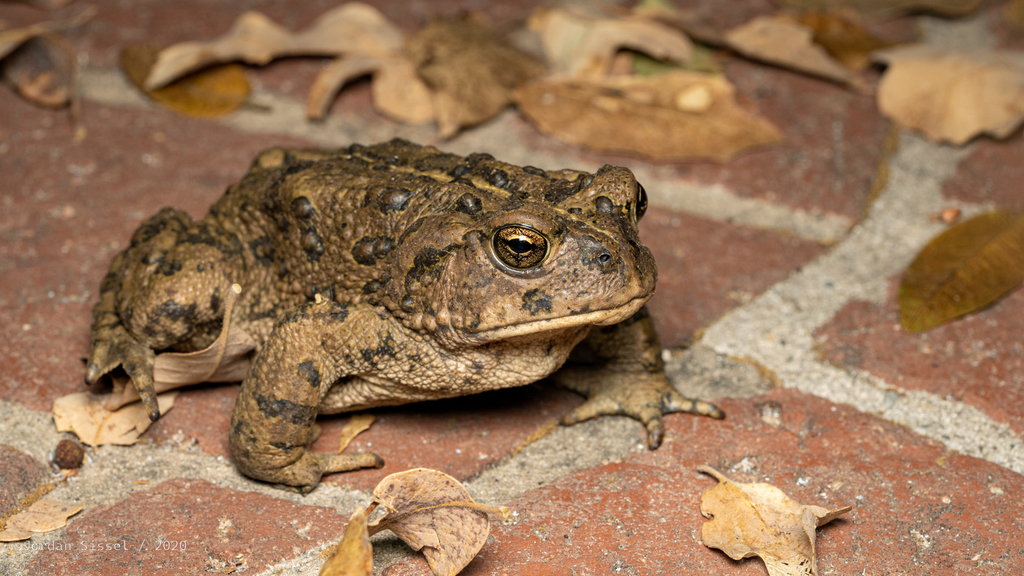
Western Toad
Anaxyrus boreas
The western toad (Anaxyrus boreas) is a large toad species, between 5.6 and 13 cm (2.2 and 5.1 in) long, native to western North America. A. boreas is frequently encountered during the wet season on roads, or near water at other times. It can jump a considerable distance for a toad. Breeding occurs between March and July in mountainous areas, and as early as January in lower-elevation regions. The female lays up to 17,000 eggs stuck together in strings that adhere to vegetation and other objects along water edges.
From the article Western toad on Wikipedia (CC BY-SA), quoted section by section
Description
It has a white or cream dorsal stripe, and is dusky gray or greenish dorsally with skin glands concentrated within the dark blotches. Its parotoid glands are oval, widely separated, and larger than the upper eyelids. It has a mottled venter and horizontal pupils but lacks cranial crests. Compared to females, males have smoother skin, reduced dorsal blotching, and nuptial pads (thickened skin) on their forefeet during breeding season. In juveniles of this species, the dorsal stripe is weak or absent. Large young have prominent dorsal and ventral spotting and yellow feet.
Range & habitat
The range of the western toad extends from western British Columbia and southern Alaska south through Washington, Oregon, and Idaho to northern Baja California, Mexico; east to Montana, western and central Wyoming, Nevada, the mountains and higher plateaus of Utah, and western Colorado. Sightings of the boreal toad in Yukon Territory, the Northwest Territories, and northwestern and north-central British Columbia have been reported. Southern records of boreal toads in New Mexico have been published, but the species is considered extirpated from the state, with a reintroduction in progress.
Wikipedia: “Distribution”
What it does
Western toads are active from January to October, depending on latitude and elevation, and hibernate over the winter. Boreal toads in one Colorado population used natural chambers near a small stream bed for hibernation. The high water table, constantly flowing stream, and deep winter snow served to maintain the air temperature within the hibernaculum at a point slightly above freezing. Emergence from hibernation followed a few days of warm temperatures that freed the entrance and increased temperatures within the chamber to about 39.2 °F (4.0 °C). At low elevations western toads are active at night; at high elevations and in the northern parts of their range they are diurnal. Body temperature of western toads is closely correlated with the substrate temperature. Basking and conduction from the substrate are primary means of increasing body temperature and cooling is achieved by evaporative cooling and conduction of heat to a cooler medium. Diurnal and nocturnal activity are often related to seasonal changes in temperature; most western toads are diurnal during the spring and fall but are nocturnal during the warmer summer months. In central Oregon, the minimum breeding age for male western toads is three years, and probably four or five years for females. California toads are reported as sexually mature at two years of age. …
Wikipedia: “Life cycle”
At the table
Western toads wait for their prey on the surface of the ground or in shallow burrows dug by other animals. Their diet consists largely of bees, beetles, ants, and arachnids. Other foods include crayfish, sow bugs, grasshoppers, trichopterans, lepidopterans, and dipterans.
Wikipedia: “Food habits”
Listen
Looking for field recordings…
Where it lives
Recorded sightings
—
geo-referenced records in GBIF, from museums, herbaria and field observers.
Drag the globe to turn it. Dots are where records exist, not a range map; darker means more records.
In the stacks
Searching the stacks…
Every page naming Anaxyrus boreas in the Biodiversity Heritage Library →
This page is assembled live from iNaturalist, GBIF, Wikipedia, the Source Library and the Internet Archive. It is not yet part of the hand-edited codex. iNaturalist taxon 64970.