- Plants
- ›Vascular Plants
- ›flowering plants
- ›Dicots
- ›Roses, Elms, Figs, and Allies
- ›rose family
- ›Amygdaloideae
- ›Amygdaleae
- ›Prunus
- ›Prunus
- ›Prunocerasus
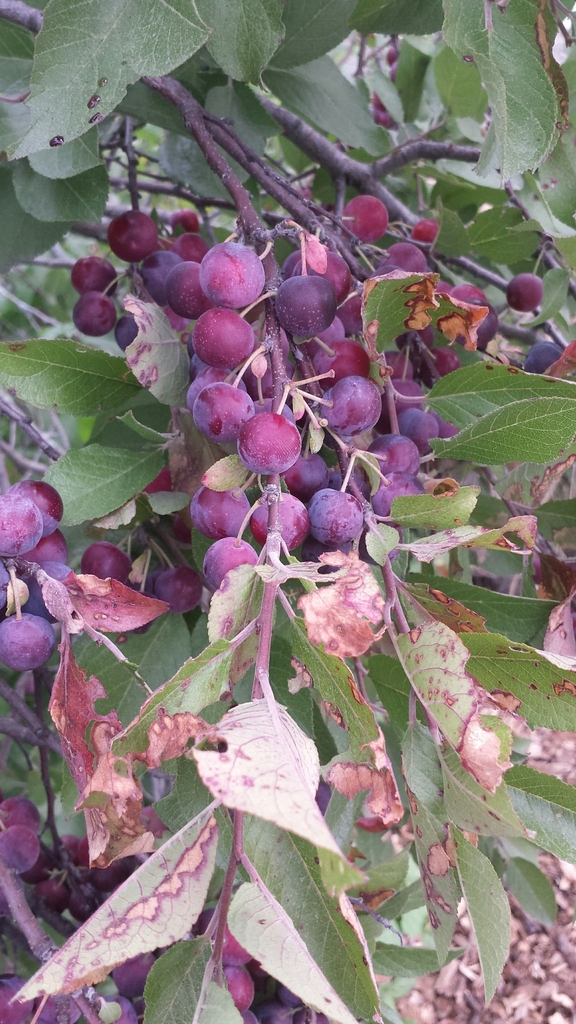
Beach Plum
Prunus maritima
Prunus maritima, the beach plum, is a species of plum native to the East Coast of the United States, from Maine south to Maryland. Although sometimes listed as extending to New Brunswick, the species is not known from collections there, and does not appear in the most authoritative works on the flora of that Canadian province.
From the article Prunus maritima on Wikipedia (CC BY-SA), quoted section by section
Description
Prunus maritima is a deciduous shrub, in its natural sand dune habitat growing 1–2 meters (3+1⁄2–6+1⁄2 feet) tall, although it can grow larger, up to 4 m (13 ft) tall. The leaves are alternate, elliptical, 3–7 centimeters (1+1⁄4–2+3⁄4 inches) long and 2–4 cm (3⁄4–1+1⁄2 in) broad, with a sharply toothed margin. They are green on top and pale below, becoming showy red or orange in the autumn. Blooming from mid-May to June, the flowers are 1–1.5 cm (3⁄8–5⁄8 in) in diameter, with five white petals and large yellow anthers. Ripening from August to early September, the fruit is a drupe, 1.5–2 cm (5⁄8–3⁄4 in) in diameter in the wild plant, and colored red, yellow, blue, or nearly black.
Range & habitat
The species can be found from Maine south to Maryland. Although sometimes listed as extending north to Canada's New Brunswick, the species is not known from collections there and does not appear in the most authoritative works on the flora of that province. The plant is salt tolerant and cold hardy. It prefers the full sun and well-drained soil. It spreads roots by putting out suckers but in coarse soil puts down a taproot. In dunes it is often partly buried in drifting sand.
Wikipedia: “Distribution and habitat”
At the table
The species is grown commercially for fruit and value-added products like jam. Taste of ripe fruit is prevailingly sweet, though individual bushes range in flavor and some are sour or slightly bitter. About the size of grapes, beach plums are much smaller in size when compared to the longer cultivated Asian varieties found in the supermarket, though are resilient to many North American stone fruit pests, such as black knot fungus. A number of cultivars have been selected for larger and better-flavored fruit, including Resigno, Jersey Gem (Rutgers), ECOS, Eastham, Hancock and Squibnocket. Natali Vineyards in Goshen, New Jersey, produces a wine from beach plums. Greenhook Ginsmiths in Greenpoint, Brooklyn, New York, makes a gin flavored with beach plums. Fresh and dried, beach plums were used extensively by Native Americans and eventually colonists. The beach plum is experiencing a revival in popularity with the resurgence of foraging, the local food movement, the La Croix flavor, and the prominence of native species selection in permaculture design.
Wikipedia: “Uses”
In human culture
Places named after the beach plum include Plum Island, Massachusetts, Plum Island, New York, Plum Cove Beach in Lanesville, Gloucester, Massachusetts, and Beach Plum Island State Park in Sussex County, Delaware.
Wikipedia: “In culture”
Where it lives
Recorded sightings
—
geo-referenced records in GBIF, from museums, herbaria and field observers.
Drag the globe to turn it. Dots are where records exist, not a range map; darker means more records.
In the stacks
Searching the stacks…
Every page naming Prunus maritima in the Biodiversity Heritage Library →
This page is assembled live from iNaturalist, GBIF, Wikipedia, the Source Library and the Internet Archive. It is not yet part of the hand-edited codex. iNaturalist taxon 64543.