- Plants
- ›Vascular Plants
- ›flowering plants
- ›Dicots
- ›Gentians, Dogbanes, Madders, and Allies
- ›madder family
- ›Ixoroideae
- ›Coffeeae
- ›Coffea
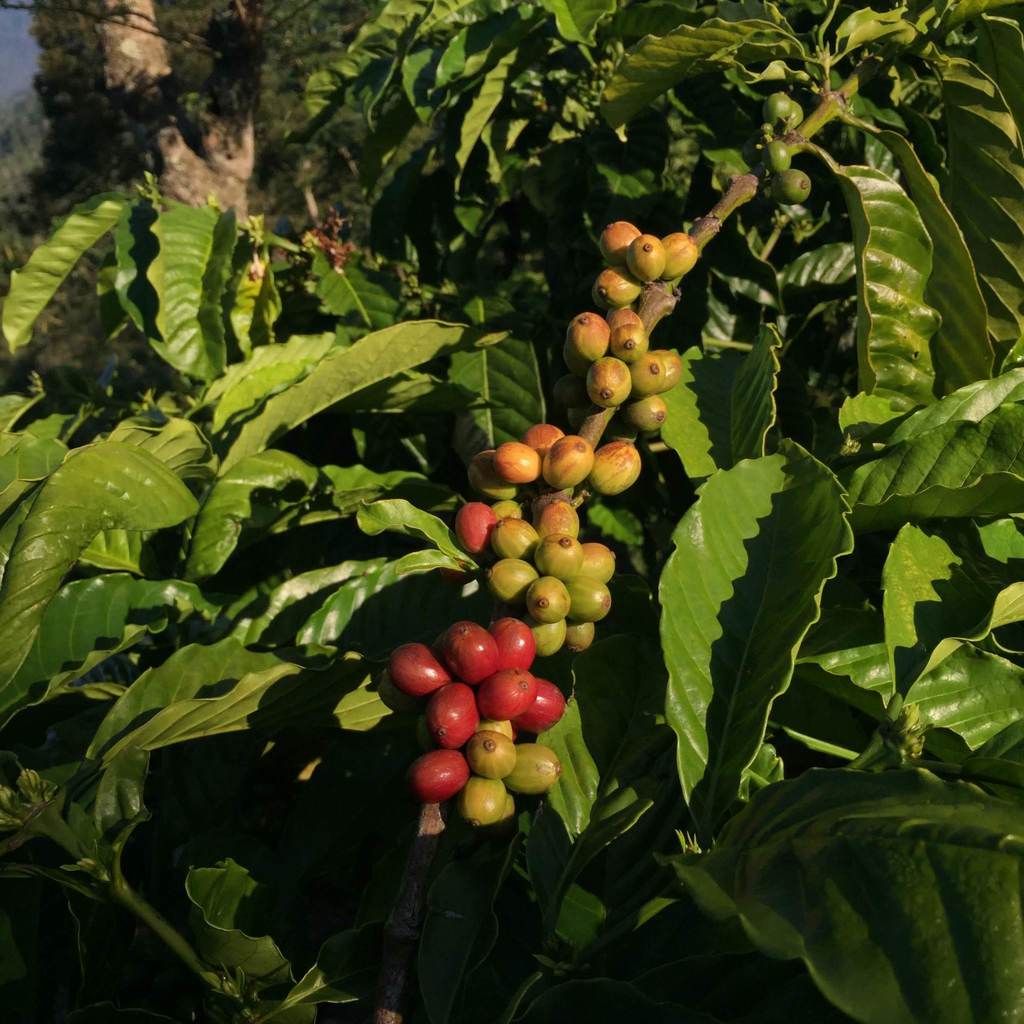
Robusta Coffee
Coffea canephora
Coffea canephora (especially C. canephora subvar. robusta, syn. Coffea robusta, or commonly robusta coffee) is a species of coffee plant that has its origins in central and western sub-Saharan Africa. It is a species of flowering plant in the family Rubiaceae. Though widely known as Coffea robusta, the plant is scientifically identified as Coffea canephora, which has two main varieties, robusta and nganda (nom. illeg.).
Coffea canephora represents around 45% of global coffee production, with Coffea arabica constituting most of the remainder. There are several differences between the composition of coffee beans from C. arabica and C. canephora. Beans from C. canephora tend to have lower acidity, more bitterness, and a more woody and less fruity flavor compared to C. arabica beans. Most of it is used for instant coffee.
From the article Coffea canephora on Wikipedia (CC BY-SA), quoted section by section
Description
Robusta is a species of flowering plant in the family Rubiaceae. The plant has a shallow root system and grows as a robust tree or shrub to about 10 metres (30 feet) tall. It flowers irregularly, taking about 10–11 months for the berries to ripen, producing oval-shaped beans. C.canephora contains a range of bioactive compounds including caffeine, and polyphenols, which both contribute to its physiological and ecological functions. The robusta plant has a greater crop yield than that of arabica, contains more caffeine (2.7% compared to arabica's 1.5%), and contains less sugar (3–7% compared to arabica's 6–9%). As it is less susceptible to pests and disease, robusta needs much less herbicide and pesticide than arabica. C.canephora exhibits substantial genetic and morphological diversity across its cultivated and wild populations.
Range & habitat
C. canephora grows indigenously in Western and Central Africa from Liberia to Tanzania and south to Angola.
Wikipedia: “Native distribution”
How it is grown
Robusta has its origins in central and western sub-Saharan Africa. It is easy to care for, has a greater crop yield, has almost double the amount of caffeine and more antioxidants, and is less susceptible to disease than arabica coffea. It represents 46% of global coffee production, with arabica constituting the remainder except for the 1.5% constituted by Coffea liberica. Microbial communities associated with C. canephora roots and fruits can influence plant health and its overall productivity. It is mostly grown in Vietnam, where French colonists introduced it in the late 19th century, though it is also grown in India, Africa, and in Brazil, where the conilon variety is widely grown. In recent years, Vietnam, which produces mostly robusta, has become the world's largest exporter of robusta coffee, accounting for over 40% of the total production. It surpasses Brazil (25% of the world's production), Indonesia (13%), India (5%), and Uganda (5%). Brazil is still the biggest coffee producer in the world, producing one-third of the world's coffee, though 69% of that is C. arabica. The species demonstrates high adaptability to diverse environmental conditions, partly due to its ability to change its behaviour and morphology. Since Robusta is easier to care for and has a greater crop yield than C. arabica, it is cheaper to produce. …
Wikipedia: “Cultivation and use”
Where it lives
Recorded sightings
—
geo-referenced records in GBIF, from museums, herbaria and field observers.
Drag the globe to turn it. Dots are where records exist, not a range map; darker means more records.
In the stacks
Searching the stacks…
Every page naming Coffea canephora in the Biodiversity Heritage Library →
This page is assembled live from iNaturalist, GBIF, Wikipedia, the Source Library and the Internet Archive. It is not yet part of the hand-edited codex. iNaturalist taxon 64345.