- Plants
- ›Vascular Plants
- ›conifers
- ›conifers
- ›cypress family
- ›Cypresses, Cedars, Junipers, and Allies
- ›Cupressus
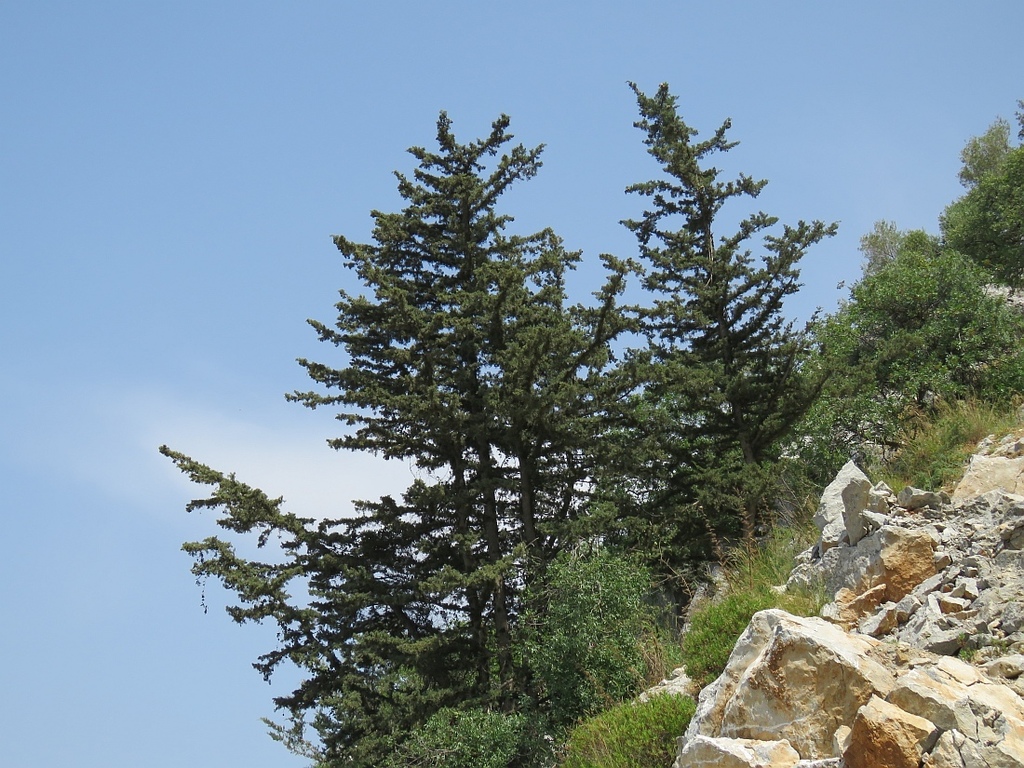
Mediterranean cypress
Cupressus sempervirens
Cupressus sempervirens, the Mediterranean cypress, Italian cypress, Tuscan cypress, or Persian cypress, is a species of conifer in the family Cupressaceae, a cypress native to the eastern Mediterranean region and Iran. It is widespread throughout the Mediterranean basin and has become endemic in similar dry summer climates due to its ability to survive in both acidic and alkaline soils and withstand drought.
Cupressus sempervirens is important in Mediterranean and Middle Eastern culture; it has long been valued for its role in symbolism, various rituals, and folk medicine. In Iran it is both a sacred tree and a metaphor for "the graceful figure of the beloved". It is popular around the world as an ornamental tree and has been studied for possible medicinal properties.
From the article Cupressus sempervirens on Wikipedia (CC BY-SA), quoted section by section
Description
Cupressus sempervirens is a medium-sized coniferous tree growing up to 35 m (115 ft) tall, with a conic crown with level branches and variably loosely hanging branchlets. It is very long-lived, with some trees reported to be over 1,000 years old. Cupressis sempervirens produces lateral shoots, or branches, which often grow upwards towards a light source. The foliage grows in dense, dark green sprays. The leaves are scale-like, 2–5 mm long, and produced on rounded (not flattened) shoots. The seed cones are ovoid or oblong and 25–40 mm long. The cones have 10–14 scales, which are green at first and mature to brown about 20–24 months after pollination. The male cones are 3–5 mm long and release highly allergenic pollen in late winter. The cones of C. sempervirens can withstand years of being sealed and are known to perform serotiny. The tree is moderately susceptible to cypress canker, caused by the fungus Seiridium cardinale, and can suffer extensive dieback where this disease is common. The species name sempervirens comes from the Latin for 'evergreen'.
Range & habitat
Cupressus sempervirens grows primarily in places with wet winters and hot summers; in the spring and autumn, the tree grows out its roots, stems, and leaves. Like most plants, it requires light for such growth. Because the tree must survive wet winters and hot, dry summers, its roots are adapted to be stout and shallow for easier gathering of the nutrients in the soil. The roots are adapted to function in both acidic and alkaline soils.
Wikipedia: “Habitats”
At the table
C. sempervirens has been widely cultivated as an ornamental tree for millennia outside its native range, mainly throughout the Mediterranean region and in other areas with similar hot, dry summers and mild, rainy winters, including California, southwest South Africa, and southern Australia. It can also be grown successfully in areas with cooler, moister summers, such as the British Isles, New Zealand, and the Pacific Northwest, as well as in humid, subtropical environments such as the coastal southern United States. In some areas, particularly the United States, it is known as "Italian" or "Tuscan cypress". Within its native range, C. sempervirens has historically been planted in gardens and cemeteries and used as a windbreak alongside roads. The tree can also prevent damage to land caused by violent weather.
The vast majority of the trees in cultivation are selected cultivars with a fastigiate crown, with erect branches forming a narrow to very narrow crown often less than a tenth as wide as the tree is tall. The dark green "exclamation mark" shape of these trees is a highly characteristic signature of Mediterranean landscapes. A 2009 investigation discovered two new species of fungi on the tree, including Phaeobotryon cupressi.
Fire resistance. Unlike many Cupressus species, C. sempervirens has low resin content, and does not readily catch or spread fire. …
Wikipedia: “Uses”
In human culture
In classical antiquity, the cypress was a symbol of mourning, and in the modern era, it remains the principal cemetery tree in both the Muslim world and Europe. This afterlife association also exists within the Jewish tradition, and since the tree approximates the shape of a candle, a representation of the soul in both Judaism and Islam, it is also common in cemeteries of both faiths in Israel. In the classical tradition, the cypress was associated with death and the underworld because it failed to regenerate when cut back too severely. Athenian households in mourning were garlanded with boughs of cypress. Cypress was used to fumigate the air during cremations. It was among the plants that were suitable for making wreaths to adorn statues of Pluto, the classical ruler of the underworld. This afterlife association also exists within both. the Jewish and Moslem traditions, since the tree approximates the shape of a candle, a representation of the soul in both faiths. However, the tree had opposing symbolism in some other cultures, where it was seen as a mark of tenacity and long life. The poet Ovid, who wrote during the reign of Augustus, records the best-known myth that explains the association of the cypress with grief. The handsome boy Cyparissus, a favourite of Apollo, accidentally killed a beloved tame stag. …
Wikipedia: “Symbolism”
Where it lives
Recorded sightings
—
geo-referenced records in GBIF, from museums, herbaria and field observers.
Drag the globe to turn it. Dots are where records exist, not a range map; darker means more records.
In the old herbals & bestiaries

In the stacks
Searching the stacks…
Every page naming Cupressus sempervirens in the Biodiversity Heritage Library →
This page is assembled live from iNaturalist, GBIF, Wikipedia, the Source Library and the Internet Archive. It is not yet part of the hand-edited codex. iNaturalist taxon 64261.