- Plants
- ›Vascular Plants
- ›flowering plants
- ›monocots
- ›grasses, sedges, cattails, and allies
- ›grasses
- ›Oatgrasses, Pampasgrasses, and allies
- ›Oatgrasses, Pampasgrasses, and allies
- ›Cortaderia
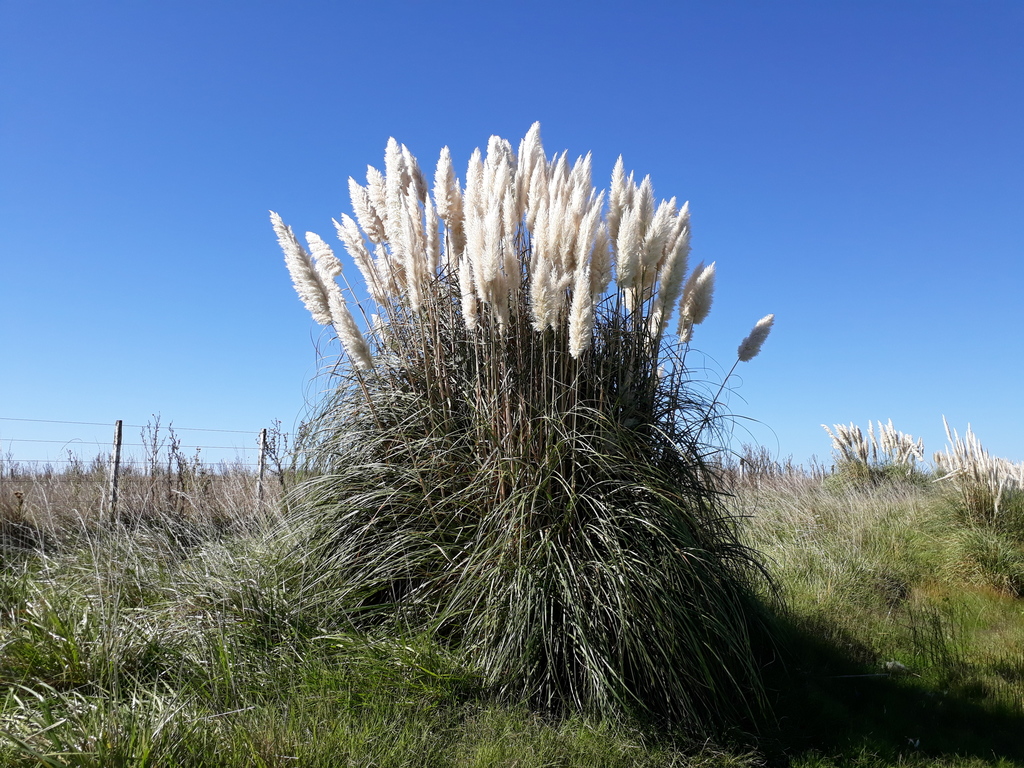
Pampas Grass
Cortaderia selloana
Cortaderia selloana is a species of flowering plant in the family Poaceae. It is referred to by the common name pampas grass, and is native to southern South America, including the Pampas region after which it is named. It is widely distributed throughout the world as a cultivated ornamental and invasive species.
From the article Cortaderia selloana on Wikipedia (CC BY-SA), quoted section by section
What it does
The native range of C. selloana includes Argentina, Bolivia, Brazil, Chile, Paraguay, and Uruguay. This region is dominated by subtropical forests and grasslands, but C. selloana is typically restricted to moist soil within riparian areas. It is found at lower elevations and at moister sites than the closely related C. jubata. It requires areas with plentiful light and soil moisture. It is a common invasive species in temperate regions around the world, where it can be found growing in moist, disturbed soil.
Control. Pampas grass can be controlled through herbicide treatment. To accomplish this, the grass is cut down near the base. Next, a 2% glyphosate chemical solution is combined with a silicone-based surfactant and applied to enhance the penetration potential. This method works best in the fall because there is overall better control compared to other seasons. Another control method is to cut and bag inflorescences to prevent seeds from spreading or pulling seedlings.
Wikipedia: “Ecology”
How it is grown
Several cultivars are available, of which the following have gained the Royal Horticultural Society's Award of Garden Merit:
Aureolineata Evita Monstrosa Patagonia Pumila Silver Feather Notcort Sunningdale Silver—grows to a height of 4 m (13.1 ft) and has particularly dense flowering plumes
Wikipedia: “Cultivation”
In human culture
Cortaderia is derived from the Argentine Spanish name cortadera, meaning 'cutter', in reference to its razor-sharp leaf margins. Selloana is named for Friedrich Sellow (1789–1831), a German botanist and naturalist from Potsdam who worked as a plant collector in Brazil. He studied the flora of South America, especially that of Brazil. The specific epithet selloana was given by Josef August and Julius Hermann Schultes in 1827.
Wikipedia: “Etymology”
Where it lives
Recorded sightings
—
geo-referenced records in GBIF, from museums, herbaria and field observers.
Drag the globe to turn it. Dots are where records exist, not a range map; darker means more records.
In the stacks
Searching the stacks…
Every page naming Cortaderia selloana in the Biodiversity Heritage Library →
This page is assembled live from iNaturalist, GBIF, Wikipedia, the Source Library and the Internet Archive. It is not yet part of the hand-edited codex. iNaturalist taxon 64240.