- Plants
- ›Vascular Plants
- ›flowering plants
- ›Dicots
- ›pinks, cactuses, and allies
- ›Pussypaw Family
- ›Claytonia
- ›Limnia
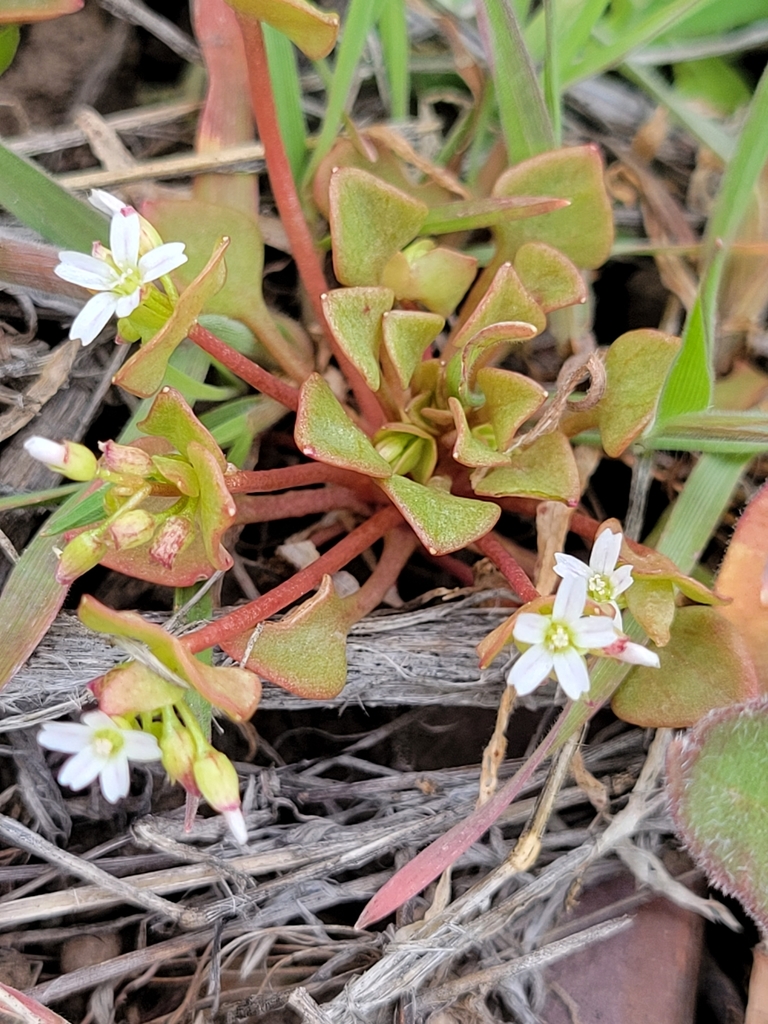
Redstem Springbeauty
Claytonia rubra
Claytonia rubra is a species of wildflower in the springbeauty family known by the common names redstem springbeauty and red miner's lettuce. It is native to western North America from southwestern Canada to the United States of America extending from The Black Hills and western slopes of the Rocky Mountains to the Cascade and Coast Range, Ochoco and Wallowa Mountains south to the Warner Mountains, Yolla Bolly Mountains, and Sierra Nevada and Transverse Ranges [Mt. Pinos and Mt. San Gorgonio], where it is found in coniferous forests and shrublands.
From the article Claytonia rubra on Wikipedia (CC BY-SA), quoted section by section
Description
Claytonia rubra is usually a spring annual or occasionally biennial plant that overwinters. Overwintering plants will have an extremely small tuber. Its stems can be 1 to 20 centimeters long. All the plant's basal leaves, those growing directly from the base of the plant, are attached by tapering petioles, leaf stems. They form a rosette that lays flat to the ground or occasionally is somewhat erect. The stems and leaf blades can be green, pink, or a strong beet-red and are usually 12 to 48 in number, but occasionally as few as two or with more than 48 leaves in overwintering plants. The shape of the leaves varies from narrowly rhombic to ovate, diamond shaped attached at one of the narrow angles to shaped like an egg with the wider portion at the base. Though they can also be spatulate, spoon shaped, or trullate, shaped like a mason's trowel. They measure 0.2–2 centimeters long by 0.2–2.5 cm wide. There are also leaves on the flowering stems which may be rounded or squared and sometimes fuse together to create a bowl around the stem with a diameter of 0.5–10 centimeters. All the leaves possess blunt (obtuse) tips according to published descriptions and taxonomic treatments. Each inflorescence has a single bract that is leaflike and measures 0.3–8 millimeters long. The flowers are very small, just 2–5 mm in diameter with petals that are 2–3 mm. …
Range & habitat
Redstem springbeauty grows in many parts of the western United States and into the province of British Columbia in western Canada. In British Columbia it is found in the Okanogan Region and on Vancouver Island. Its native range includes most of Washington and Oregon on both sides of the Cascade Range, but more commonly east of the range. The species grows in all the mountainous part of California including the North Coast, the Klamath Ranges, the north and south Coast Ranges, in the Sierra Nevada, the Transverse Ranges, and even in the Warner Mountains and the White Mountains. The southernmost known population is on Mount Pinos in California. To the east in Nevada, redstem springbeauty is found in many of the state's mountain ranges including Pine Forest, the Ruby Mountains, Santa Rosa, East Humboldt, Wild Horse, Monitor, Wassuk, and the Independence Mountains. Likewise it has been reported from most parts of Idaho, but mostly in the western portions of Montana and a few widespread locations in Wyoming. In Utah it is found in mountainous areas including the Canyon Mountains, the Pahvant Range, the Pine Valley Mountains, the Tushar Mountains, and the Wasatch Range. It also grows in the Black Hills of South Dakota. In Colorado it is only known from three Front Range counties, Douglas, Jefferson, and Boulder.
Wikipedia: “Range and habitat”
What it does
Redstem springbeauty shows a preference for a particular elevation with fewer plants emerging and smaller sizes when planted at different elevations in experiments.
Wikipedia: “Ecology”
Where it lives
Recorded sightings
—
geo-referenced records in GBIF, from museums, herbaria and field observers.
Drag the globe to turn it. Dots are where records exist, not a range map; darker means more records.
In the stacks
Searching the stacks…
Every page naming Claytonia rubra in the Biodiversity Heritage Library →
This page is assembled live from iNaturalist, GBIF, Wikipedia, the Source Library and the Internet Archive. It is not yet part of the hand-edited codex. iNaturalist taxon 64184.