- Animals
- ›Molluscs
- ›Bivalves
- ›Autobranchia
- ›Heteroconchia
- ›Euheterodonta
- ›Imparidentia
- ›Venerids
- ›Cyrenoidea
- ›Basket Clams
- ›Corbicula
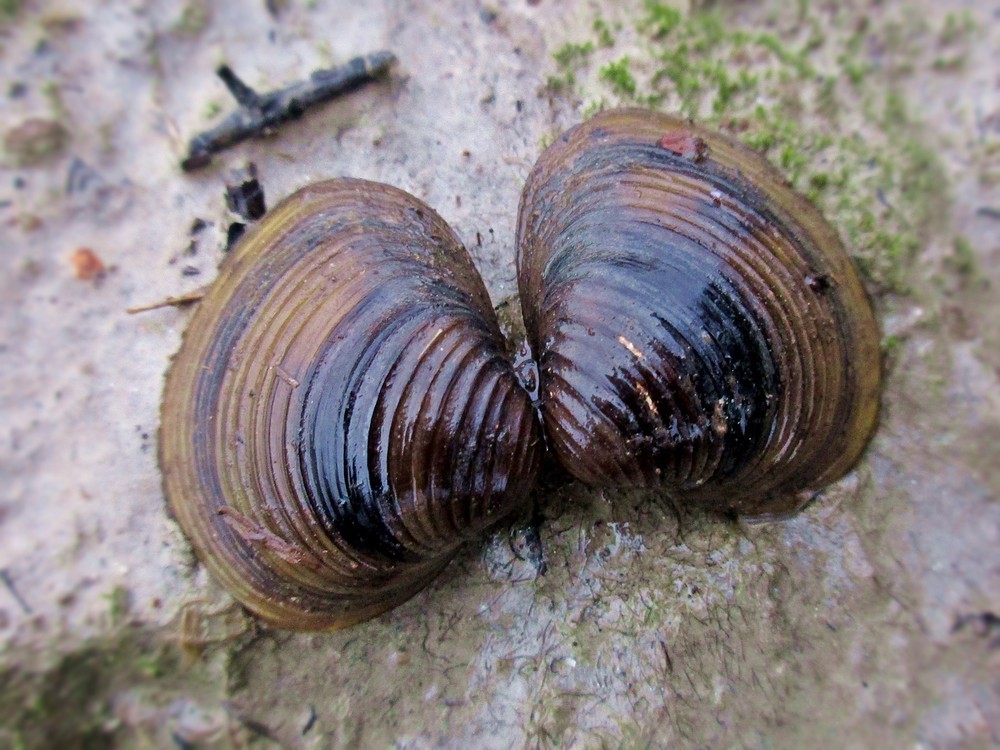
Asian Clam
Corbicula fluminea
Corbicula fluminea is a species of freshwater clam native to eastern Asia which has become a successful invasive species throughout the world, including North America, South America, Europe, and New Zealand. It is native to freshwater environments of Eastern Asia, including Russia, Thailand, Cambodia, the Philippines, China, Taiwan, Korea, and Japan. C. fluminea also occurs naturally in freshwater environments of Africa. Corbicula fluminea is commonly known in the west as the Asian clam, Asiatic clam, or Asian gold clam. In Southeast Asia, C. fluminea is known as the golden clam, prosperity clam, pygmy clam, or good luck clam. In New Zealand, it is commonly referred as the freshwater gold clam.
From the article Corbicula fluminea on Wikipedia (CC BY-SA), quoted section by section
Range & habitat
Studies on which abiotic habitat characteristics are most strongly associated with Asian clam population abundance have produced varying results. Brazilian habitats have been found to have support the largest abundances of invasive Corbicula spp. in areas with coarser dominant sediment fractions, while negatively correlated with increasing levels of organic matter. Other studies have shown abiotic habitat characteristics such as water redox potential, inorganic nutrient content, hardness, and organic matter content in tandem with the amount of very coarse sand combine to explain 59.3% of Corbicula population habitat association via statistical tests. Asian clam invasions seem to be limited by elevation (88% of the invaded range is below 500m elevation), latitude (90% lies between latitudes 30°and 55°) as well as the minimum winter temperature (−10 °C (14 °F)) of the ecosystem. In 2001 it was identified in Puerto Rico from a collected specimen back in 1998, 18° of latitude.
Wikipedia: “Habitat association”
What it does
Right after reaching maturity, these clams produce eggs, followed by sperm. Throughout adult life, Corbicula is a self-fertile simultaneous hermaphrodite which can broadcast spawn up to 570 mucoid larvae per day per individual, and more than 68,000 per year per individual. Larvae are ~200 microns in length when discharged from an adult and dispersed through water until becoming sessile adults. Adults can reach a length of about 5 centimetres (2.0 in).
Wikipedia: “Life cycle”
In human culture
Corbicula fluminea enjoys several physiological capabilities which are advantageous in promoting its invasion of novel lentic/lotic environments including:
Rapid individual growth rate Short time to reach sexual maturity Short lifespan paired with high fecundity Fast rate of water filtration for suspension feeding Ability to broadcast gametes over a broad area by utilizing water flow (in rivers) Tolerance of a wide variety of substrate/habitat types Corbicula fluminea is a self-fertilizing, simultaneous hermaphrodite which can asexually produce internally-brooded, semi-buoyant planktonic larvae when spermiogenesis is induced at temperatures above 10 °C (50 °F). This allows C. fluminea to colonize novel habitats at an advanced rate.
Wikipedia: “Life history advantages”
Where it lives
Recorded sightings
—
geo-referenced records in GBIF, from museums, herbaria and field observers.
Drag the globe to turn it. Dots are where records exist, not a range map; darker means more records.
In the stacks
Searching the stacks…
Every page naming Corbicula fluminea in the Biodiversity Heritage Library →
This page is assembled live from iNaturalist, GBIF, Wikipedia, the Source Library and the Internet Archive. It is not yet part of the hand-edited codex. iNaturalist taxon 64006.