
Bivalves
Bivalvia
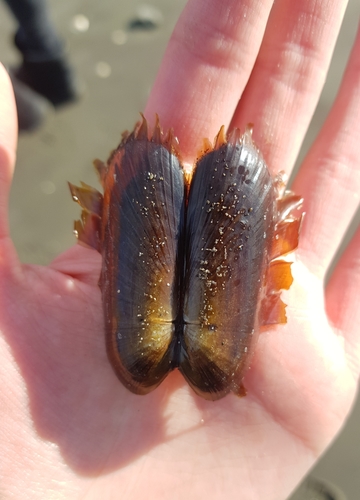
Bivalvia () or bivalves, in previous centuries referred to as the Lamellibranchiata and Pelecypoda, is a class of aquatic molluscs (marine and freshwater) that have laterally compressed soft bodies enclosed by a calcified exoskeleton consisting of a hinged pair of half-shells known as valves. As a group, bivalves have no head and lack some typical molluscan organs such as the radula and the odontophore. Their gills have evolved into ctenidia, specialised organs for feeding and breathing.
Common bivalves include clams, oysters, cockles, mussels, scallops, and numerous other families that live in saltwater, as well as a number of families that live in freshwater. Majority of the class are benthic filter feeders that bury themselves in sediment, where they are relatively safe from predation. Others lie on the sea floor or attach themselves to rocks or other hard surfaces. Some bivalves, such as scallops and file shells, can swim. Shipworms bore into wood, clay, or stone and live inside these substances.
2 branches of this class, most-observed first
See this branch on the Wheel of Life →
Where it lives
Recorded sightings
—
geo-referenced records in GBIF, from museums, herbaria and field observers.
Drag the globe to turn it. Dots are where records exist, not a range map; darker means more records.
In the stacks
Searching the stacks…
Every page naming Bivalvia in the Biodiversity Heritage Library →
This page is assembled live from iNaturalist, GBIF, Wikipedia, the Source Library and the Internet Archive. It is not yet part of the hand-edited codex. iNaturalist taxon 47584.