- Plants
- ›Vascular Plants
- ›flowering plants
- ›Dicots
- ›Buttercups, Poppies, and Allies
- ›buttercup family
- ›Anemones, buttercups, larkspurs and allies
- ›anemones and allies
- ›Hepatica
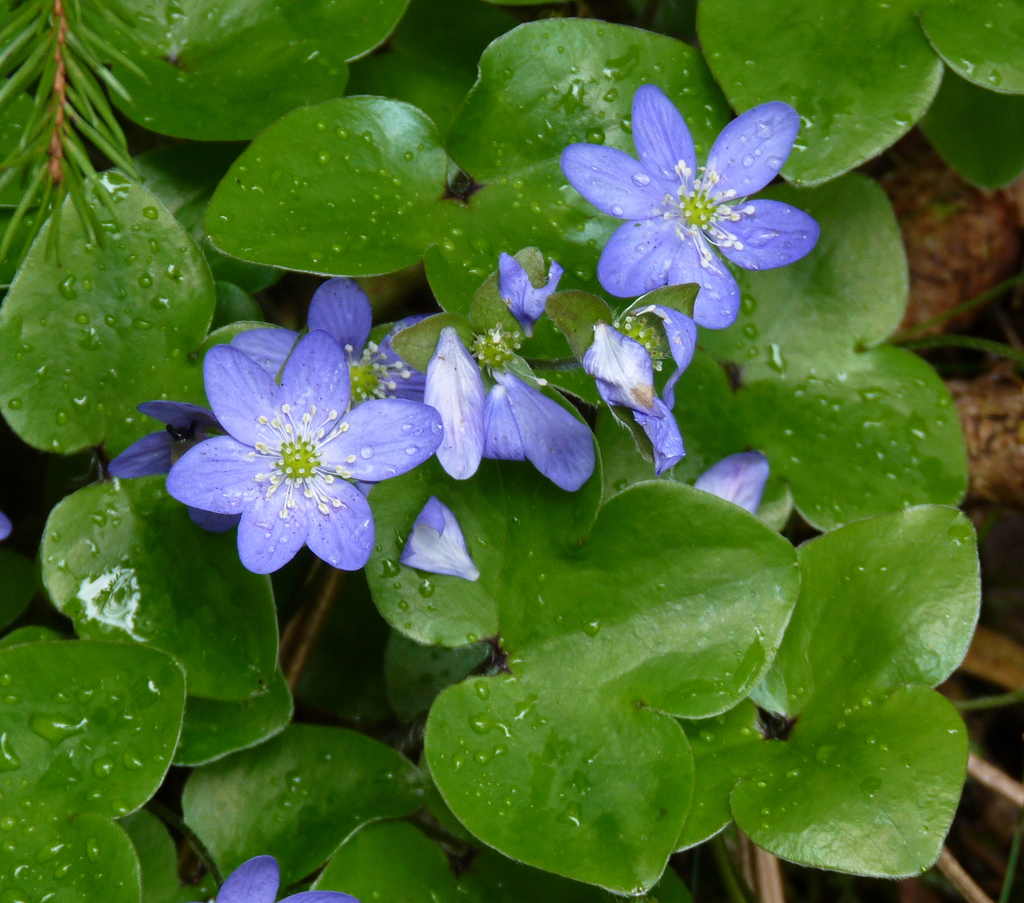
Liverleaf
Hepatica nobilis
Hepatica nobilis, liverleaf, is a species of flowering plant, a herbaceous perennial in the buttercup family Ranunculaceae. It is native to the eastern United States and to central and eastern Canada. It is a small plant growing to 10 cm (3.9 in) tall and broad, with bright blue flowers strongly resembling anemones, in early spring.
From the article Anemone hepatica on Wikipedia (CC BY-SA), quoted section by section
Description
Anemone hepatica grows 5–15 cm (2–6 in) high. Leaves and flowers emerge directly from the rhizome, not from a stem above ground. The leaves have three lobes and are fleshy and hairless, 7–9 cm (2+3⁄4–3+1⁄2 in) wide and 5–6 cm (2–2+1⁄4 in) long. The upper side is dark green with whitish stripes and the lower side is violet or reddish brown. Leaves emerge during or after flowering and remain green through winter. The flowers are blue, purple, pink, or white and appear in winter or spring. They have five to ten oval showy sepals and three green bracts.
Range & habitat
It is found in woods, thickets and meadows, especially in the mountains of continental Europe, North America and Japan.
Wikipedia: “Distribution and habitat”
What it does
Hepatica flowers produce pollen but no nectar. In North America, the flowers first attract Lasioglossum sweat bees and small carpenter bees looking in vain for nectar. Then when the stamens begin to release pollen, the bees return to collect and feed on pollen. Mining bees sometimes visit the flowers, but prefer flowers that produce both nectar and pollen.
Wikipedia: “Ecology”
At the table
Under the name Hepatica nobilis, which is regarded as a synonym, this plant has gained the Royal Horticultural Society's Award of Garden Merit.
Wikipedia: “Uses”
Toxicity
Like other Ranunculaceae, fresh liverwort contains protoanemonin and is therefore slightly toxic.
In human culture
It is since 2006 the official flower of the Sweden Democrats political party in Swedish politics. In Japan, where the plant is known as Yukiwariso (雪割草, yukiwarisō, lit. 'snow-breaking plant') or Misumisō (ミスミソウ), it has become popular as the subject of winter flower festivals in Tokyo and Niigata. The plant is also a common subject in Japanese artwork from the 19th century, which depicts cultivars with colours and petal shapes which are not believed to be extant in the present day; cultivation of the plant tailed off following the Meiji Restoration, regaining popularity in the 1970s with the discovery of several unique natural varieties near Niigata, leading to a renewed interest in developing liverleaf cultivars.
Wikipedia: “Culture”
Where it lives
Recorded sightings
—
geo-referenced records in GBIF, from museums, herbaria and field observers.
Drag the globe to turn it. Dots are where records exist, not a range map; darker means more records.
In the old herbals & bestiaries


In the stacks
Searching the stacks…
Every page naming Hepatica nobilis in the Biodiversity Heritage Library →
This page is assembled live from iNaturalist, GBIF, Wikipedia, the Source Library and the Internet Archive. It is not yet part of the hand-edited codex. iNaturalist taxon 639660.