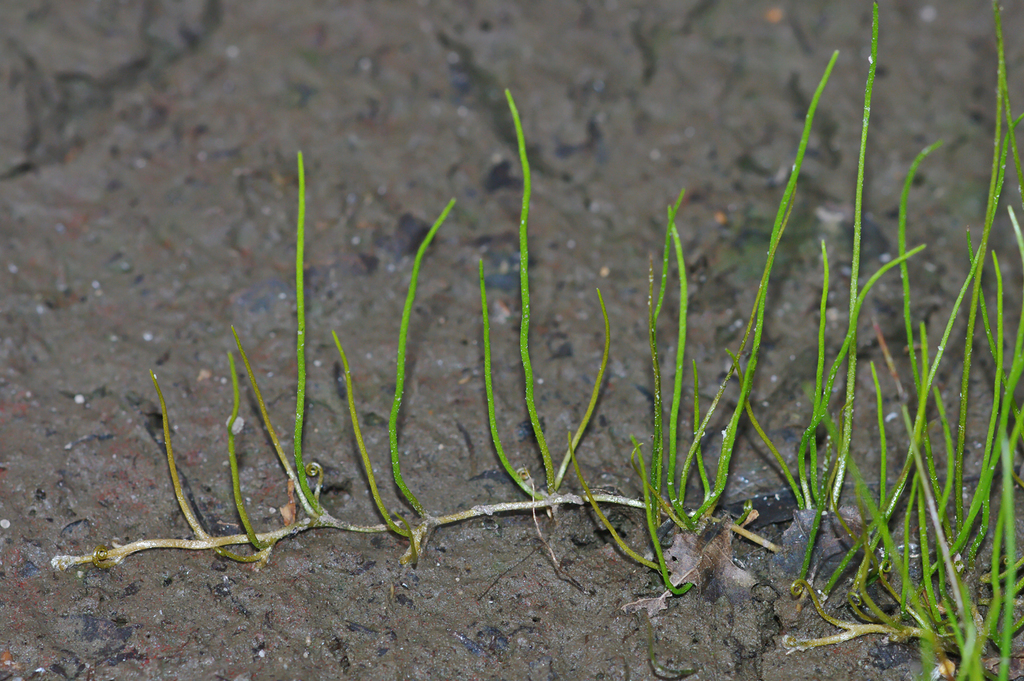
Pillwort
Pilularia globulifera
Pilularia globulifera, or pillwort, is an unusual species of fern native to western Europe, where it grows at edges of lakes, ponds, ditches and marshes, on wet clay or clay-sand soil, sometimes in water up to 30 cm (12 in) deep. It has a pea-shaped 4-chambered sporocarp, each chamber formed from a modified leaf and containing several sori bearing both macrosporangia and microsporangia. The species is thus heterosporous.
From the article Pilularia globulifera on Wikipedia (CC BY-SA), quoted section by section
Description
Pillwort has slender, cylindrical, rush-like fronds up to 8 cm (3.1 in) tall that are shaped like croziers as they unfurl. It has a pea-shaped, 4-chambered sporocarp about 3 mm (0.1 in) in diameter, each chamber formed from a modified leaf and containing several sori bearing both megasporangia and microsporangia. The species is thus heterosporous.
Range & habitat
Pillwort grows on silt and mud at the margins of lakes, ponds and other watercourses that are submerged for at least part of the year. Some of the plants growing in association with this species in the UK include water celery (Apium inundatum), marsh pennywort (Hydrocotyle vulgaris) and lesser spearwort (Ranunculus flammula). In its habitat in shallow water on pond margins or in poached wet grassland, it seems to grow well in bare locations where it faces little competition. Populations vary greatly from year to year; it sometimes "disappears" from a site only to recur there many years later, and cleaning out a ditch may stimulate it to reappear.
Wikipedia: “Habitat”
At the table
Pillwort can be grown in a "bog garden" or as a marginal aquatic in a garden pond.
== References ==
Wikipedia: “Uses”
Where it lives
Recorded sightings
—
geo-referenced records in GBIF, from museums, herbaria and field observers.
Drag the globe to turn it. Dots are where records exist, not a range map; darker means more records.
In the stacks
Searching the stacks…
Every page naming Pilularia globulifera in the Biodiversity Heritage Library →
This page is assembled live from iNaturalist, GBIF, Wikipedia, the Source Library and the Internet Archive. It is not yet part of the hand-edited codex. iNaturalist taxon 63840.