- Plants
- ›Vascular Plants
- ›flowering plants
- ›Dicots
- ›Roses, Elms, Figs, and Allies
- ›rose family
- ›Amygdaloideae
- ›Lyonothamneae
- ›Lyonothamnus
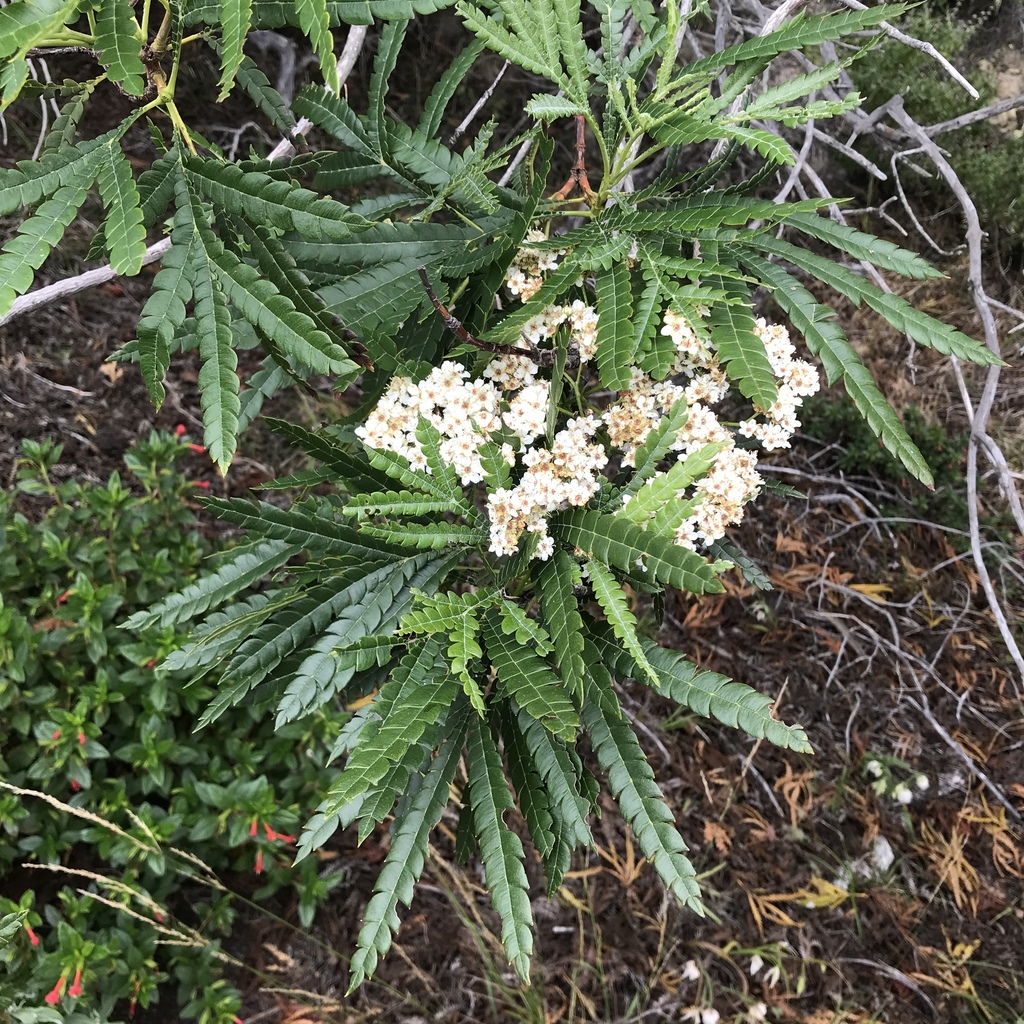
ironwood
Lyonothamnus floribundus
Lyonothamnus is a monotypic genus of trees in the rose family containing the single living species Lyonothamnus floribundus, which is known by the common name Channel Island ironwood, and the subspecies L. f. ssp. aspleniifolius and L. f. ssp. floribundus.
From the article Lyonothamnus on Wikipedia (CC BY-SA), quoted section by section
Description
Lyonothamnus is endemic to the Channel Islands of California, where it grows in the chaparral and oak woodlands of the rocky coastal canyons. This is a tree growing up to 15 metres (49 ft) tall with peeling reddish gray or brown bark. The evergreen leaves are shiny, dark green with lighter undersides, and borne on short petioles. The two subspecies have different leaf shapes. The inflorescence is a cluster of woolly white flowers with many short, whiskery stamens. The fruit is a pair of hard follicles. In natural populations on the islands the tree grows in distinct groves. Isozyme analysis has determined that each grove is a clonal colony in the landscape. Each ironwood clone, or genet, is a group of genetically identical individuals comprising a dozen to several hundred tree trunks, or ramets. Later studies with DNA (RAPD) analysis also found that the trees are clonal. Conservation Because island ironwoods are clonal there are fewer genetic individuals on each island. Isolated clones in the steep rugged terrain can influence cross pollination. Limited cross pollination may be a reason for low seed production/viability observed in natural populations on the island. Genetic integrity of each island’s population of Lyonothamnus floribundus is important. …
How it is grown
The Lyonothamnus ssp. aspleniifolius tree is grown in the horticulture nursery trade and used in landscape design; in drought tolerant, California native plants, traditional, and habitat-wildlife gardens; in public landscapes and private garden settings.
Wikipedia: “Cultivation”
Where it lives
Recorded sightings
—
geo-referenced records in GBIF, from museums, herbaria and field observers.
Drag the globe to turn it. Dots are where records exist, not a range map; darker means more records.
In the stacks
Searching the stacks…
Every page naming Lyonothamnus floribundus in the Biodiversity Heritage Library →
This page is assembled live from iNaturalist, GBIF, Wikipedia, the Source Library and the Internet Archive. It is not yet part of the hand-edited codex. iNaturalist taxon 63620.