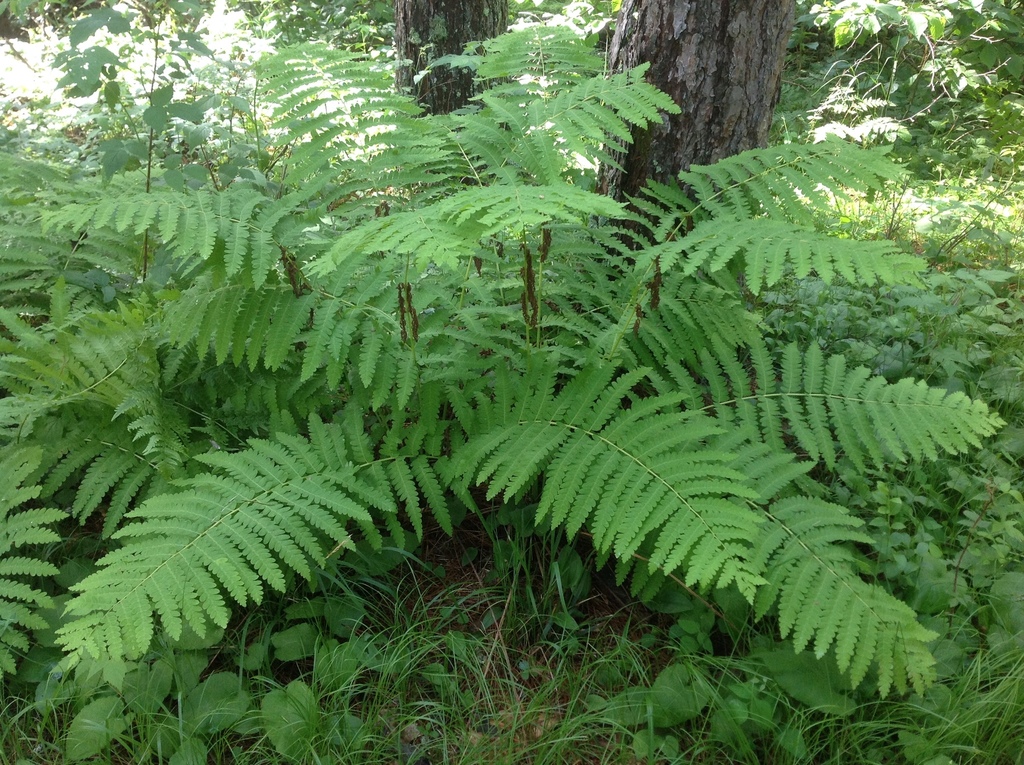
interrupted fern
Osmunda claytoniana
Claytosmunda is a genus of fern. It has only one extant species, Claytosmunda claytoniana (synonym Osmunda claytoniana), the interrupted fern, native to Eastern Asia, Eastern United States, and Eastern Canada.
The specific epithet is named after the English-born Virginian botanist John Clayton. "Interrupted" describes the gap in middle of the blade left by the fertile portions after they wither and eventually fall off.
From the article Claytosmunda on Wikipedia (CC BY-SA), quoted section by section
Description
Claytosmunda claytoniana fronds are bipinnate, 40–100 cm (16–39 in) tall and 20–30 cm (8–12 in) broad, the blade formed of alternate segments forming an arching blade tightening to a pointed end. The lower end is also slightly thinner than the rest of the frond because the first segments are shorter. Three to seven short, cinnamon-colored fertile segments are inserted in the middle of the length, giving the plant its name. In their absence, the plant in all its stages appears similar to Osmundastrum cinnamomeum (cinnamon fern). The base of the segments distinguishes the two species: where O. cinnamomeum has typical felt-like hairs, the few hairs present on C. claytoniana are extremely short, usually requiring a magnifying glass to see well. Like other species in the family Osmundaceae, it grows a very large rhizome, with persistent stipe bases from previous years. It forms small, dense colonies, spreading locally through its rhizome, and often forming fairy rings.
What it does
Claytosmunda claytoniana is found in humid zones, mostly in forests, but also in more open habitats and biomes, although rarely in bogs. The interrupted fern is often found alongside ostrich, cinnamon, and sensitive ferns.
Wikipedia: “Ecology”
In medicine
The Haudenosaunee used the plant as treatment for blood disorders and venereal diseases.
== References ==
Wikipedia: “Medicinal”
Where it lives
Recorded sightings
—
geo-referenced records in GBIF, from museums, herbaria and field observers.
Drag the globe to turn it. Dots are where records exist, not a range map; darker means more records.
In the stacks
Searching the stacks…
Every page naming Osmunda claytoniana in the Biodiversity Heritage Library →
This page is assembled live from iNaturalist, GBIF, Wikipedia, the Source Library and the Internet Archive. It is not yet part of the hand-edited codex. iNaturalist taxon 63058.