- Plants
- ›Vascular Plants
- ›flowering plants
- ›Dicots
- ›Mallows, Rock Roses, and Allies
- ›Mallow and Hibiscus Family
- ›Baobab subfamily
- ›Ochroma
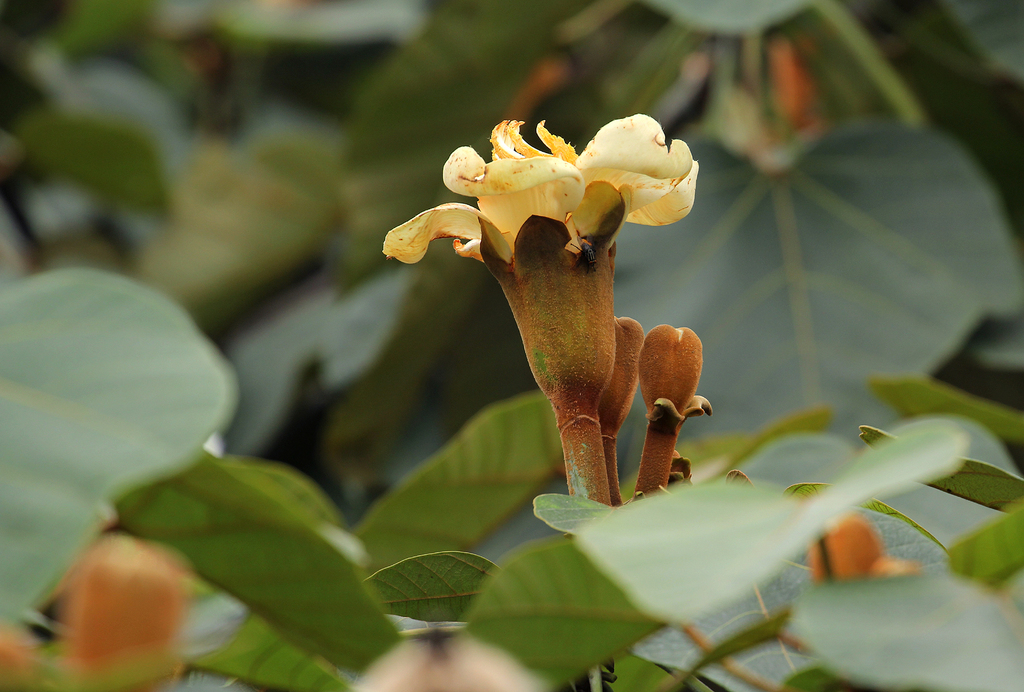
Balsa Tree
Ochroma pyramidale
Ochroma pyramidale, commonly known as balsa, is a large, fast-growing tree native to the Americas. It is the sole member of the genus Ochroma, and is classified in the subfamily Bombacoideae of the mallow family Malvaceae. The tree is famous for its wide usage in woodworking, due to its softness and its high strength compared to its low density. The name balsa is the Spanish word for "raft" and the Portuguese word for ferry.
A deciduous angiosperm, Ochroma pyramidale can grow up to 30 metres (98 ft) tall, and is classified as a hardwood despite the wood itself being very soft; it is the softest commercial hardwood and is widely used because of its light weight.
From the article Ochroma on Wikipedia (CC BY-SA), quoted section by section
At the table
Balsa wood is very soft and light, with a coarse, open grain. The density of dry balsa wood ranges from 40 to 475 kg/m3 (2.5 to 29.7 lb/cu ft), with a typical density around 160 kg/m3 (10 lb/cu ft). Balsa is the softest wood ever measured using the Janka hardness test (22 to 167 lbf (98 to 743 N)). The wood of the living tree has large cells that are filled with water. This gives the wood a spongy texture. It also makes the wood of the living tree not much lighter than water and barely able to float. For commercial production, the wood is kiln-dried for about two weeks, leaving the cells hollow and empty. The large volume-to-surface ratio of the resulting thin-walled, empty cells gives the dried wood a large strength-to-weight ratio because the cells are mostly air. Unlike naturally rotted wood, which soon disintegrates in the rainforests where balsa trees grow, the cell walls of kiln-seasoned balsa wood retain their strong structure of cellulose and lignin. Because it is low in density but high in specific strength (strength per weight), balsa is a very popular material for light, stiff structures in model bridge tests, model buildings, and construction of model aircraft; all grades are usable for airworthy control line and radio-controlled aircraft varieties of the aeromodeling sports, with the lightest "contest grades" especially valuable for free-flight model aircraft. …
Wikipedia: “Uses”
How it is grown
Ecuador supplies 70% or more of commercial balsa. In recent years, about 60% of the balsa has been plantation-grown in densely packed patches of around 1000 trees per hectare (400 per acre) (compared to about two to three per hectare/around one an acre in nature). The trees are harvested after six to ten years of growth in Ecuador. The remaining volume of balsa is harvested from plantations in Papua New Guinea; the climate is different, therefore harvesting occurs at 4-5 years of age.
Wikipedia: “Cultivation”
Where it lives
Recorded sightings
—
geo-referenced records in GBIF, from museums, herbaria and field observers.
Drag the globe to turn it. Dots are where records exist, not a range map; darker means more records.
In the stacks
Searching the stacks…
Every page naming Ochroma pyramidale in the Biodiversity Heritage Library →
This page is assembled live from iNaturalist, GBIF, Wikipedia, the Source Library and the Internet Archive. It is not yet part of the hand-edited codex. iNaturalist taxon 62810.