- Animals
- ›Chordates
- ›Vertebrates
- ›Mammals
- ›Therians
- ›Placental Mammals
- ›Ungulates, Carnivorans, and Allies
- ›Odd-toed Ungulates
- ›Equines
- ›Equus
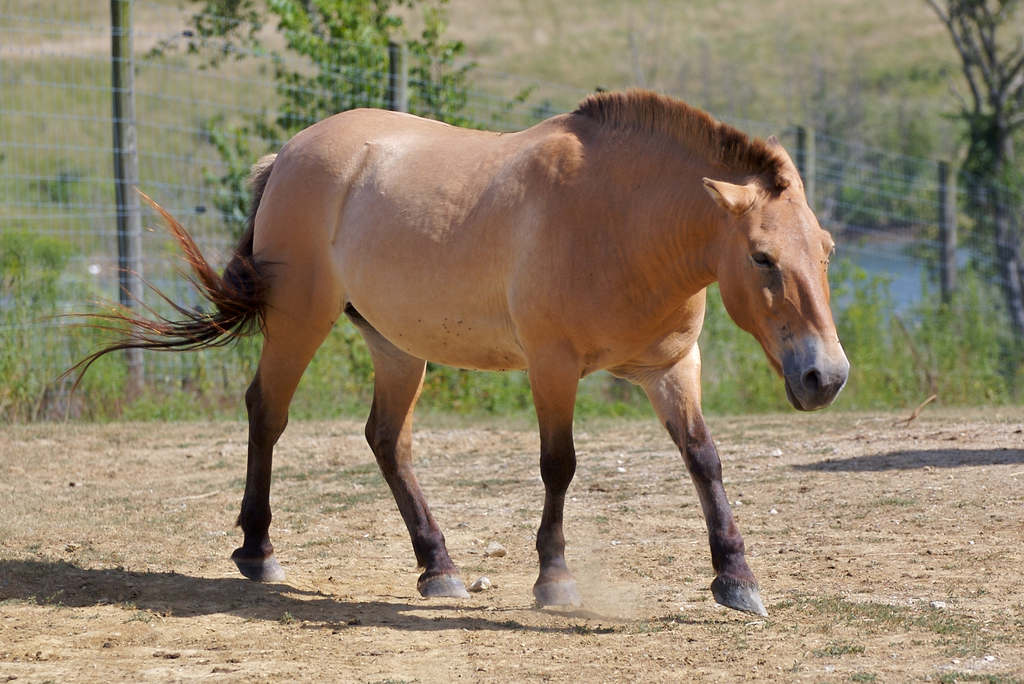
Wild Horse
Equus ferus
The wild horse (Equus ferus) is a species of the genus Equus, which includes as subspecies the modern domesticated horse (Equus ferus caballus) and the endangered Przewalski's horse (Equus ferus przewalskii, sometimes treated as a separate species, i.e., Equus przewalskii). The European wild horse, also known as the tarpan, that went extinct in the late 19th or early 20th century, has previously been treated as the nominate subspecies of wild horse, Equus ferus ferus, but more recent studies have cast doubt on whether tarpans were truly wild or if they actually were feral horses or hybrids.
Other subspecies of Equus ferus may have existed and could have been the stock from which domesticated horses are descended. Przewalski's horse had reached the brink of extinction, but was reintroduced successfully into the wild. The tarpan became extinct in the 19th century, but is theorized to have been present on the steppes of Eurasia at the time of domestication. Since the extinction of the tarpan, attempts have been made to reconstruct its phenotype using domestic horses, resulting in horse breeds such as the Heck horse. However, the genetic makeup and foundation bloodstock of those breeds is substantially derived from domesticated horses, so these breeds possess domesticated traits.
From the article Wild horse on Wikipedia (CC BY-SA), quoted section by section
Description
Across time and space, wild horses show considerable variability in body size and limb dimensions, likely as adaptations to local environmental and climatic conditions. The living Przewalski's horse has an estimated body mass of 250–360 kilograms (550–790 lb), though the body mass of Przewalski's horse varies considerably according to rhythmic annual cycles. Some extinct wild horse populations are thought to have been considerably larger, with some Pleistocene European wild horses (including those assigned to Equus (ferus) mosbachensis and Equus (ferus) latipes) suggested to have body masses of around 500–607 kilograms (1,102–1,338 lb).ST2 Earlier Middle Pleistocene horses (such as those assigned to E. (ferus) mosbachensis) differ from later ones in some aspects of the anatomy of the limbs and teeth.
Range & habitat
Wild horses were formerly widespread across the Old World during the Late Pleistocene and early Holocene, occurring from Western Europe and North Africa (where remains are referred to as Equus algericus), to the far north of Siberia (where they are referred to as Equus lenensis) to East Asia. Today the only living wild horse subspecies, Przewalski's horse, which was formerly extinct in the wild, has been reintroduced to small areas spanning from its former distribution in northeast China, Mongolia and Kazakhstan, as well as areas outside of its historical distribution, including Spain.
Wikipedia: “Distribution”
What it does
Wild horses show considerable environmental tolerances, having historically inhabited environments ranging from temperate forest to steppe (including the prehistoric mammoth steppe biome) and tundra, though in general they tend to show a preference for open environments. Horses are typically considered to be grazers. They may have seasonal food preferences, as seen in the Przewalski's horse, which historically consumed browse like shrubs during the winter months due to being forced into suboptimal habitat by human pressure. Some extinct Pleistocene wild horse populations that inhabited forested environments show dental wear suggesting them to have been mixed feeders or even predominantly browsers during certain times of the year, though this may be reflecting the consumption of low growing forbs rather than shrubs. Wild horses live in herds with a social hierarchy, formed by a dominant adult male or sometimes multiple males (harem stallions), as well as several mares and their offspring. The harem stallion aggressively defends his herd/harem against rival males. Upon reaching adulthood, both male and female horses disperse to other herds to avoid inbreeding, with young adult males also forming bachelor groups when they are around 3 years of age. In bachelor groups male horses engage in play and ritual behaviour, with the group forming a hierarchy. …
Wikipedia: “Ecology”
In human culture
E. ferus has had several subspecies; those which survived into modern times are:
The domesticated horse (Equus ferus caballus). The Eurasian wild horse (Equus ferus ferus), incorrectly listed as Equus caballus ferus in MSW 3; originally considered synonymous with the tarpan, though recent research has cast doubt on this. Horses identified as tarpans were found in Europe and western Asia before the last surviving animals —possibly hybrids by that time — became effectively extinct in the late 19th century. The last specimen died in 1909 whilst in captivity in an estate in Poltava Governorate, Russian Empire. Przewalski's horse (Equus ferus przewalskii), incorrectly listed as Equus caballus przewalskii in MSW 3; also known as the Mongolian wild horse or takhi, it is native to Central Asia and the Gobi Desert. It is sometimes considered its own species, Equus przewalskii. The latter two are the only never-domesticated "wild" groups that survived into historic times. However, other subspecies of Equus ferus may have existed. In the Late Pleistocene epoch, there were several other subspecies of E. ferus which have all since gone extinct. The exact categorization of Equus remains into species or subspecies is a complex matter and the subject of ongoing work.
Wikipedia: “Subspecies and their history”
Listen
Looking for field recordings…
Where it lives
Recorded sightings
—
geo-referenced records in GBIF, from museums, herbaria and field observers.
Drag the globe to turn it. Dots are where records exist, not a range map; darker means more records.
In the old herbals & bestiaries


In the stacks
Searching the stacks…
Every page naming Equus ferus in the Biodiversity Heritage Library →
This page is assembled live from iNaturalist, GBIF, Wikipedia, the Source Library and the Internet Archive. It is not yet part of the hand-edited codex. iNaturalist taxon 62629.