- Plants
- ›Vascular Plants
- ›flowering plants
- ›Dicots
- ›Gentians, Dogbanes, Madders, and Allies
- ›Dogbane Family
- ›milkweeds
- ›Asclepiadeae
- ›Asclepiadinae
- ›Asclepias
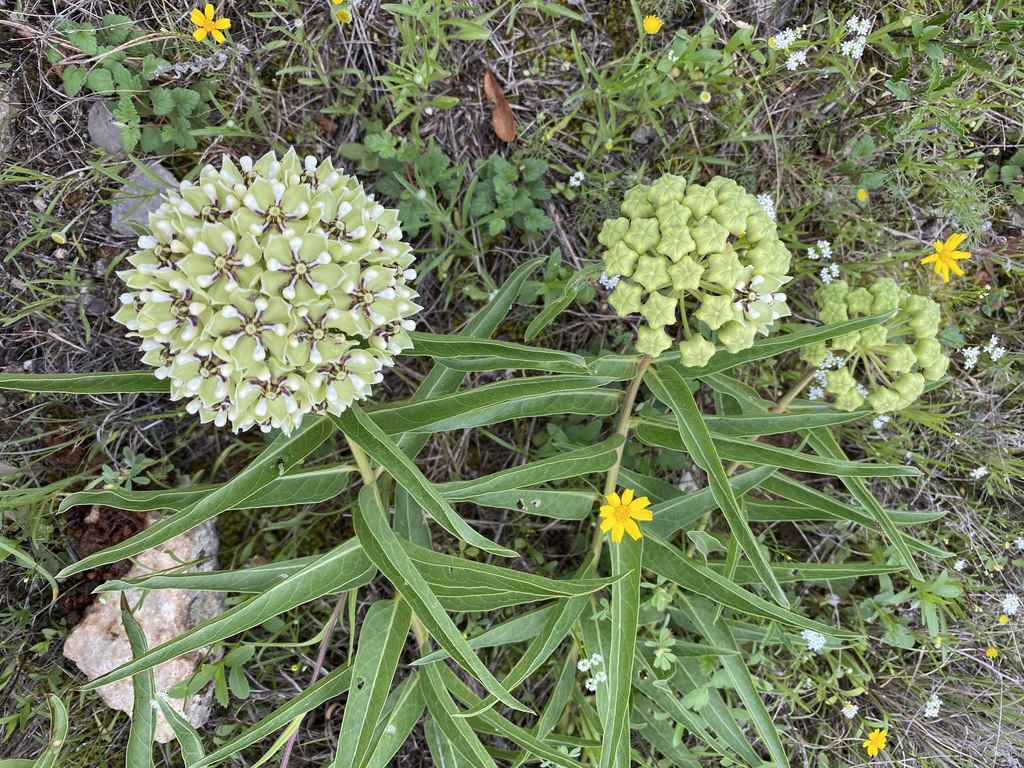
Antelopehorn Milkweed
Asclepias asperula
Asclepias asperula is a species of milkweed native to the Southwestern United States and northern Mexico. Its common names include antelope horns, green-flowered milkweed, and spider antelope horns.
From the article Asclepias asperula on Wikipedia (CC BY-SA), quoted section by section
Description
It is a perennial plant growing to 0.3–0.9 m (1–3 ft) tall, with clustered greenish-yellow flowers with maroon highlights. It blooms from April through June. Antelope horns is a common milkweed in Central Texas. It gets its name from the follicles (seed pods) that resemble the horns of antelope. You can easily spot the flower clusters (technically, umbellate cymes) in open meadows. Milkweed plants are a major food source for Monarch and Queen butterfly caterpillars and as with other milkweed plants, it bleeds white latex if a stem is cut and this sap is toxic to some animals and to humans. It also makes Monarch and Queen butterflies taste bad to potential predators, an effective defense mechanism. From a distance the flowers appear as tennis-sized spheres, but they are clusters of small green, purple, and white flowers. Each flower has 5 pale green petals that cup upward around 5 prominent white hoods (which store nectar).
What it does
The central circular structure is a gynostegium, the fusion of 2 stigma and 5 anthers. Antelope horns do not have individual pollen grains. The pollen sticks together as granular masses contained on a pollinarium structure located within each of the 5 stigmatic chambers. The pollinarium is made up of 2 pollinium “wings” connected to a central corpusculum via 2 translator arms. The picture "Antelope horns pollinarium" shows a pollinarium that was pulled out of the stigmatic slit using an insect pin.
Antelope Horns pollination. Pollination of Antelope Horns happens when flowers are visited by insects that get their reward in nectar (in this case primarily sucrose) which is accessible at the base of each of the hoods. Several different types of insects visit milkweed searching for nectar including bees, butterflies, moths, flies and beetles. As they move around the flower in search of nectar one of their legs may slip into a stigmatic slit. The only way to safely remove their leg is to move it upwards toward the top of the slit. The leg can then snag on the corpusculum and pull out the entire pollinarium. When the insect visits another milkweed flower carrying this pollinarium, there is a chance a pollinium would slip into an empty stigmatic slit, dislodge, and remain there. …
Wikipedia: “Flower structure and pollination”
How it is grown
The plant is difficult to cultivate and does not grow well in containers. In cultivation, this species favors quickly draining soil that is high in inorganic matter, such as sand and rock chips. It can grow in loam and clay, if provided with adequate drainage and frequent dryness. Moisture level demands and tolerance depend upon the subspecies and possibly ecotype. The plant has a deep taproot, so it needs to have the deepest-possible pot if grown in a container and should not be waterlogged.
Wikipedia: “Cultivation”
Where it lives
Recorded sightings
—
geo-referenced records in GBIF, from museums, herbaria and field observers.
Drag the globe to turn it. Dots are where records exist, not a range map; darker means more records.
In the stacks
Searching the stacks…
Every page naming Asclepias asperula in the Biodiversity Heritage Library →
This page is assembled live from iNaturalist, GBIF, Wikipedia, the Source Library and the Internet Archive. It is not yet part of the hand-edited codex. iNaturalist taxon 62298.