- Plants
- ›Vascular Plants
- ›flowering plants
- ›Dicots
- ›Roses, Elms, Figs, and Allies
- ›buckthorn family
- ›Ceanothus
- ›Ceanothus
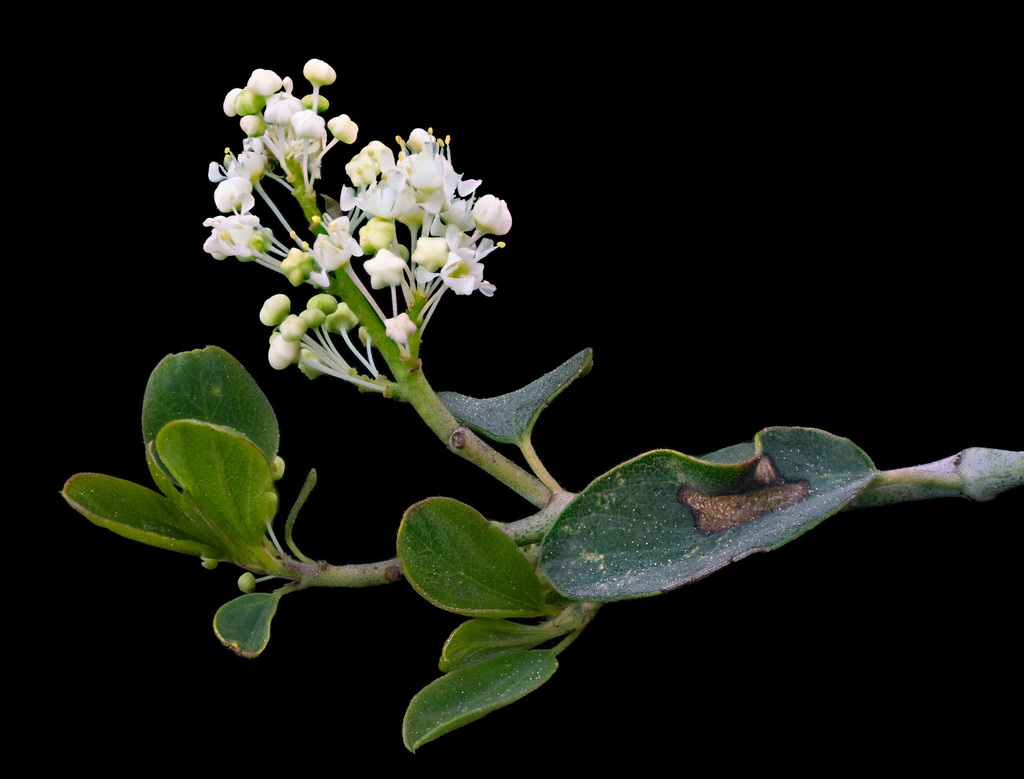
mountain whitethorn
Ceanothus cordulatus
Ceanothus cordulatus is a species of shrub in the family Rhamnaceae known by the common names mountain whitethorn and whitethorn ceanothus. It is native to California and adjacent sections of Oregon, Nevada, and Baja California, where it grows on mountain ridges and other forested areas. This is a spreading shrub growing usually wider than tall and up to about 1.5 meters. The stems are gray, with the twigs yellow-green in color and fuzzy in texture when new. The evergreen leaves are alternately arranged and up to 3 centimeters long. Each is oval in shape with three ribs and generally not toothed. The leaves may be hairy or not. The inflorescence is panicle-shaped, up to about 4 centimeters long. The flowers are white to off-white with five sepals and five petals. The fruit is a rough, ridged capsule up to half a centimeter long. It has three valves inside, each containing a seed. It is a nitrogen-fixing plant, that is uniquely abundant in old-growth forest conditions when compared to similar types of nitrogen-fixing plants. In addition, Ceanothus cordulatus is known to be an important source of nitrogen patches for significantly longer times than other similar post-disturbance successional shrubs, following disturbance events such as forest fires.
Where it lives
Recorded sightings
—
geo-referenced records in GBIF, from museums, herbaria and field observers.
Drag the globe to turn it. Dots are where records exist, not a range map; darker means more records.
In the stacks
Searching the stacks…
Every page naming Ceanothus cordulatus in the Biodiversity Heritage Library →
This page is assembled live from iNaturalist, GBIF, Wikipedia, the Source Library and the Internet Archive. It is not yet part of the hand-edited codex. iNaturalist taxon 62228.