- Plants
- ›Vascular Plants
- ›flowering plants
- ›Dicots
- ›myrtles, evening primroses, and allies
- ›evening primrose family
- ›Oenothera
- ›Oenothera
- ›Oenothera
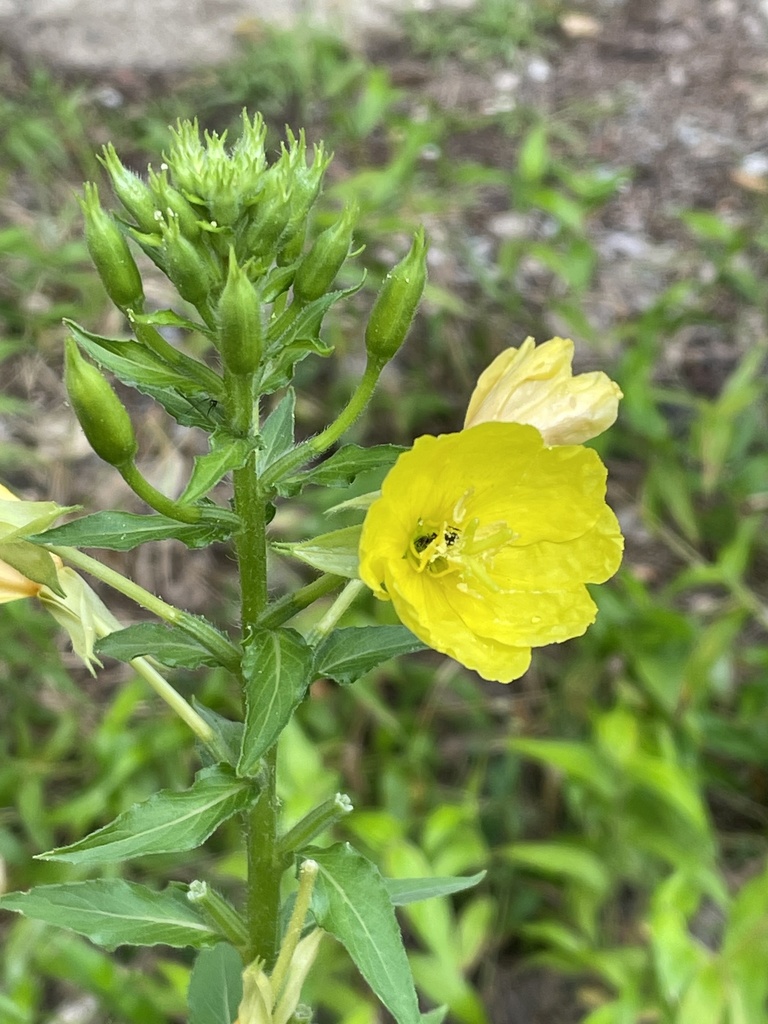
common evening-primrose
Oenothera biennis
Oenothera biennis (common evening-primrose, evening star, sundrop, weedy evening primrose, German rampion, hog weed, King's cure-all, or fever-plant.) is a species of Oenothera native to eastern and central North America, from Newfoundland west to Alberta, southeast to Florida, and southwest to Texas, and widely naturalized elsewhere in temperate and subtropical regions. Evening primrose oil is produced from the plant.
From the article Oenothera biennis on Wikipedia (CC BY-SA), quoted section by section
Description
Oenothera biennis usually has a life span of two years (biennial) growing to 1.6 m (5 ft 3 in) tall in the seeding year. The leaves are lanceolate, 8–18 cm (3–7 in) long and 2–6 cm (3⁄4–2+1⁄4 in) wide, produced in a tight rosette the first year, and spirally on a stem the second year. However, plants with annual life cycles are documented, and have been selected for under experimental conditions in environments with low competition.
Growing cycle. Most commonly, O. biennis grows as a low, spreading herb in the first year, just a few centimetres tall, with its leaves spreading out in a rosette to cover the ground, whilst storing energy in a thick root. In the second year, it grows up much taller, to around 1.6 metres (5.2 ft) tall, on a semi-woody stem, which then flowers and seeds. This will usually die at first frosts, but occasionally grows another stem in the third year.
Blooming and fruiting. Blooming lasts from late spring to late summer. The flowers are hermaphrodite, produced on a tall spike and only last until the following noon. They open visibly fast every evening producing an interesting spectacle, hence the name "evening primrose". The blooms are yellow, 2.5–5 cm (1–2 in) diameter, with four bilobed petals. The flower structure has a bright nectar guide pattern, invisible to the naked eye. …
What it does
This plant is a weedy species that favors disturbed environments. It has been introduced and become established on all continents except Antarctica. The seeds of the plant are important food for birds, including American goldfinch, Northern bobwhite, and mourning dove, and it is a larval host for both the primrose moth and the white-lined sphinx moth. Bumblebees and honeybees also visit the flowers. The primrose moth (Schinia florida) is a common consumer of Oenothera biennis. The adults lay eggs on the flower, and the emerging caterpillars feed on the plant.
The seeds of O. biennis can remain viable in the soil seed bank for 70 years or more.
Wikipedia: “Ecology”
At the table
Over the centuries, Indigenous people in North America have used the plant as food and traditional medicine. The evening primrose was introduced to Europe in the early 17th century as an ornamental plant in botanical gardens where its flowers are favored for nectar by pollinators, such as bees, and its seeds are food for birds.
Food uses. Most of the plant parts are edible, having a taste that is mild. The roots can be eaten raw or cooked like potatoes. The leaves can be eaten raw in salads or cooked like spinach or in soups. Anishinaabe tribes traditionally make tea from the evening primrose leaves for use as a dietary aid and to reduce fatigue. The flowering stems are preferably used when they are still young in June. They have to be peeled and can then be eaten raw or fried. The flower buds are regarded as a delicacy and can be harvested from June to October. The seeds have a protein content of about 15%, an oil content of 24%, and contain about 43% cellulose. The proteins are especially rich in the sulphur-containing amino acids, methionine and cysteine, and tryptophan. Gamma-linolenic acid (GLA), and linoleic acid are present. Mainly for these polyunsaturated fatty acids, evening primrose oil is sold as a dietary supplement.
Research. There is not enough clinical evidence to support the use of evening primrose oil as a therapy for any medical condition. …
Wikipedia: “Uses”
How it is grown
The knowledge of agricultural practices in the cultivation of evening primrose is relatively new and only pertain to the commercialized production of evening primrose seed oil. Information of agricultural practices for the production of root vegetable or other plant parts is not known yet. The evening primrose prefers sunny and arid places with loamy soil and occurs below 700 metres (2,300 ft) above sea level. One important prerequisite is to meet adequate nitrogen requirements. While too high nitrogen levels could lead to a quality and quantity decline of the oil content in the seeds, moderate nitrogen levels lead to increased seed quality and quantity. Because the evening primrose is a light-dependent germinator, it is important that the seeds are not planted too deep into the soil, about 0.5–1.0 centimetre (0.2–0.4 in) deep. The cultivation of evening primrose is thus suitable for no-till farming, but the plants require an intense mechanical weed control. The seeds are tiny, about 0.3–0.7 grams (0.011–0.025 oz). They need approximately two to three weeks to germinate and are therefore very susceptible to the outgrowth of weeds. Evening primrose seeds can be sown in the first half of April (spring seeds) or from mid-July to mid-August (autumn seeds). …
Wikipedia: “Agricultural practices”
Where it lives
Recorded sightings
—
geo-referenced records in GBIF, from museums, herbaria and field observers.
Drag the globe to turn it. Dots are where records exist, not a range map; darker means more records.
In the stacks
Searching the stacks…
Every page naming Oenothera biennis in the Biodiversity Heritage Library →
This page is assembled live from iNaturalist, GBIF, Wikipedia, the Source Library and the Internet Archive. It is not yet part of the hand-edited codex. iNaturalist taxon 62207.