- Plants
- ›Vascular Plants
- ›flowering plants
- ›Dicots
- ›Mallows, Rock Roses, and Allies
- ›Mallow and Hibiscus Family
- ›Malvoideae
- ›Malveae
- ›Alcea
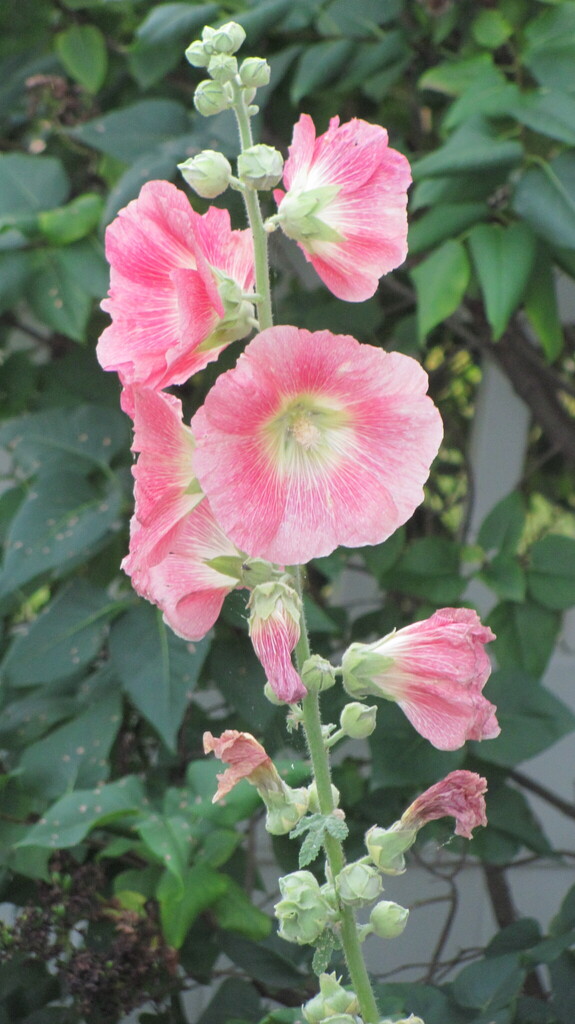
Hollyhock
Alcea rosea
Alcea rosea, the common hollyhock, is an ornamental dicot flowering plant in the family Malvaceae. It was imported into Europe from southwestern China during, or possibly before, the 15th century. William Turner, a herbalist of the time, gave it the name "holyoke" from which the English name derives.
From the article Alcea rosea on Wikipedia (CC BY-SA), quoted section by section
Description
Alcea rosea is a 2.4 metres (8 feet) tall plant with large flowers around 13 centimetres (5 in) in diameter. Its leaves are large and heart-shaped.
In medicine
In herbal medicine, which may lack evidence, hollyhock is believed to be an emollient and laxative. It is thought to control inflammation, to stop bedwetting and as a mouthwash in cases of bleeding gums.
Wikipedia: “Herbalism”
How it is grown
Alcea rosea is variously described as a biennial (having a two-year life cycle), as an annual, or as a short-lived perennial. It frequently self-sows, which may create a perception that the plants are perennial. The plant may flower during its first year when sown early. It will grow in a wide range of soils, and can easily reach a height of 2.4 m (8 ft) The flowers are in a range of colours from white to dark red, including pink, yellow and orange. Different colours prefer different soils. The darker red variety seems to favour sandy soils, while the lighter colour seems to favour clay soils. The plants are easily grown from seed, and readily self-seed. However, tender plants, whether young from seed or from old stock, may be wiped out by slugs and snails. The foliage is subject to attack from rust fungus, which may be treated with fungicides. Commercial growers have reported that some closely related species (Alcea ficifolia and A. rugosa) are resistant to this fungus.
Wikipedia: “Cultivation”
Where it lives
Recorded sightings
—
geo-referenced records in GBIF, from museums, herbaria and field observers.
Drag the globe to turn it. Dots are where records exist, not a range map; darker means more records.
In the old herbals & bestiaries

Illustrated Herbal Primer
Chen Jiamo (陳嘉謨) · 1628 · p.174

Hortus Eystettensis
Basilius Besler · 1640 · p.241

Notable Commentaries on the History of Plants
Leonhart Fuchs · 1542 · p.541

Notable Commentaries on the History of Plants
Leonhart Fuchs · 1549 · p.539

Six Groups of the History of Plants
Rembert Dodoens · 1583 · p.662

Six Groups of the History of Plants
Rembert Dodoens · 1583 · p.662

Compendium of Materia Medica
李時珍 · 1596 · p.15

The Flowering Garden: Autumn
Crispijn van de Passe · 1616 · p.36

Illustrated Herbal Primer
Chen Jiamo (陳嘉謨) · 1628 · p.174

Illustrated Herbal Primer
Chen Jiamo (陳嘉謨) · 1628 · p.174

Hortus Eystettensis
Basilius Besler · 1640 · p.240

Illustrated Compendium of Materia Medica (Vol. 12)
吳其濬 · 1848 · p.143
In the stacks
Searching the stacks…
Every page naming Alcea rosea in the Biodiversity Heritage Library →
This page is assembled live from iNaturalist, GBIF, Wikipedia, the Source Library and the Internet Archive. It is not yet part of the hand-edited codex. iNaturalist taxon 62205.