- Plants
- ›Vascular Plants
- ›flowering plants
- ›Dicots
- ›Waterlilies, Fanworts, and Allies
- ›Waterlily Family
- ›Nymphaea
- ›Nymphaea
- ›Nymphaea
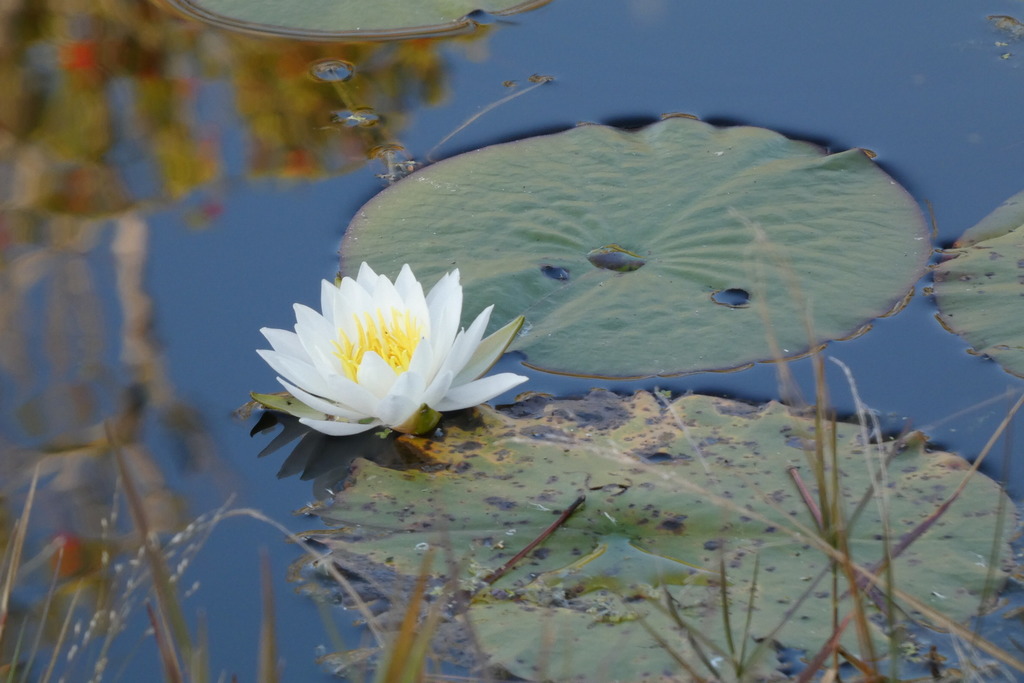
European White Waterlily
Nymphaea alba
Nymphaea alba – commonly called the white water lily, European white water lily, or white nenuphar ( NEN-yuu-far) – is an aquatic flowering plant in the family Nymphaeaceae. It is native to North Africa, temperate Asia, Europe, and tropical Asia (Jammu and Kashmir).
Since Nymphaea alba is an aquatic plant, its specialized trichomes are hydropotes, formed at an abaxial surface of the young leaf and packed tightly in the rosette at the rhizome's flattened apex. The rhizomes contain high amounts of carbohydrate and protein.
From the article Nymphaea alba on Wikipedia (CC BY-SA), quoted section by section
Description
Nymphaea alba has a round dark green leaves up to 35 cm (14 in) in length and white flowers which usually bloom during the daytime in summer. Both leaves and flowers float on the water's surface. At first, the flower is cup-shaped, with a size of around 8 cm (3.1 in). It increases to 20 cm (7.9 in) and becomes star-shaped over time. The flower's petals are arranged in a row, pointing up surrounding many yellow stamens. The species may spread 150 cm (59 in) per plant.
Range & habitat
Nymphaea alba is native all over Europe and in parts of North Africa and the Middle East in fresh water. In Africa, it is found in Algeria, Morocco and Tunisia. In temperate Asia, Armenia, Azerbaijan, Siberia, Iran, Iraq, Palestine and Turkey. It is found in tropical Asia, within the Indian territory of Jammu and Kashmir. Lastly, within Europe, it is found in Belarus, Estonia, Latvia, Lithuania, Moldova, Russian Federation, Ukraine, Austria, Belgium, Czech Republic, Germany, Hungary, Netherlands, Poland, Slovakia, Switzerland, Denmark, Finland, Ireland, Norway, Sweden, United Kingdom, Albania, Bosnia and Herzegovina, Bulgaria, Croatia, Greece, Italy, Montenegro, North Macedonia, Romania, Serbia, Slovenia, France, Portugal and Spain. It has been introduced to the Azores, Bangladesh, Chile, parts of China, Myanmar, and New Zealand. Nymphaea alba grows in ponds, ditches, lakes, or canals with still or slow-moving water.
Wikipedia: “Distribution and habitat”
In medicine
It contains the active alkaloids nupharine and nymphaeine, and is a sedative and an aphrodisiac/anaphrodisiac depending on sources. Although roots and stalks are used in traditional herbal medicine along with the flower, the petals and other flower parts are the most potent. Alcohol can be used to extract the active alkaloids, and it also boosts the sedative effects. The root of the plant was used by monks and nuns for hundreds of years as an anaphrodisiac, being crushed and mixed with wine. In the earliest printed medical textbooks, authors maintained this use, though warning against consuming large and frequent doses.
Wikipedia: “Phytochemistry”
How it is grown
Nymphaea alba is a vigorous plant which needs plenty of space as the leaves can spread up to 1.5 m (4.9 ft). It prefers to grow in clay or loam in full sun. When it is first introduced into the water, it should be placed rather shallow with the rhizome at around 20 cm (7.9 in) below the surface. As the plant gets established it can be sunk deeper down to a depth of about 90 cm. In nature it regularly grows deeper than this. In north-eastern India young leaves and peduncles of Nymphaea alba and other species are harvested and eaten as vegetables. The rhizomes are also harvested to be boiled and eaten. Parts of the plant have been used as traditional medicine to treat diarrhea, piles, coughing and other ailments. The flowers are also harvested for decoration and for their pleasant smell, and have a long vase-life.
== References ==
Wikipedia: “Cultivation”
Where it lives
Recorded sightings
—
geo-referenced records in GBIF, from museums, herbaria and field observers.
Drag the globe to turn it. Dots are where records exist, not a range map; darker means more records.
In the old herbals & bestiaries

Hortus Eystettensis
Basilius Besler · 1640 · p.122

De medicinali materia libri sex
Dioscorides · 1552 · p.489

Living Images of Plants
Otto Brunfels · 1532 · p.44

Commentaries on the Six Books of Pedanius Dioscorides on Medical Matter
Pietro Andrea Mattioli · 1565 · p.1065

Six Groups of the History of Plants
Rembert Dodoens · 1583 · p.596
In the stacks
Searching the stacks…
Every page naming Nymphaea alba in the Biodiversity Heritage Library →
This page is assembled live from iNaturalist, GBIF, Wikipedia, the Source Library and the Internet Archive. It is not yet part of the hand-edited codex. iNaturalist taxon 62009.