- Plants
- ›Vascular Plants
- ›flowering plants
- ›monocots
- ›Agaves, Orchids, Irises, and Allies
- ›Orchids
- ›Orchidoid Orchids
- ›Orchideae
- ›Orchidinae
- ›Dactylorhiza
- ›Angustifoliae
- ›Dactylorhiza majalis
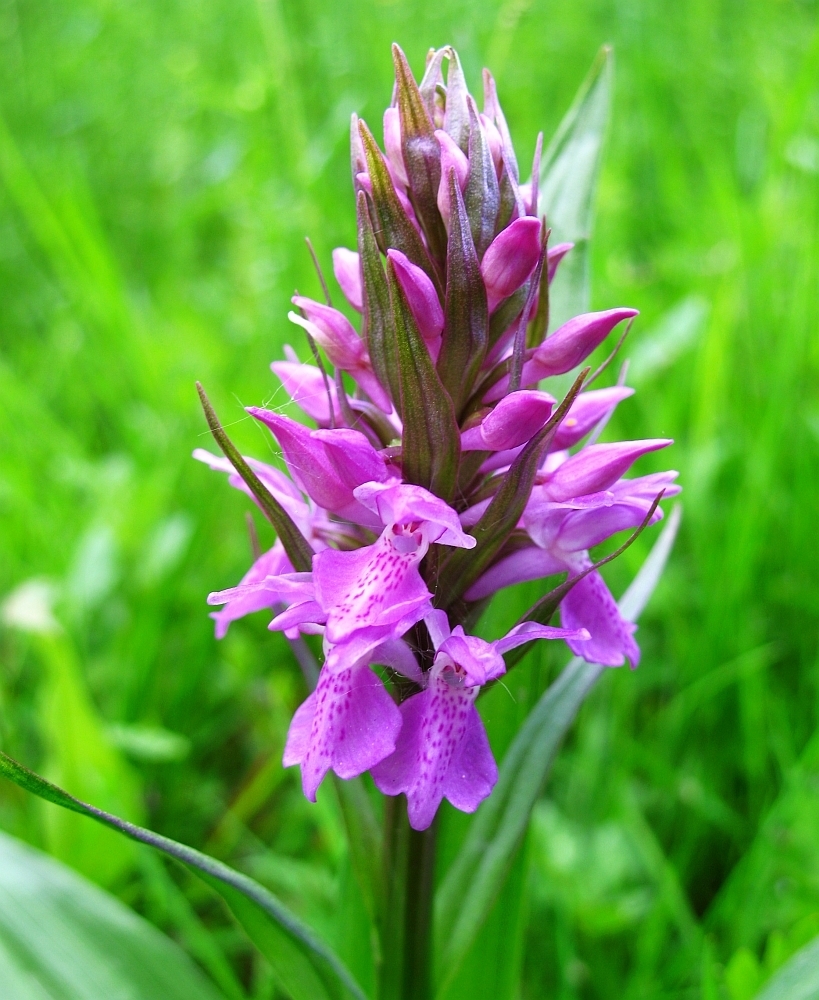
Southern Marsh-orchid
Dactylorhiza praetermissa
Dactylorhiza majalis subsp. praetermissa, the southern marsh orchid or leopard marsh orchid, is a commonly occurring species of European orchid. Some authorities consider it a separate species, Dactylorhiza praetermissa.
From the article Dactylorhiza majalis subsp. praetermissa on Wikipedia (CC BY-SA), quoted section by section
Description
Dactylorhiza majalis subsp. praetermissa grows to 70 cm (28 in) tall, with leaves generally unspotted. The flowers, appearing from May to July, are various shades of pink with variable markings. The basal lip of the flower is rounded. This species is able to form hybrids with other Dactylorhiza species, and crosses with Dactylorhiza maculata subsp. fuchsii occur especially often.
Range & habitat
It is native to northern and central Europe (Britain, Denmark, Norway, Sweden, Germany, Netherlands, Belgium, France, Estonia and Latvia). It is also reportedly naturalized in Italy and in parts of Canada (Ontario and Newfoundland). This species is found close to water, in damp calcareous or neutral meadows, fens, by ponds, lakes, or reservoirs, and in dune slacks.
Wikipedia: “Distribution and habitat”
What it does
The flowers of this species are pollinated by insects including the cuckoo bee and skipper butterfly. Dactylorhiza are known to be mycorrhizal generalists. D. m. subsp. praetermissa has been shown to benefit from association with fungal species in the genus Rhizoctonia and others in the Tulasnellaceae family.
Wikipedia: “Ecology”
Where it lives
Recorded sightings
—
geo-referenced records in GBIF, from museums, herbaria and field observers.
Drag the globe to turn it. Dots are where records exist, not a range map; darker means more records.
In the stacks
Searching the stacks…
Every page naming Dactylorhiza praetermissa in the Biodiversity Heritage Library →
This page is assembled live from iNaturalist, GBIF, Wikipedia, the Source Library and the Internet Archive. It is not yet part of the hand-edited codex. iNaturalist taxon 62002.