- Animals
- ›Chordates
- ›Vertebrates
- ›Cartilaginous Fishes
- ›Sharks and Rays
- ›Rays
- ›Skates
- ›Hardnose Skates
- ›Rostroraja
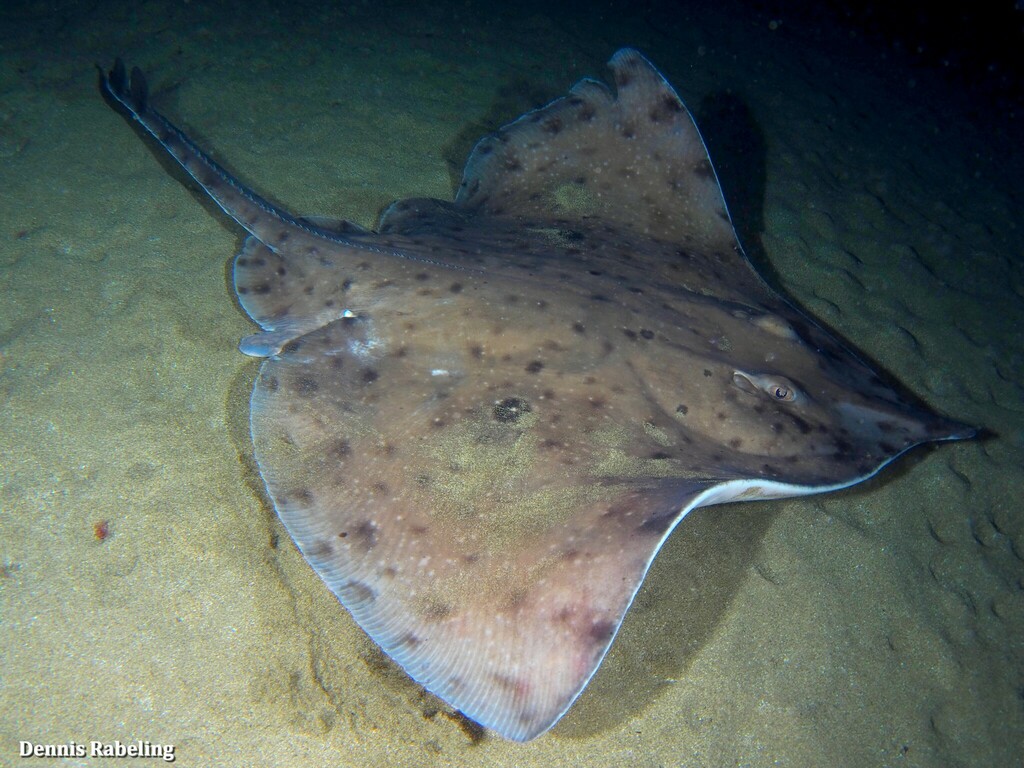
Owl Skate
Rostroraja alba
The bottlenose skate, spearnose skate, or white skate, Rostroraja alba, is a species of skate in the family Rajidae. It is a benthic fish native to the coastal eastern Atlantic Ocean. Due to overfishing, it has been depleted or extirpated in many parts of its former range in the northeastern Atlantic and the Mediterranean Sea, and is now endangered.
From the article Bottlenose skate on Wikipedia (CC BY-SA), quoted section by section
Description
Most bottlenose skates are 60–150 cm (24–59 in) long, with maximum recorded lengths of 230 cm (91 in) for males and 202 cm (80 in) for females. The flattened, angular pectoral fin fisc is about 1.4–1.5 times as broad as long. The snout is broad-based, abruptly tapering to a protruding sharp point and covered with small, sharp thorns. There are 40–45 rows of teeth in the upper jaw. The juveniles have 1 thorn before and 0–1 thorns behind the eyes and three rows of large thorns on the tail, 10–16 on the midline and 7–17 on either side. The adults have about 6 thorns around the inner margin of the orbit and 16–30 mid-dorsal and 17–29 lateral thorns on the tail. The skin is rough in adults except for a smooth patch in the center of the disc; the underside is prickly except for smooth patches on the snout. The young are entirely smooth, except for on the snout. Large juveniles and adults are greyish or bluish with or without numerous small white spots above, white below with brown to black disc margins. Hatchlings are plain reddish-brown above, often with blue spots, and white below with broad dusky disc margins.
Range & habitat
The bottlenose skate is found along the coastlines of the eastern Atlantic Ocean, from southwest Ireland to South Africa and extends into the southwestern Indian Ocean to Mozambique. It is present as well in the western and northeastern sectors of the Mediterranean Sea. It is a benthic species of sandy and detrital bottoms, at depths of 40–400 m (exceptionally down to 500 m) from coastal regions to the upper continental slope. Du Buit (1974) reported that it is more prevalent in rocky habitats.
Wikipedia: “Distribution and habitat”
What it does
The bottlenose skate is a benthic predator of bony fishes, other elasmobranchs, fish offal, crabs, shrimps, mysids, octopus, and cuttlefish. Younger, smaller fish are usually found in shallower water. Like other skates, this species is oviparous, with females producing 55–156 ova per year after a gestation period of 15 months. The egg cases are oblong in shape, with stiff pointed horns at each corners and the larger horns flattened. They are deposited in sandy or muddy flats in the spring. The capsules measure 12.5–18.3 cm (4.9–7.2 in) long and 10–13.9 cm (3.9–5.5 in) wide. This species is estimated to mature at 130 cm (51 in) for males and 120 cm (47 in) for females.
Wikipedia: “Biology and ecology”
Where it lives
Recorded sightings
—
geo-referenced records in GBIF, from museums, herbaria and field observers.
Drag the globe to turn it. Dots are where records exist, not a range map; darker means more records.
In the stacks
Searching the stacks…
Every page naming Rostroraja alba in the Biodiversity Heritage Library →
This page is assembled live from iNaturalist, GBIF, Wikipedia, the Source Library and the Internet Archive. It is not yet part of the hand-edited codex. iNaturalist taxon 61753.