- Plants
- ›Vascular Plants
- ›flowering plants
- ›Dicots
- ›pinks, cactuses, and allies
- ›pink family
- ›Caryophylloideae
- ›Caryophylleae
- ›Saponaria
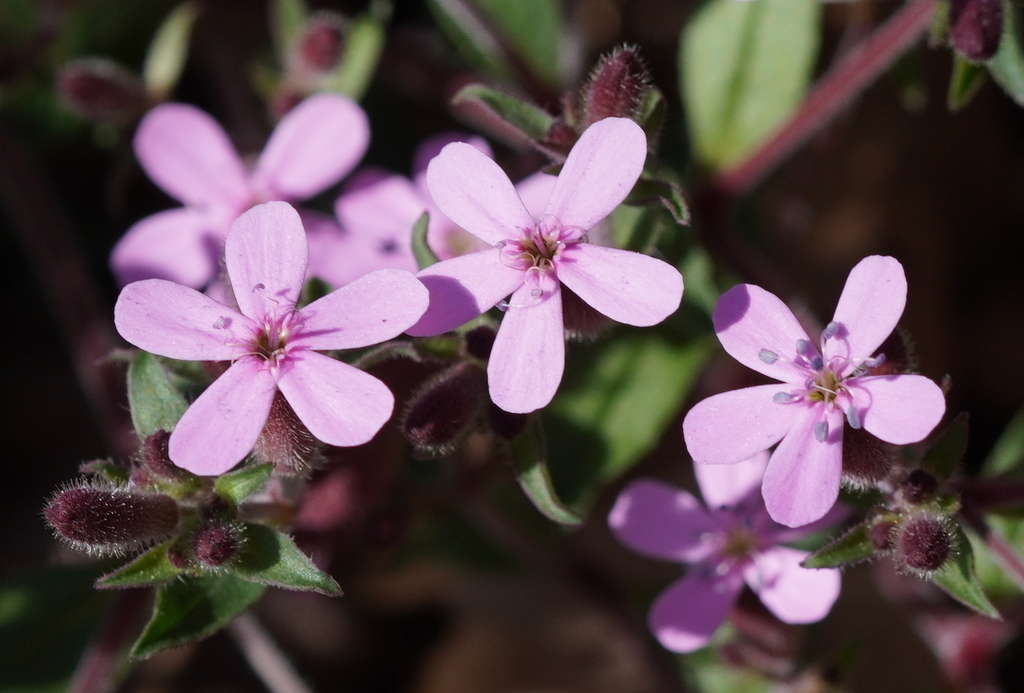
Rock Soapwort
Saponaria ocymoides
Saponaria ocymoides, the rock soapwort or tumbling Ted, is a species of semi-evergreen perennial flowering plant belonging to the family Caryophyllaceae, native to south western and southern central Europe.
From the article Saponaria ocymoides on Wikipedia (CC BY-SA), quoted section by section
Description
Reaching a height of 10–40 centimetres (3.9–15.7 in), the stem is prostrate to ascending, woody, reddish, quite hairy and very branched. The leaves are ovate to lanceolate, sessile and hairy, 1–3 cm long. The five-petalled flowers are arranged in groups at the ends of branches. They have red or pink (rarely white) petals and blue anthers. The sepals are fused in a tube about an 8 to 10 millimeters long. The flowering period extends from May to August in the Northern Hemisphere. The fruit is an ovoid capsule, up to 9 mm long.
Range & habitat
This species ranges from the mountains of Spain to Corsica, Sardinia and Slovenia, from the Apennines to the Alps. It grows in rocky and stony places, dry slopes and forests (especially pine forests). It prefers calcareous (alkaline) soils, at an elevation of up to 1,500 metres (4,900 ft), rarely up to 2,400 metres (7,900 ft).
Wikipedia: “Distribution”
How it is grown
Saponaria ocymoides is cultivated as an ornamental plant for rock gardens and dry stone walls, in well-drained alkaline or neutral soil in full sun. Like most alpine plants it dislikes winter wetness around its roots. It has gained the Royal Horticultural Society's Award of Garden Merit.
Wikipedia: “Cultivation”
In human culture
The Latin specific epithet ocymoides means “resembling basil” (Ocimum). However the resemblance is superficial, as the two plants are not closely related. In fact Saponaria ocymoides belongs to the same family as pinks and carnations.
Wikipedia: “Etymology”
Where it lives
Recorded sightings
—
geo-referenced records in GBIF, from museums, herbaria and field observers.
Drag the globe to turn it. Dots are where records exist, not a range map; darker means more records.
In the stacks
Searching the stacks…
Every page naming Saponaria ocymoides in the Biodiversity Heritage Library →
This page is assembled live from iNaturalist, GBIF, Wikipedia, the Source Library and the Internet Archive. It is not yet part of the hand-edited codex. iNaturalist taxon 61480.