- Plants
- ›Vascular Plants
- ›flowering plants
- ›Dicots
- ›Roses, Elms, Figs, and Allies
- ›rose family
- ›Amygdaloideae
- ›Maleae
- ›Chaenomeles
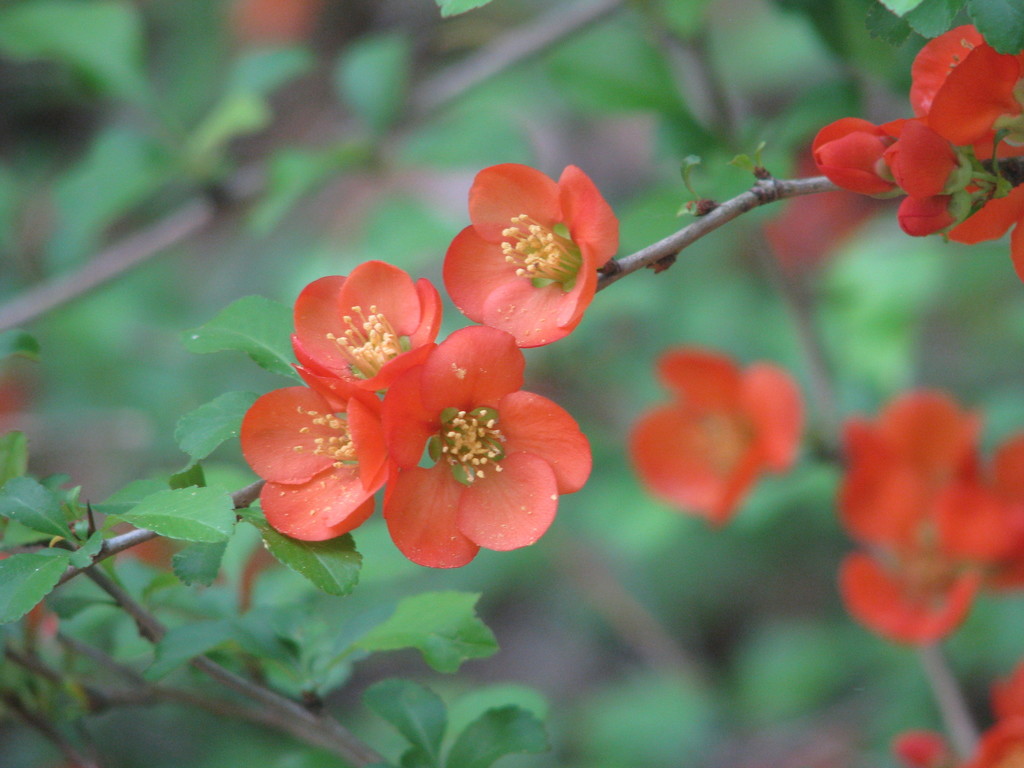
Japanese Quince
Chaenomeles japonica
Chaenomeles japonica, known as Maule's quince, is a species of flowering quince. It is a thorny deciduous shrub that is commonly cultivated. It is shorter than another commonly cultivated species C. speciosa, growing to only about 1 m in height. The fruit is called Kusa-boke (草木瓜, Kusa-boke) in Japanese. It is best known for its colorful spring flowers of red, white, pink or multi. It produces apple-shaped fruit that are a golden-yellow color containing red-brown seeds....
From the article Chaenomeles japonica on Wikipedia (CC BY-SA), quoted section by section
Description
It is a bulky shrub with thorns and widely spreading branches, which reaches heights of growth of 0.6 to 2.0 meters. The leaves are lanceolate to obovate, roughly toothed and glabrous even when young. They are 4 to 5 inches long and 2 to 3 inches wide, including the petiole. The unusually large stipules are 1 centimeter long and 1.5 to 2 centimeters wide, kidney-shaped and serrated on the edge; they are only found on long shoots. It blooms in winter, before leaf budding; it blooms again in summer but with less abundance. Usually there are 2 to 3 flowers arranged together; they are coloured orange to brick red. When open, the flowers are 3 to 4 centimeters wide. The fruit is called Kusa-boke (草木瓜, Kusa-boke) in Japanese. It produces apple-shaped fruit, 4 to 7 centimeters in diameter, that are a golden-yellow color containing red-brown seeds.
At the table
The fruit is edible, but hard and astringent, unless bletted or cooked. As with all fruits of the rose family, the pulp is non-toxic and the kernels contain small amounts of poison. The fruit is occasionally used in jam, jelly and pie making as a substitute for its cousin, the true quince, Cydonia oblonga. C. japonica is also popularly grown in bonsai. It accepts all types of soil, but grows very slowly in calcareous soil.
Wikipedia: “Uses”
Where it lives
Recorded sightings
—
geo-referenced records in GBIF, from museums, herbaria and field observers.
Drag the globe to turn it. Dots are where records exist, not a range map; darker means more records.
In the stacks
Searching the stacks…
Every page naming Chaenomeles japonica in the Biodiversity Heritage Library →
This page is assembled live from iNaturalist, GBIF, Wikipedia, the Source Library and the Internet Archive. It is not yet part of the hand-edited codex. iNaturalist taxon 61236.