- Plants
- ›Vascular Plants
- ›flowering plants
- ›Dicots
- ›Mustards, Capers, and Allies
- ›mustard family
- ›Brassicoideae
- ›Camelinodae
- ›Lepidieae
- ›Lepidium
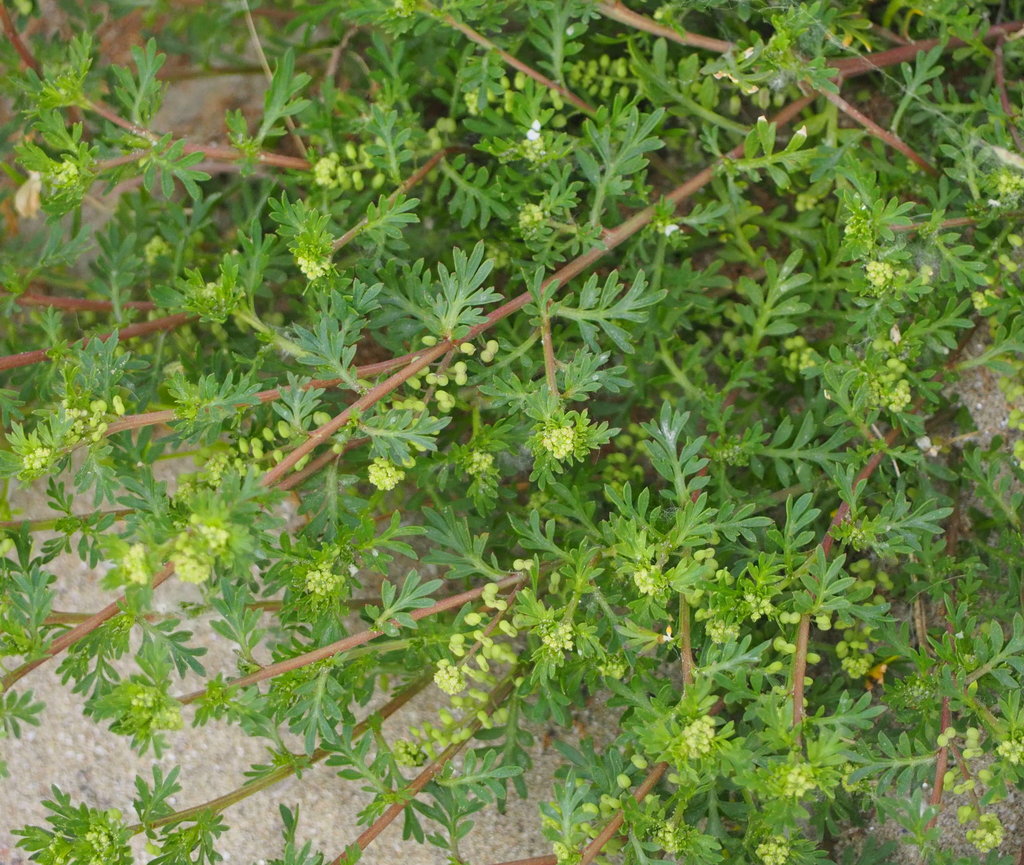
Lesser swine-cress
Lepidium didymum
Lepidium didymum, synonym Coronopus didymus, the lesser swine-cress, is a species of flowering plant in the cabbage and mustard family Brassicaceae.
From the article Lepidium didymum on Wikipedia (CC BY-SA), quoted section by section
Description
Lepidium didymum is an annual or biennial herb with decumbent or ascending and glabrous green stems, up to 40 centimetres (16 in) long, radiating from a central position. The leaves are pinnate and alternate and can reach a length of 5 cm (2 in). It blooms between July and September. The flowers are inconspicuous, with four very short white petals or none at all, and 2 (rarely 4), stamens. The fruits consist of two rounded valves, notched at the apex, with a very short style between them. They are wrinkled and contain orange or reddish brown seeds, that are 1–5 mm long.
Range & habitat
Lepidium didymum is of uncertain origin, but is often cited as native to South America, mainly Argentina, Bolivia, Brazil, Chile, Paraguay, Peru, Uruguay and Venezuela. It has been introduced elsewhere as a weed of cultivation. It has naturalised across the globe, from Africa, Europe, Asia, Australasia, North America and South America. In Britain, it had been recorded from the wild by 1778, chiefly in England and the south of Ireland, growing on cultivated and waste ground, in gardens and lawns, by paths and roadsides.
Wikipedia: “Distribution”
At the table
The leaves of this plant are edible, and have a salty, cress or mustard flavour.
== References ==
Wikipedia: “Uses”
Where it lives
Recorded sightings
—
geo-referenced records in GBIF, from museums, herbaria and field observers.
Drag the globe to turn it. Dots are where records exist, not a range map; darker means more records.
In the stacks
Searching the stacks…
Every page naming Lepidium didymum in the Biodiversity Heritage Library →
This page is assembled live from iNaturalist, GBIF, Wikipedia, the Source Library and the Internet Archive. It is not yet part of the hand-edited codex. iNaturalist taxon 60987.