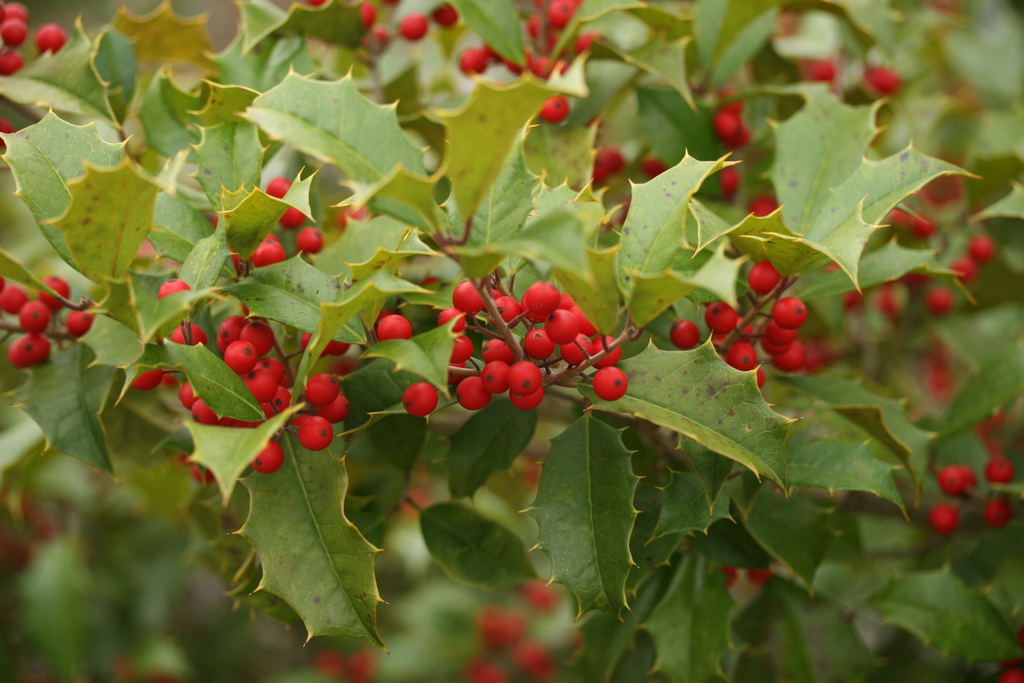
American holly
Ilex opaca
Ilex opaca, the American holly, is a species of holly, native to the eastern and south-central United States, from coastal Massachusetts south to central Florida, and west to southeastern Missouri and eastern Texas.
From the article Ilex opaca on Wikipedia (CC BY-SA), quoted section by section
Description
Ilex opaca is a medium-sized broadleaved evergreen tree growing on average to 10–20 m (33–66 ft) wide, and up to 30 m (98 ft) tall. Typically, its trunk diameter reaches 50 cm (20 in), sometimes up to 120 cm (47 in). The bark is light gray, roughened by small warty lumps. The branchlets are stout, green at first and covered with rusty down, later smooth and brown. The winter buds are brown, short, obtuse or acute. The branches are short and slender. The roots are thick and fleshy. The leaves are alternate, 5–7.5 cm (2.0–3.0 in) long and 2–4 cm (0.79–1.57 in) wide, stiff, yellow green and dull matte to sub-shiny above (distinctly less glossy than the otherwise fairly similar European holly, Ilex aquifolium), often pale yellow beneath; the edges are curved into several sharp, spike-like points, and a wedge-shaped base and acute apex; the midrib is prominent and depressed, the primary veins conspicuous; the petiole is short, stout, grooved, thickened at base, with a pair of minute stipules. The leaves remain on the branches for two to three years, finally falling in the spring when pushed off by growing buds.
The flowers are greenish white, small, borne in late spring in short pedunculate cymes from the axils of young leaves or scattered along the base of young branches. The calyx is small, four-lobed, imbricate in the bud, acute, margins ciliate, persistent. …
What it does
Due to its shade tolerance, Ilex opaca typically grows as an understory tree in moist forests of the east-central, southeastern, and south-central United States. It is found in sparse numbers in the northern part of its range from Cape Cod, Massachusetts, south to northern New Jersey (including southern Connecticut and southeastern New York, on Long Island). It is abundant further south on the Gulf and Atlantic lowlands. It will grow in both dry and swampy soil, but grows slowly. Ilex opaca var. arenicola, or scrub holly, is found as a shrub component in xeric scrub habitats of the Florida peninsula. The ideal yearly precipitation average for the species ranges from 102 cm to 165 cm. The flowers are pollinated by insects, including bees, wasps, ants, and night-flying moths. It is a larval host plant for Callophrys henrici. The tree also forms a thick canopy which offers protection for birds from predators and storms. Songbirds including thrushes, mockingbirds, catbirds, bluebirds and thrashers, as well as some gamebirds and mammals frequently feed on the berries.
Wikipedia: “Ecology”
At the table
The wood is very pale, tough, close-grained, takes a good polish, and is used for whip-handles, engraving blocks and also cabinet work. It can also be dyed and used as a substitute for ebony. It has a density of 0.58 to 0.64. The sap is watery, and contains a bitter substance used as an herbal tonic. Leaves from the American holly can be used to make a tea-like beverage. American holly tea does not contain caffeine.
Ornamental plant. Ilex opaca is often cultivated by plant nurseries for use as a broadleaf evergreen ornamental plant, planted as a shrub or slower growing ornamental tree. Over 1,000 cultivars have been selected, including plants selected for cold tolerance ('Cobalt', a male cultivar, is able to tolerate temperatures as low as −32 °C), growth form (e.g. dwarf forms such as 'Cardinal Hedge', a female plant growing to 1.2 m tall), and color and abundance of fruit (notable female cultivars including the large-berried 'Yule', and the yellow-berried 'Canary' and 'Morgan Gold'). With Ilex cassine it is a parent of the hybrid Ilex × attenuata, which has ornamental cultivars.
The holly in winter. Holly is a popular winter Christmas and holiday season decoration. To Christians, the thorny foliage is attributed to the crown of thorns Christ wore, the berries represent his drops of blood, and the evergreen represents life after death. …
Wikipedia: “Cultivation and uses”
Where it lives
Recorded sightings
—
geo-referenced records in GBIF, from museums, herbaria and field observers.
Drag the globe to turn it. Dots are where records exist, not a range map; darker means more records.
In the stacks
Searching the stacks…
Every page naming Ilex opaca in the Biodiversity Heritage Library →
This page is assembled live from iNaturalist, GBIF, Wikipedia, the Source Library and the Internet Archive. It is not yet part of the hand-edited codex. iNaturalist taxon 60749.