- Animals
- ›Chordates
- ›Vertebrates
- ›Cartilaginous Fishes
- ›Sharks and Rays
- ›Rays
- ›Stingrays
- ›River Stingrays
- ›Typical River Stingrays
- ›Paratrygon
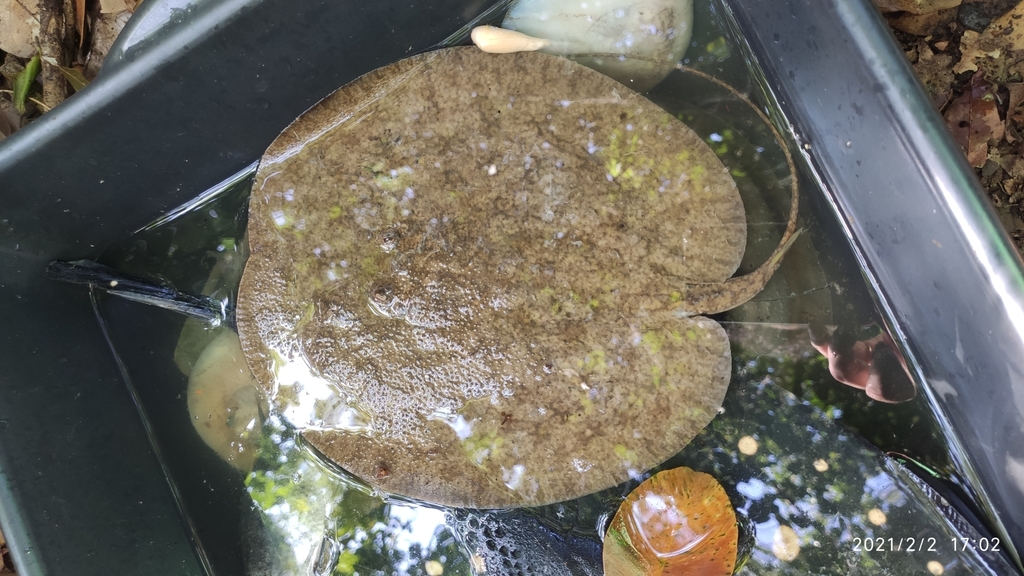
Discus Ray
Paratrygon aiereba
Paratrygon aiereba also known as discus ray, manzana ray or ceja ray is a river stingray from the Amazon basin in South America.
From the article Paratrygon aiereba on Wikipedia (CC BY-SA), quoted section by section
Description
This freshwater ray has small eyes and a disc shaped roughly like a lily pad (the snout is slightly concave). It is brownish above with a dark vermiculated or reticulated pattern. It reaches up to 1.6 m (5.2 ft) in disc width and 110 kg (240 lb) in weight, making it one of the largest species in the family. There are unconfirmed claims of much larger individuals, but these are considered highly questionable. Most individuals do not surpass a disc width of 1.3 m (4.3 ft). Males reach maturity at a disc width of about 60 cm (2.0 ft) and females at about 72 cm (2.4 ft).
Wikipedia: “Appearance”
What it does
It mainly feeds on fish, but also take invertebrates such as insects and crustaceans, and it is a top predator in its habitat. Adults are found in relatively deep waters in main river channels, but move to shallower waters to feed at night. After a nine-month gestation, the female give birth to an average of two young with a disc width of about 16 cm (6.3 in). Juveniles are found in relatively shallow waters at sandy beaches and in creeks.
== References ==
Wikipedia: “Behavior”
Where it lives
Recorded sightings
—
geo-referenced records in GBIF, from museums, herbaria and field observers.
Drag the globe to turn it. Dots are where records exist, not a range map; darker means more records.
In the stacks
Searching the stacks…
Every page naming Paratrygon aiereba in the Biodiversity Heritage Library →
This page is assembled live from iNaturalist, GBIF, Wikipedia, the Source Library and the Internet Archive. It is not yet part of the hand-edited codex. iNaturalist taxon 607468.