- Plants
- ›Vascular Plants
- ›flowering plants
- ›monocots
- ›Aroids, Water Plantains, Seagrass, and allies
- ›flowering-rush family
- ›Butomus
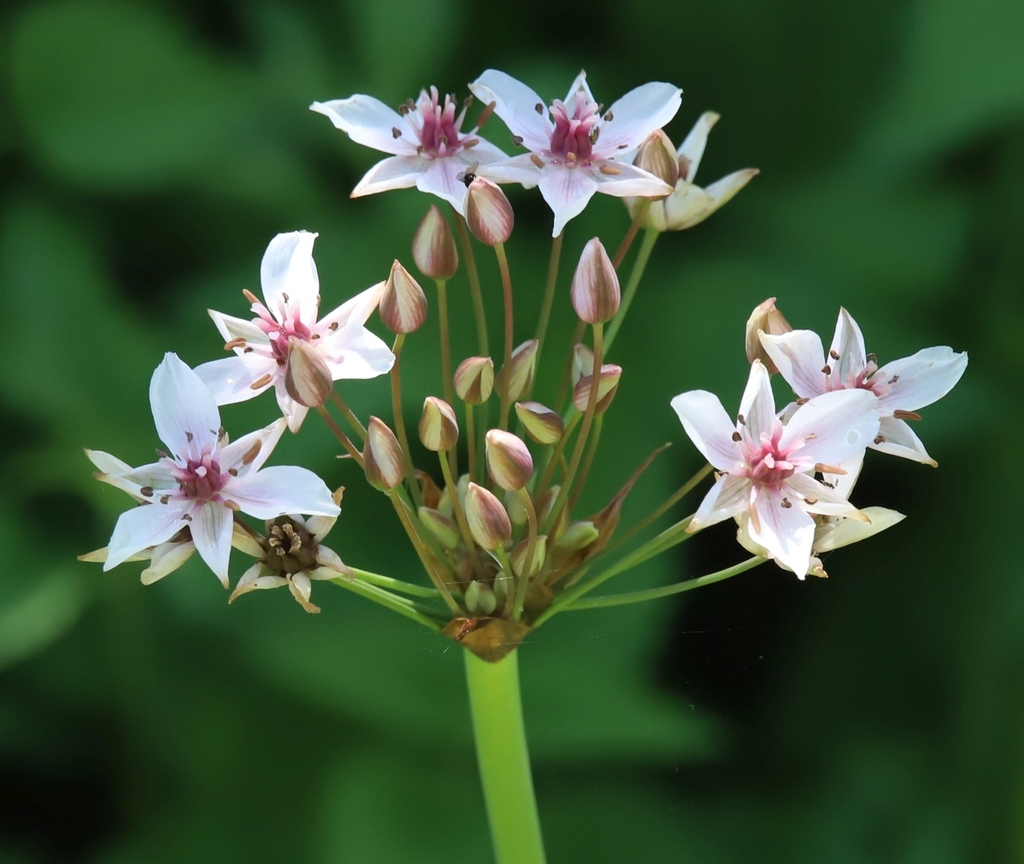
Flowering-rush
Butomus umbellatus
Butomus umbellatus is a Eurasian plant species in the family Butomaceae. It is the only species in the family. Common names include flowering rush or grass rush. Introduced into North America as an ornamental plant it has now become a serious invasive weed in the Great Lakes area and in parts of the Pacific Northwest. In Israel, one of its native countries, it is an endangered species due to the habitat loss. It can also be found in Great Britain locally, for example at the Caldicot and Wentloog Levels. The plant is a rhizomatous, hairless, perennial aquatic plant. Its name is derived from Greek bous, meaning "cow", "ox" etc. and tome, a cut (the verb 'temnein' meaning "to cut"), which refers to the plant's swordlike leaves.
From the article Butomus umbellatus on Wikipedia (CC BY-SA), quoted section by section
Description
In contrast to what its English name suggests, it is not a true rush. It is native to Old World continents and grows on the margins of still and slowly moving water down to a depth of about 3 m. It has pink flowers. The plant has linear, pointed leaves up to 1 metre long, or more. The leaves are triangular in cross-section and arise in two rows along the rhizome/base. They are untoothed, parallel veined and twisted. The inflorescence is umbel-like consisting of a single terminal flower surrounded by three cymes. The flowers are regular and bisexual, 2 to 3 cm across. There are three petal-like sepals which are pink with darker veins. They persist in the fruit. The three petals are like the sepals but somewhat larger. 6–9 stamens. Carpels superior, 6–9 and slightly united at the base. When ripe they are obovoid and crowned with a persistent style. Ovules are numerous and found scattered over the inner surface of the carpel wall, except on the midrib and edges. Fruit is a follicle. The seeds have no endosperm, and a straight embryo. It flowers from July until August.
At the table
Butomus umbellatus is cultivated as an ornamental waterside plant. In parts of Russia the rhizomes are used as food.
Wikipedia: “Uses”
Where it lives
Recorded sightings
—
geo-referenced records in GBIF, from museums, herbaria and field observers.
Drag the globe to turn it. Dots are where records exist, not a range map; darker means more records.
In the stacks
Searching the stacks…
Every page naming Butomus umbellatus in the Biodiversity Heritage Library →
This page is assembled live from iNaturalist, GBIF, Wikipedia, the Source Library and the Internet Archive. It is not yet part of the hand-edited codex. iNaturalist taxon 60462.