- Plants
- ›Vascular Plants
- ›flowering plants
- ›Dicots
- ›myrtles, evening primroses, and allies
- ›myrtle family
- ›Myrtoideae
- ›Metrosidereae
- ›Metrosideros
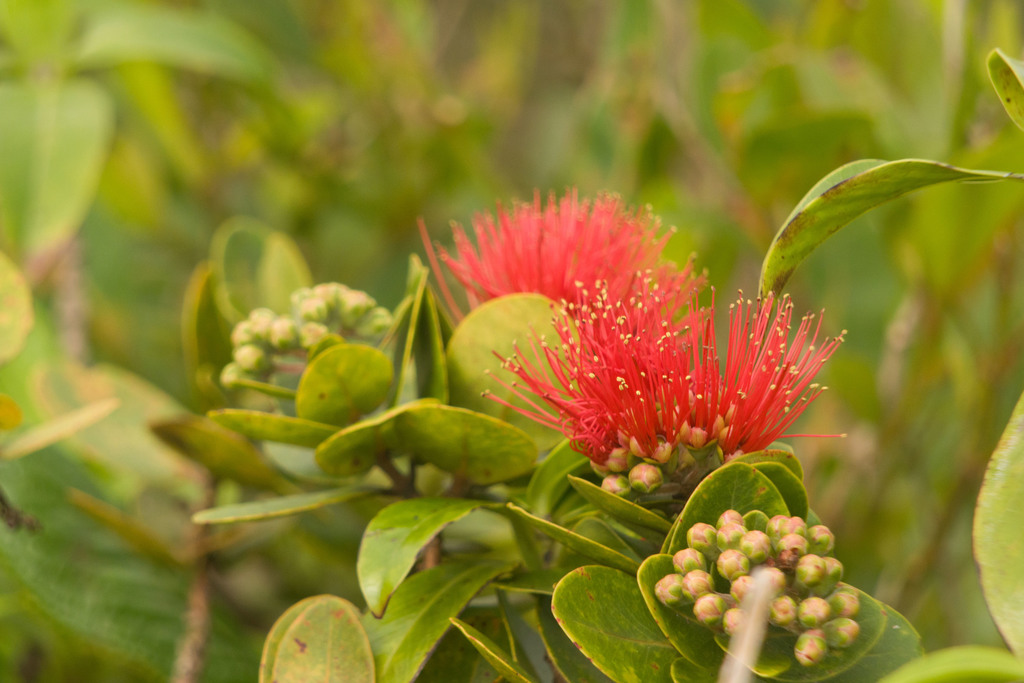
ʻŌhiʻa Lehua
Metrosideros polymorpha
Metrosideros polymorpha, the ʻōhiʻa lehua, is a species of flowering evergreen tree in the myrtle family, Myrtaceae, that is endemic to the six largest islands of Hawaiʻi. It is a member of the diverse Metrosideros genus, which are widespread over the southwest Pacific. It is the state tree of Hawaiʻi.
It is a highly variable tree, being 20–25 m (66–82 ft) tall in favorable situations, and a much smaller prostrate shrub when growing in boggy soils or directly on basalt. It produces a brilliant display of flowers, made up of a mass of stamens, which can range from fiery red to yellow. Many native Hawaiian traditions refer to the tree and the forests it forms as sacred to Pele, the volcano goddess, and to Laka, the goddess of hula. ʻŌhiʻa trees grow easily on lava, and are usually the first plants to grow on new lava flows.
From the article Metrosideros polymorpha on Wikipedia (CC BY-SA), quoted section by section
Description
Metrosideros polymorpha is relatively slow growing and may occur as a tall tree or a prostrate shrub, and everything in between. It can grow up to 30 m (98 ft) in height. The trunk varies in form. In some trees, it is straight and smooth; in others, it is twisted and prominently fluted. Flowers are usually bright to medium red but orange-red, salmon, pink, yellow, or orange forms are also found. The flowers appear in clusters on the terminal ends of the branches. Masses of stamens extend from the flower and give the blossoms their characteristic pom-pom shape. The stomata of the leaves are able to close up in the presence of harmful gases, which gives it an advantage over many non-native trees.
Similar species. There are about 50 species in the genus Metrosideros in Southeast Asia and the Pacific and as well one species in South Africa. The Hawaiian Islands are home to five species of Metrosideros that are endemic to the islands, meaning they are found nowhere else in the world. These are: Metrosideros polymorpha, M. macropus, M. rugosa, M. tremuloides, and M. waialealae. The species are readily distinguished from one another by the characteristics of their leaves. Metrosideros kermadecensis, from the Kermadec Islands north of New Zealand, has recently become naturalized on Maui and may become a pest species. Several cultivars of M. …
Range & habitat
Metrosideros polymorpha is the most common native tree in the Hawaiian Islands, tolerating a wide range of soil conditions, temperature, and rainfall. It grows from sea level right up to the tree line at elevations of 2,500 m (8,200 ft) and is commonly found in moist and dry forests, high shrublands, and is a colonizer of recent lava flows. Dominant in cloud forests above 400 m (1,300 ft), the tree is also common in seasonally wet forests, where it may be dominant or form mixtures with the native Acacia koa. Preferred soils are acidic to neutral (pH 3.6–7.4) and either a Histosol, Mollisol, Podsol, Oxisol, Ultisol, or Alfisol. Rainfall of 1,000–3,000 mm (39–118 in) per year is favored, but ʻōhiʻa can grow in dry forests that receive as little as 400 mm (16 in) or bogs that get more than 10,000 mm (390 in) of rain. On moist, deep soils, ʻōhiʻa grows to 20–25 m (66–82 ft) high. Trees growing in forests often have stilt roots, having germinated on logs or the stems of fallen hāpuʻu (Cibotium tree ferns), which have long decayed away when the tree has reached maturity. Some trees have fibrous aerial roots to gather moisture. At high elevations, and in areas with poor soils or little rainfall, shrub forms are the norm.
Wikipedia: “Distribution and habitat”
At the table
The reddish brown heartwood of M. polymorpha is very hard, fine textured, and has a specific gravity of 0.7. In native Hawaiian society, it is used in house and heiau construction, as well as to make papa kuʻi ʻai (poi boards), weapons, tool handles, hohoa (round kapa beaters), and kiʻi (statues and idols). Although the trunk of ʻōhiʻa is not used to make the kaʻele (hull) of waʻa (outrigger canoes), it was used for their nohona waʻa (seats), pale (gunwales), and pola (decking). Wae (spreaders) were made from the curved stilt roots of ʻōhiʻa. Pā (fencing) was made from the wood due to its availability; kauila (Colubrina oppositifolia or Alphitonia ponderosa), more durable woods when in contact with soil, was rarer. As the wood burns hot and cleanly, it is excellent wahie (firewood). The lehua (flowers) and liko lehua (leaf buds) are used in making lei. The flowers were used medicinally to treat pain experienced during childbirth. ʻŌhiʻa lehua is one of the few honey plants that is native to the Hawaiian Islands.
Wikipedia: “Uses”
In human culture
It is a common misconception that the word ʻōhiʻa is used to refer to the tree and that the word lehua refers only to its flowers. The Hawaiian Dictionary describes lehua with these words:
The flower of the ʻōhiʻa tree ... also the tree itself. [emphasis added] Thus endorsing the common practice of referring to Metrosideros polymorpha as a lehua tree, or as an ʻōhiʻa lehua, or simply an ʻōhiʻa. The genus name Metrosideros is derived from the Greek words metra, meaning 'heartwood', and sideron, meaning 'iron', and refers to the hard wood of the trees in this genus. The specific epithet polymorpha, meaning 'many forms', is very appropriate, since individuals of this species exhibit many different morphologies and inhabit a broad range of ecological situations. The Hawaiian language word ʻōhiʻa is thought to have been derived from the ancestral Proto-Oceanic word, *kafika. Throughout Oceania, there are many similar-sounding words that were also derived from the same ancestral protoform and, in most cases, they are names for the "mountain apple", or "Malay apple" tree, Syzygium malaccense. …
Wikipedia: “Etymology”
Where it lives
Recorded sightings
—
geo-referenced records in GBIF, from museums, herbaria and field observers.
Drag the globe to turn it. Dots are where records exist, not a range map; darker means more records.
In the old herbals & bestiaries

In the stacks
Searching the stacks…
Every page naming Metrosideros polymorpha in the Biodiversity Heritage Library →
This page is assembled live from iNaturalist, GBIF, Wikipedia, the Source Library and the Internet Archive. It is not yet part of the hand-edited codex. iNaturalist taxon 60447.