- Plants
- ›Vascular Plants
- ›flowering plants
- ›Dicots
- ›myrtles, evening primroses, and allies
- ›myrtle family
- ›Myrtoideae
- ›Metrosidereae
- ›Metrosideros
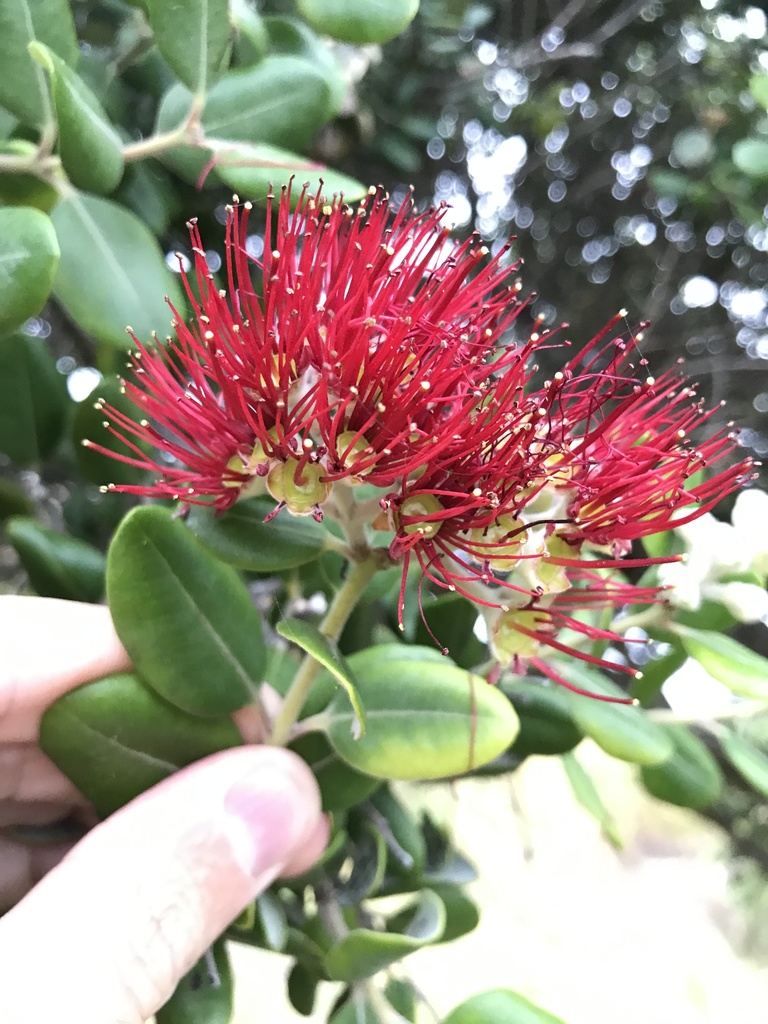
Kermadecs pōhutukawa
Metrosideros kermadecensis
Metrosideros kermadecensis, commonly known as the Kermadec pōhutukawa, is a species of tree in the family Myrtaceae. It is endemic to the Kermadec Islands of New Zealand. It reaches a height of up to 20 metres (70 feet), with its main trunk reaching 3 m (10 ft) in diameter. The species is classified in the subgenus Metrosideros. M. kermadecensis was first described by the British botanist Joseph Dalton Hooker in 1864, and was described as Metrosideros polymorpha. It was given its current binomial name in 1928 by the New Zealand botanist Walter Oliver.
Metrosideros kermadecensis has been recorded to be browsed by introduced goats, mostly consuming the more accessible parts of the tree, such as the seedlings, shoots, and trunks, which consist of about 32 percent of their diet. M. kermadecensis, along with numerous other species (primarily from the family Myrtaceae), have been facing an ongoing threat from myrtle rust, an invasive species of fungus. M. kermadecensis's conservation status was assessed by the IUCN Red List in 2023 as "Vulnerable", and its population trend was assessed as "Decreasing".
From the article Metrosideros kermadecensis on Wikipedia (CC BY-SA), quoted section by section
Description
Metrosideros kermadecensis is a tree in the family Myrtaceae. It reaches a height of up to 20 metres (70 feet) tall. It is usually multitrunked (occasionally single), with its main trunk reaching 3 m (10 ft) in diameter. Its bark is greyish-brown to whitish in colour and usually firm. It has an estimated lifespan of 40–80 years. Its petioles are 5–7 mm long and very coriaceous (leather-like) in character. Its laminae (leaf blades) are 20–50 × 10–30 mm long, dark green in colour. They are almost oval-shaped and coriaceous in character. The leaves are light green in colour on the uppersides. Its inflorescences (flower clusters) are 8–12 mm long. M. kermadecensis's hypanthiums are obconic in character. Its sepals are coriaceous and triangular in character. Its petals are caducous, scarlet, crimson to pink in colour, 2.2 cm–3.2 cm × 2.0 cm–3.0 cm (0.87 in–1.26 in × 0.79 in–1.18 in) long, glabrous, roundish to oblong in character. Each flower has numerous stamens, which are 10–23 mm long. Its nectarial discs initially green in colour, maturing into a red or red-green colour. Its capsules are woody 6.0–7.2 mm long. Its seeds are 2.5–4.5 mm long, and yellow to pale orange in colour.
Range & habitat
Metrosideros kermadecensis is endemic to the Kermadec Islands, where it is found on Raoul Island, and the North and South Meyer Islands. M. kermadecensis is also found on the Herald Islets, which includes the Dayrell, Napier, and Nugent islets, which are part of the Kermadec Island chain. They are found 1,000 km (620 mi; 540 nmi) northeast from mainland New Zealand. The species was supposedly present on Macauley Island, but the New Zealand botanist Peter de Lange, disputes this, as there is no documentation.
Habitat. It occurs from almost sea level to 516 m (2,000 ft) above sea level, ranging from the coastline to the highest altitudes of the islands. M. kermadecensis is commonly associated with Alsophila kermadecensis and Rhopalostylis baueri in the forests. M. kermadecensis is the dominant tree species on Raoul Island, the largest island in the Kermadec Island chain.
Wikipedia: “Distribution”
What it does
Metrosideros kermadecensis plays host to the endemic beetle Oemona hirta. It also plays host to the insects Uraba lugens and Ornithodoros capensis. The native moss and liverwort species, Syrrhopodon armatus and Cheilolejeunea trifaria, respectively, have been observed growing on M. kermadecensis. Peniophora sacrata, a species of fungus, has also been observed growing on M. kermadecensis. M. kermadecensis has been recorded to be browsed by introduced goats, mostly consuming the more accessible parts of the tree, such as the seedlings, shoots, and trunks, consisting of about 32 percent of their diet.
Wikipedia: “Ecology”
In human culture
Metrosideros kermadecensis was first described by the British botanist Joseph Dalton Hooker in 1864, and was described as Metrosideros polymorpha. It was given its current binomial name in 1928 by the New Zealand botanist Walter Oliver. His rationale for moving the species into a separate taxon was that it had smaller flowers, and its leaves were more oval-shaped and glabrous than other species he was comparing it to, such as M. collina, M. excelsa, and M. polymorpha.
Wikipedia: “History”
Where it lives
Recorded sightings
—
geo-referenced records in GBIF, from museums, herbaria and field observers.
Drag the globe to turn it. Dots are where records exist, not a range map; darker means more records.
In the stacks
Searching the stacks…
Every page naming Metrosideros kermadecensis in the Biodiversity Heritage Library →
This page is assembled live from iNaturalist, GBIF, Wikipedia, the Source Library and the Internet Archive. It is not yet part of the hand-edited codex. iNaturalist taxon 60446.