- Plants
- ›Vascular Plants
- ›flowering plants
- ›monocots
- ›grasses, sedges, cattails, and allies
- ›grasses
- ›Paniceae, andropogoneae, paspaleae, and allies
- ›bristle, rosette, and barnyard grasses, and allies
- ›Boivinellinae
- ›Echinochloa
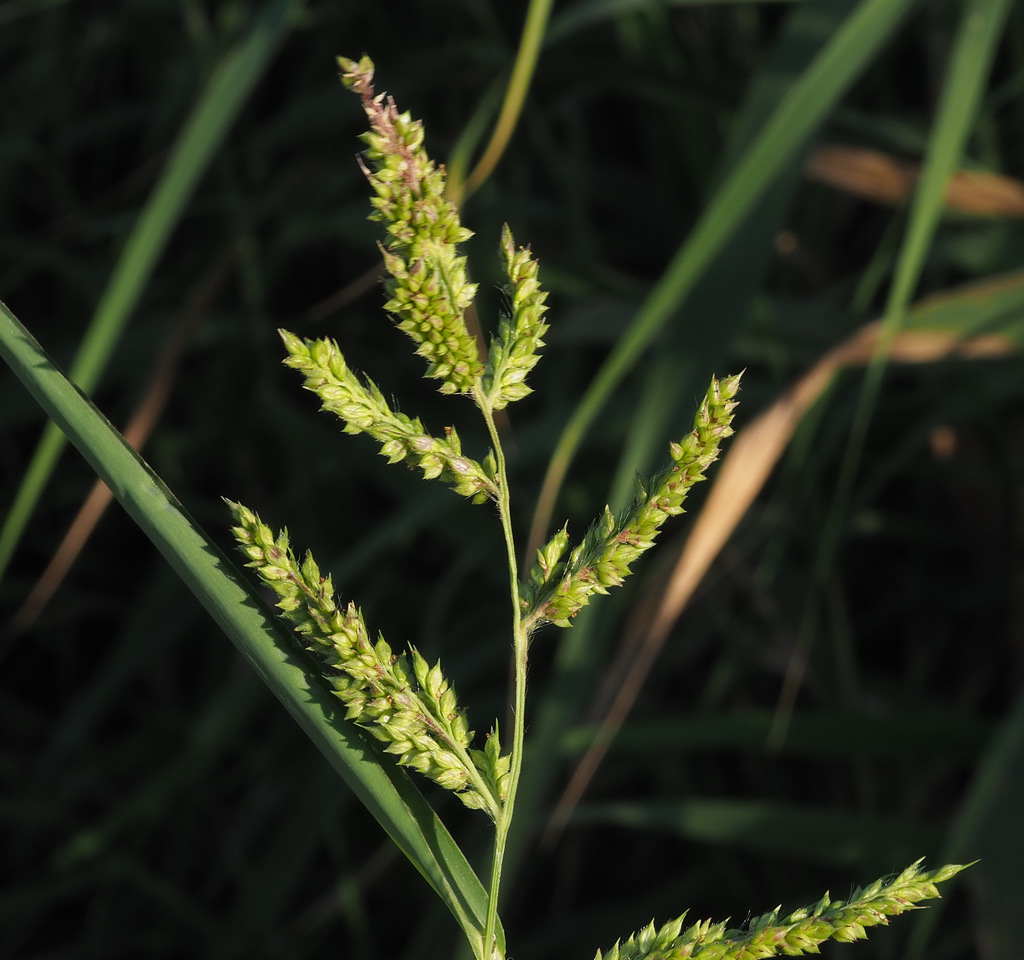
barnyardgrass
Echinochloa crus-galli
Echinochloa crus-galli is a species of wild grass originating from tropical Asia that was formerly classified as a panicum grass. It is commonly known as cockspur, cockspur grass, barnyard grass, barnyard millet, water grass, cocksfoot grass, cockshin grass. It is sometimes referred to using the general term, barnyard grass, which may refer to any species of the genus Echinochloa. This plant can grow to 1.5 m (5 ft) in height and has long, flat leaves which are often purplish at the base. Most stems are upright, but some will spread out over the ground. Stems are flattened at the base. The seed heads are a distinctive feature, often purplish, with large millet-like seeds in crowded spikelets.
Considered one of the world's worst weeds, it reduces crop yields and causes forage crops to fail by removing up to 80% of the available soil nitrogen. It acts as a host for several mosaic virus diseases. Heavy infestations can interfere with mechanical harvesting.
From the article Echinochloa crus-galli on Wikipedia (CC BY-SA), quoted section by section
Range & habitat
Barnyard grass commonly occurs in Europe and throughout tropical Asia and Africa in fields and along roadsides, ditches, along railway lines, and in disturbed areas such as gravel pits and dumps. It also invades riverbanks and the shores of lakes and ponds. It occurs in all agricultural regions. This species is considered an invasive species in North America where it occurs throughout the continental United States. It is also found in southern Canada from British Columbia east to Newfoundland. It was first spotted in the Great Lakes region in 1843.
Wikipedia: “Distribution and habitat”
What it does
Ranging from boreal moist to wet through tropical and very dry to moist forest life zones. Adapted to nearly all types of wet places, this grass is often a common weed in paddy fields, roadsides, cultivated areas, and fallow fields. It grows on variety of wet sites such as ditches, low areas in fertile croplands and wet wastes, often growing in water. It succeeds in cool regions, but is better adapted to areas where average annual temperature is 14–16 °C (57–61 °F). It is not restricted by soil pH.
Wikipedia: “Ecology”
Where it lives
Recorded sightings
—
geo-referenced records in GBIF, from museums, herbaria and field observers.
Drag the globe to turn it. Dots are where records exist, not a range map; darker means more records.
In the stacks
Searching the stacks…
Every page naming Echinochloa crus-galli in the Biodiversity Heritage Library →
This page is assembled live from iNaturalist, GBIF, Wikipedia, the Source Library and the Internet Archive. It is not yet part of the hand-edited codex. iNaturalist taxon 60283.