- Plants
- ›Vascular Plants
- ›flowering plants
- ›Dicots
- ›Mints, Plantains, Olives, and Allies
- ›Verbena Family
- ›Verbeneae
- ›Verbena
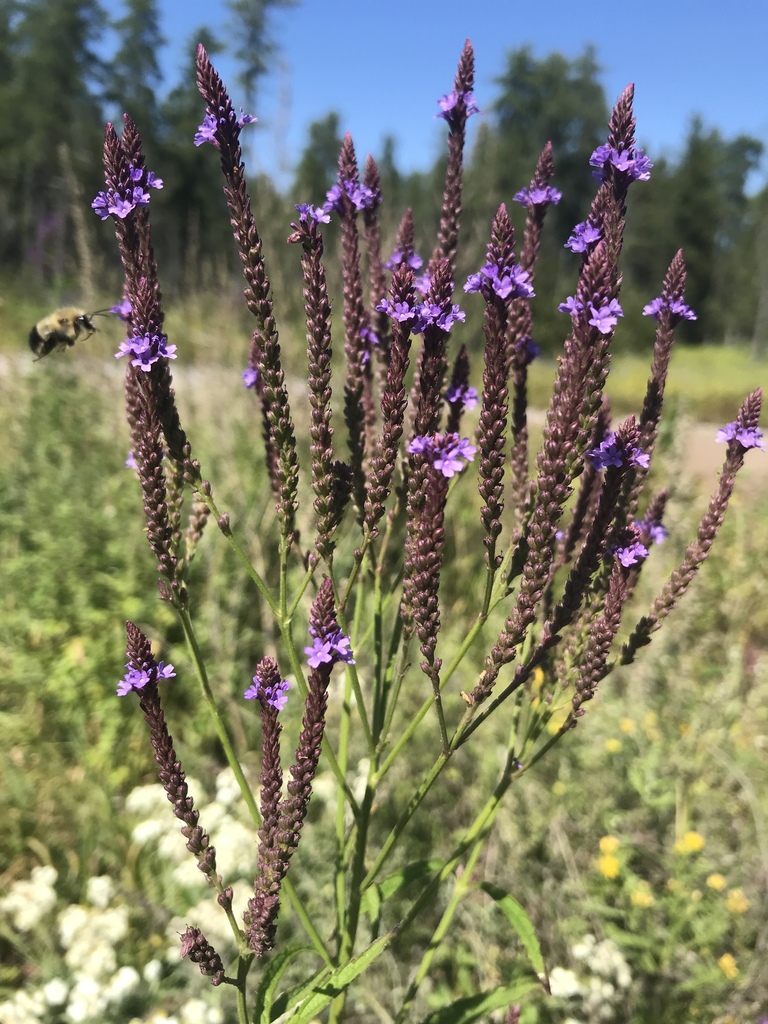
blue vervain
Verbena hastata
Verbena hastata (American vervain, blue vervain or swamp verbena) is a flowering plant in the vervain family, Verbenaceae. It is a herb with opposite, simple leaves which have double-serate margins, borne on stiffly erect, branching square stems. The flowers appear in summer and are purple. This is a common plant that occurs across North America. They are hardy and drought resistant.
From the article Verbena hastata on Wikipedia (CC BY-SA), quoted section by section
Description
V. hastata is a perennial species that grows as a stiffly erect stem, occasionally branching in the upper half, reaching up to 1.5 metres (5 feet) tall. The stems are four-angled (square), hairy, and green to reddish in color. The leaves are opposite, simple, and measure up to 15 centimetres (6 inches) long and 3 cm (1 in) across. They have doubly-serrate margins and a variety of shapes, from lanceolate to ovate, and may have two lateral lobes.
The bloom period is from mid- to late summer. The inflorescence is a panicle, or group, of flowering spikes, up to 30 cm (1 ft) long at the end of the upper stems. Each flowering spike in the panicle is up to 13 cm (5 in) long, with densely packed, numerous 5-lobed flowers, which measure up to 0.75 cm (1⁄4 in) long. The flowers are violet or deep purple, rarely white. They open from the bottom of the spike upward, with a few flowers open at a time.
Chemistry. Verbena hastata contains lophirone C, lophirone B, verbenalin, verbascoside, luteolin, oleanolic acid, ursolic acid, and the naphthoquinone derivative 4,9-dihydroxy-α-lapachone.
Range & habitat
V. hastata is native in the United States in all states except Alaska and Hawaii. In Canada, it is native in the provinces of British Columbia, Saskatchewan, Manitoba, Ontario, Quebec, New Brunswick, Nova Scotia, and Prince Edward Island. The plant prefers moist conditions and typically grows in wet meadows, wet river bottomlands, stream banks, slough peripheries, fields and waste areas. It is adapted to wetlands and can spread to form small colonies.
Wikipedia: “Distribution and habitat”
What it does
The flowers attract many types of bees and other insect pollinators. Several species of birds eat the seeds, including cardinals, field sparrows, swamp sparrows, song sparrows, and slate-colored juncos. Cottontail rabbits will sometimes eat the leaves, though most other mammalian herbivores avoid it due its bitter taste. The plant is also a larval host to the common buckeye butterfly (Junonia coenia), the verbena moth (Crambodes talidiformis), and the verbena bud moth (Endothenia hebesana).
Wikipedia: “Ecology”
Where it lives
Recorded sightings
—
geo-referenced records in GBIF, from museums, herbaria and field observers.
Drag the globe to turn it. Dots are where records exist, not a range map; darker means more records.
In the stacks
Searching the stacks…
Every page naming Verbena hastata in the Biodiversity Heritage Library →
This page is assembled live from iNaturalist, GBIF, Wikipedia, the Source Library and the Internet Archive. It is not yet part of the hand-edited codex. iNaturalist taxon 60251.