- Plants
- ›Vascular Plants
- ›flowering plants
- ›Dicots
- ›Heathers, Balsams, Primroses, and Allies
- ›primrose family
- ›Theophrastoideae
- ›Samoleae
- ›Samolus
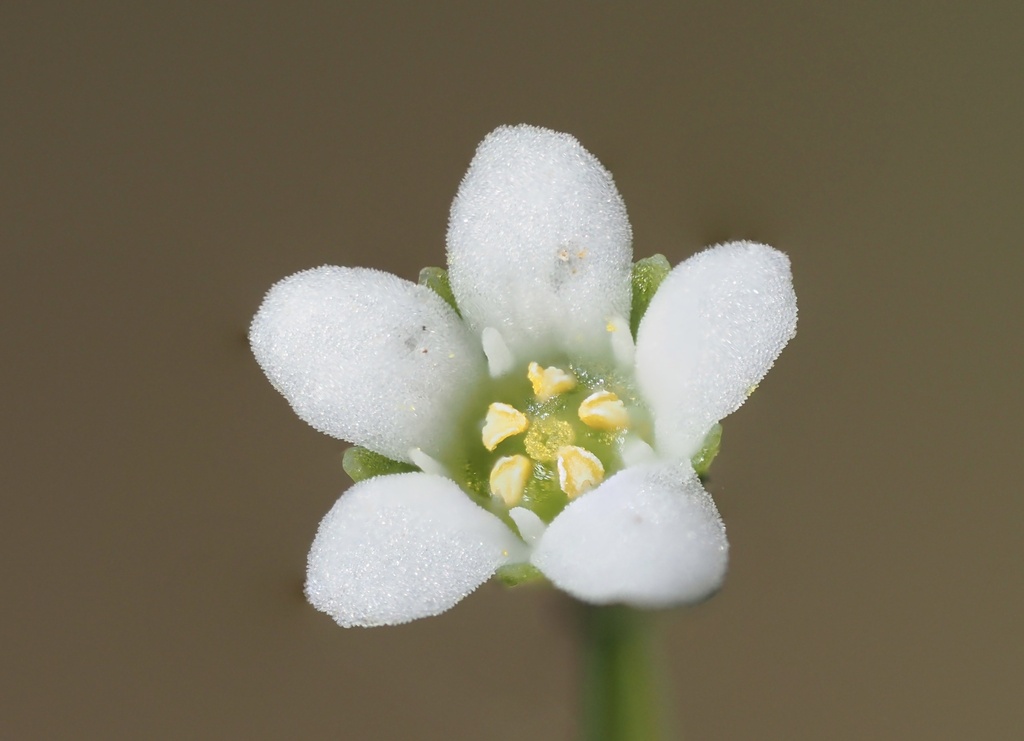
seaside brookweed
Samolus parviflorus
Samolus valerandi is a species of semi-aquatic flowering plant in the primrose family, Primulaceae. Common names include seaside brookweed, brookweed, thin-leaf brookweed, water cabbage and water rose.
From the article Samolus valerandi on Wikipedia (CC BY-SA), quoted section by section
Description
It is a small perennial, growing to around 35 cm (13.8 inches) high. Its inflorescence is a raceme, with small white flowers on long stalks. Its corollas have five lobes. It can produce flowers throughout the growing season, from spring to fall. Its fruits are capsules that are green and globose.
Range & habitat
Samolus valerandi is widely distributed across western and Mediterranean Europe, north Africa, Asia and Australia, Central and South America including Cuba, and Japan.
Wikipedia: “Distribution”
At the table
The plant's leaves, when cut and agitated in water, produce a lather, for which reason in Palestine it has been used by the local Arab population, in former times, to launder clothes and was called by them sabūn 'arab (= Arab soap).
Wikipedia: “Uses”
How it is grown
The plant can be grown in ponds, bog gardens, and damp areas in the garden. S. valerandi prefers light (sandy), medium (loamy), and heavy (clay) soils, preferably neutral or basic (alkaline) soils. It can tolerate both shade and a bright, sunny position. It requires moist or wet soil and can even grow in water. The plant can tolerate maritime exposure and is self-fertile. S. valerandi is sometimes grown in aquariums, although they seem to last only a limited time when grown fully submersed.
Uses. The plant's leaves, when cut and agitated in water, produce a lather, for which reason in Palestine it has been used by the local Arab population, in former times, to launder clothes and was called by them sabūn 'arab (= Arab soap).
Wikipedia: “Cultivation”
Where it lives
Recorded sightings
—
geo-referenced records in GBIF, from museums, herbaria and field observers.
Drag the globe to turn it. Dots are where records exist, not a range map; darker means more records.
In the stacks
Searching the stacks…
Every page naming Samolus parviflorus in the Biodiversity Heritage Library →
This page is assembled live from iNaturalist, GBIF, Wikipedia, the Source Library and the Internet Archive. It is not yet part of the hand-edited codex. iNaturalist taxon 60234.