- Plants
- ›Vascular Plants
- ›flowering plants
- ›Dicots
- ›Sunflowers, Bellflowers, Fanflowers, and Allies
- ›bellflower family
- ›Lobelia subfamily
- ›Downingia
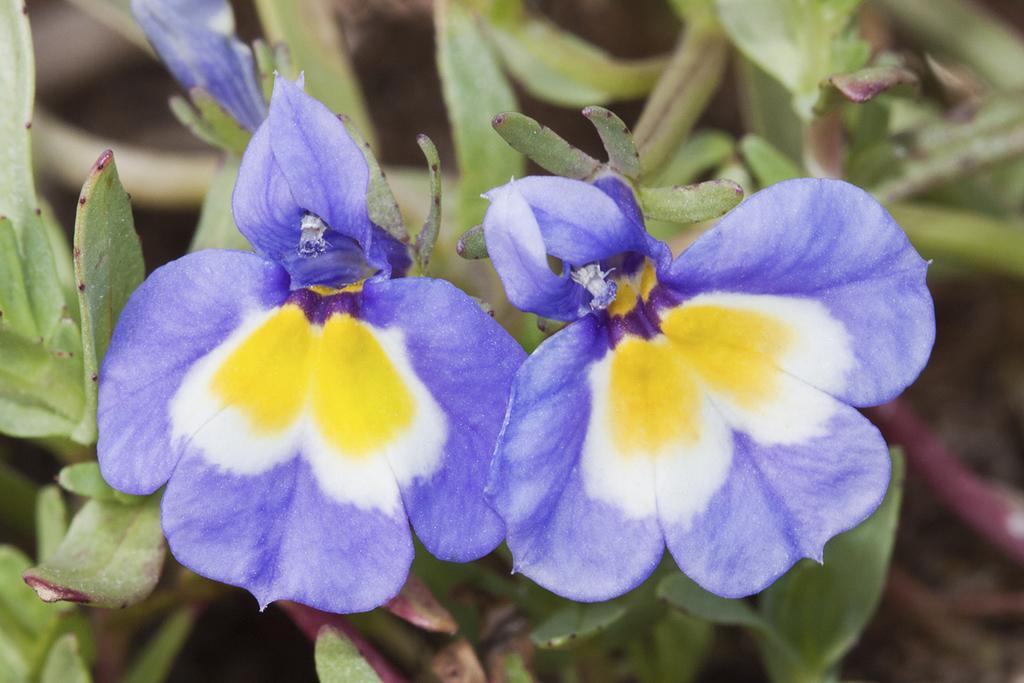
Hoover's calicoflower
Downingia bella
Downingia bella, also known as Hoover's calicoflower or Hoover's Downingia, is a member of the Bellflower Family (Campanulaceae). The genus is named after A.J. Downing (1815–1852) a noted American horticulturist and landscape architect.
This native annual herb is endemic to California and found in valley grassland communities. Its habitat is wetlands, generally vernal pools between 4600 and 5250 feet (1400 to 1600m). As approximately 20% of vernal pools in California have been lost, D. bella is uncommon. The range of D. bella is scattered from locations in Riverside County to areas in the Great Central Valley.
From the article Downingia bella on Wikipedia (CC BY-SA), quoted section by section
Description
Like all Downingia, the stem is decumbent to erect with leaves that are along the stem and often fall before the plant flowers. The flowers are not sessile and in a spike inflorescence with individual flowers having a corolla length of 10 to 12 mm. The corolla is glabrous and has 2 distinct lips, the upper with 2 lobes and lower with 3 lobes. The upper lobes are narrowly triangular or elliptic in shape while the lower lobes are obtuse and abruptly toothed. The corolla is blue with the lower lip having a central white field which then has two yellow spots (can be joined) in its middle. At the throat D. bella has 2 raised nipples that generally have 3 alternating purple spots. The 5 fused stamens have anthers that are included in the corolla tube and are angled less than 45 degrees to filaments. The inferior ovary is pedicel-like and is 2 chambered. The fruits of D. bella are between 16 and 18 mm with tough lateral walls that are tardily dehiscent despite no noticeable translucent lines. The seeds within the fruit are longitudinally striate. Some areas in northern Sutter County have D. bella with a minute corolla horn similar to D. ornatissima.
Where it lives
Recorded sightings
—
geo-referenced records in GBIF, from museums, herbaria and field observers.
Drag the globe to turn it. Dots are where records exist, not a range map; darker means more records.
In the stacks
Searching the stacks…
Every page naming Downingia bella in the Biodiversity Heritage Library →
This page is assembled live from iNaturalist, GBIF, Wikipedia, the Source Library and the Internet Archive. It is not yet part of the hand-edited codex. iNaturalist taxon 60160.